

For entrepreneurs who have meticulously cultivated their businesses from inception, the decision to delegate significant responsibility to a professional management team marks a pivotal, often challenging, transition. This shift necessitates a fundamental reevaluation of executive compensation, a departure from the lean budgets that may have characterized earlier growth phases. Founders accustomed to modest personal salaries might find themselves confronted with the reality that attracting seasoned presidents, CFOs, or COOs requires compensation packages substantially exceeding their prior norms – and potentially their own current earnings. Even a chief executive officer, who may already benefit from substantial equity incentives, must recognize the strategic imperative to offer premium compensation to secure executives possessing critical, specialized capabilities.
New research from Chief Executive Group, detailed in their 2026-2027 CEO & Senior Executive Compensation Report, offers a comprehensive look at the financial landscape of senior leadership within U.S. private companies. The findings underscore a clear correlation: as companies scale in revenue, so too does the compensation required to attract and retain top-tier management talent. This report serves as a vital resource for business leaders contemplating their next strategic move, particularly when that move involves bringing in external expertise to drive further expansion.
Unveiling the Price of Executive Leadership
The report’s national median figures paint a compelling picture of executive remuneration in the private sector. In 2025, the median total compensation for presidents of U.S. private companies reached an impressive $354,608. Chief Operating Officers (COOs) garnered a median of $282,940, while Chief Financial Officers (CFOs) earned a median of $272,434. While these national averages provide a baseline, they only tell a fraction of the story, as compensation varies dramatically based on company size, industry, and other critical factors.
Compensation Tiers: A Deep Dive into Revenue Brackets
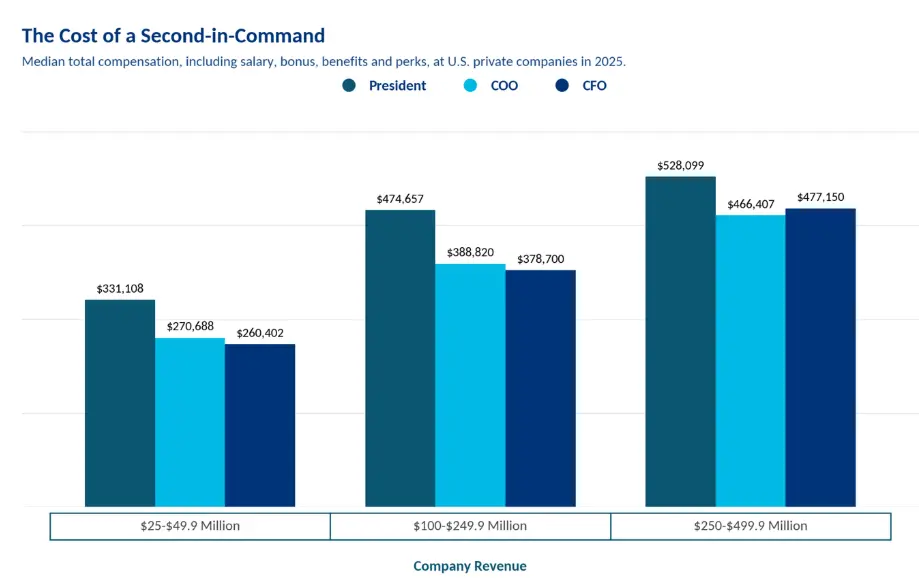
The true impact of revenue scale on executive compensation becomes evident when examining specific financial tiers. For private companies generating between $25 million and $49.9 million in annual revenue, the median total compensation for presidents stood at $331,108 in 2025. COOs in this bracket earned a median of $270,688, and CFOs, $260,402. These figures indicate that even at this substantial revenue level, the cost of experienced leadership is a significant investment.
As companies ascend to higher revenue strata, the compensation demands escalate considerably. In the $100 million to $249.9 million revenue bracket, median compensation for presidents surged to $474,657. COOs in this category saw median earnings of $388,820, and CFOs, $378,700. This demonstrates a clear inflection point where the complexity and scope of operations necessitate a higher caliber of leadership, reflected directly in their remuneration.
The apex of this revenue-driven compensation trend is observed in companies generating between $250 million and $499.9 million in annual revenue. Here, median compensation for presidents reaches a remarkable $528,099. COOs are compensated at a median of $466,407, and CFOs at $477,150. These figures underscore the substantial financial resources commanded by executives steering the largest private enterprises.
It is crucial to understand that these reported figures encompass total compensation, which includes base salary, bonuses, equity grants, benefits, and other perquisites. Furthermore, these numbers represent medians, meaning that half of executives in similar roles and company sizes earn more. This highlights that the compensation required to attract an executive with exceptional experience or highly specialized skills will likely fall into the upper quartile of these ranges, or even exceed them. For instance, among CFOs at companies with revenues between $100 million and $249.9 million, top-quartile total compensation reached $596,198 in 2025, significantly surpassing the median of $378,700. This data suggests that business owners and CEOs planning to recruit senior talent should budget against the higher end of the compensation spectrum, recognizing that the midpoint often represents only the lower half of the market’s competitive offerings.
The Strategic Imperative: Beyond Affordability to Capability
The challenge for founders and CEOs contemplating the integration of professional management extends far beyond merely assessing their financial capacity to offer higher cash compensation than they currently receive. The more profound question revolves around identifying the specific capabilities the business critically needs to achieve its next phase of growth and determining the market value of those capabilities. Often, the most prudent strategy involves recruiting key executives from larger organizations, where compensation structures are typically more robust, to inject the necessary expertise that will propel the company forward.
Consider the diverse needs of a growing enterprise. A company embarking on expansion into new geographic markets or product lines may require a president with a proven track record of managing larger, more intricate organizational structures. For a founder preparing for a potential sale, an initial public offering, or seeking substantial outside investment, a CFO with deep expertise in complex financing, financial reporting, transaction structuring, and capital raising becomes indispensable. Similarly, a rapidly expanding manufacturing firm might need an operations leader capable of instilling greater discipline and efficiency in production processes and supply chain management. Each of these roles presents a unique compensation challenge, demanding a tailored approach that reflects the specific skills and experience required.
The Chief Executive Group’s research further illuminates the nuanced factors influencing executive compensation. Compensation structures vary significantly across different industries, ownership models, and levels of company profitability. For example, private equity-backed companies often present more competitive compensation packages, particularly through performance-based bonuses and equity incentives, compared to many other privately held businesses. This competitive landscape means that founders vying for the same pool of elite talent must look beyond base salary alone. They need to strategically consider performance bonuses, long-term incentive plans, and other mechanisms designed to reward executives for their direct contribution to building and enhancing enterprise value.
Realigning Perspectives: The Founder’s Equity vs. Hired Executive’s Compensation
A fundamental distinction often exists between the compensation package of a founder-CEO and that of a hired senior executive: ownership. Founders typically possess a significant equity stake in the business, a substantial portion of their potential financial return stemming from the long-term appreciation of the company’s value. Hired executives, while often incentivized with equity, may not have the same level of personal investment or potential upside tied to the company’s ultimate valuation. This difference in ownership fundamentally shapes how each individual evaluates an opportunity.
The salary and short-term compensation elements that a CEO draws may represent only one facet of their financial reward derived from building the company. A senior executive brought in to lead critical functions, lacking equivalent ownership, will likely assess their compensation through a different lens. Their evaluation will be heavily weighted towards immediate and near-term financial rewards, coupled with a clear understanding of their career progression and market value.
There is no singular, universally applicable formula for determining the appropriate compensation for a second-in-command or any senior executive. Simply offering a higher salary does not automatically guarantee superior leadership or performance. However, as chief executives strategize for the next critical phase of their company’s growth, using their own compensation as the sole benchmark for attracting essential executive talent is often a flawed approach.
A more productive and strategic question to ask is: What do comparable companies pay for the specific capabilities we require? And, critically, how can we structure compensation packages to align with and incentivize the tangible results and strategic outcomes the business expects to achieve? This forward-looking perspective, grounded in market realities and performance objectives, is essential for making informed hiring decisions that will truly drive sustained success and value creation.
The Chief Executive Group’s 2026-2027 CEO & Senior Executive Compensation Report offers a detailed and invaluable resource for navigating these complex compensation decisions. It provides granular benchmarks for presidents, COOs, CFOs, and other senior executive roles, segmented by company size, industry, ownership structure, and performance metrics. This data empowers leaders to move beyond assumptions and make data-driven decisions that support their ambitious growth agendas and ensure they are attracting the caliber of talent necessary to achieve their strategic vision.
