

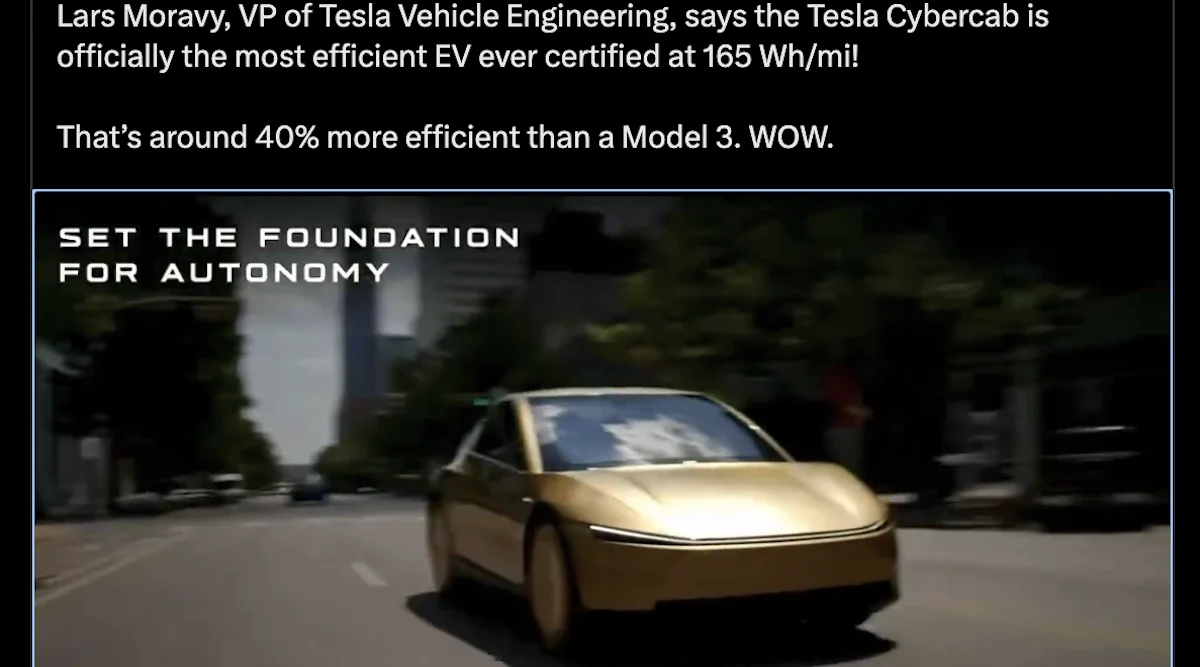
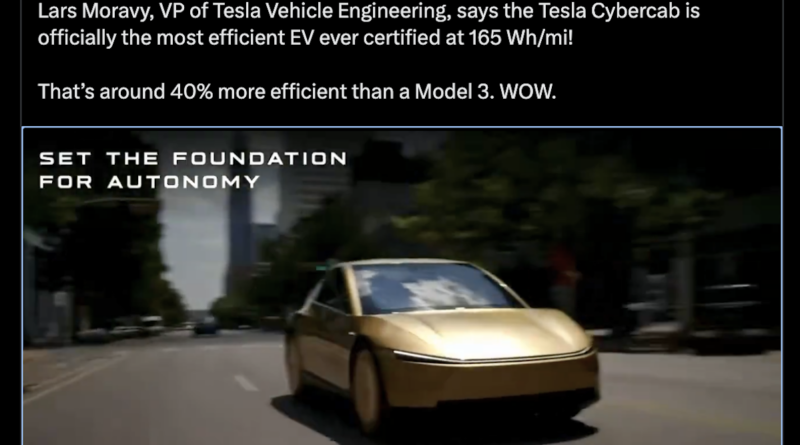
The Tesla Cybercab has established a new benchmark for electric vehicle efficiency, reporting a rating of 165 watt-hours per mile (Wh/mi) that translates to an estimated operating cost of approximately 2.6 cents per mile. This performance metric positions the purpose-built robotaxi as one of the most efficient transport machines ever designed, significantly outperforming current industry leaders in the electric sedan segment. For comparison, the Lucid Air Pure, which is widely regarded as the most efficient luxury electric vehicle currently in mass production, achieves approximately 230 Wh/mi. The substantial gap between the Cybercab and its contemporaries highlights a shift in Tesla’s engineering focus toward extreme optimization for a ride-hailing business model where operating margins are dictated by energy consumption and maintenance overhead.
The efficiency of the Cybercab is a result of radical design choices that prioritize aerodynamics and weight reduction over traditional passenger comforts and utility. Unlike conventional vehicles, the Cybercab is devoid of a steering wheel, pedals, and manual driver controls, allowing for a more streamlined interior and reduced structural complexity. The vehicle is designed to accommodate only two passengers, which drastically reduces the total volume and mass of the chassis. By eliminating the hardware necessary for human operation and limiting the cabin size, Tesla has been able to craft a vehicle with a low drag coefficient and a minimal frontal area, both of which are critical factors in reducing energy consumption at cruising speeds.
Technical Foundations of the 165 Wh/mile Benchmark
To understand the significance of 165 Wh/mi, it is necessary to examine the broader landscape of electric vehicle (EV) energy consumption. Most modern electric sedans, such as the Tesla Model 3 Long Range or the Hyundai Ioniq 6, operate in the range of 240 to 280 Wh/mi in real-world conditions. High-performance SUVs often exceed 350 Wh/mi. By achieving 165 Wh/mi, the Cybercab is effectively utilizing nearly 40% less energy than the Model 3, which was previously considered the gold standard for mass-market efficiency.
This efficiency is not merely a product of battery chemistry but is deeply rooted in the "unboxed" manufacturing process Tesla intends to use for the Cybercab. This method involves assembling sub-sections of the car simultaneously before joining them together, reducing the footprint of the factory and the weight of the vehicle frame. Furthermore, the Cybercab features an inductive charging system, removing the need for a traditional charging port and the associated heavy cabling and motorized flaps, further contributing to weight savings and aerodynamic continuity.
The economic implications of 2.6 cents per mile are transformative for the transportation industry. According to data from the American Automobile Association (AAA), the average cost to operate a new internal combustion engine (ICE) vehicle in the United States—including fuel, maintenance, and repairs—is approximately 60 to 70 cents per mile. Even when accounting for the absence of a human driver, the Cybercab’s energy efficiency allows it to undercut the operational costs of traditional public transit systems and existing ride-sharing platforms like Uber and Lyft, which currently face high costs due to driver commissions and fuel expenses.

Chronology of Tesla’s Autonomous Ambitions
The unveiling of the Cybercab and its efficiency metrics represents the latest chapter in a decade-long narrative regarding autonomous transport.
In 2016, Tesla CEO Elon Musk released "Master Plan, Part Deux," which outlined the creation of a "Tesla Network" consisting of a fleet of autonomous vehicles that owners could add their cars to when not in use. By 2019, during Tesla’s "Autonomy Day," the company shifted focus toward a dedicated robotaxi, predicting that a fleet of one million autonomous vehicles would be on the road by 2020. While that timeline proved overly optimistic, the hardware and software development continued through the release of "Full Self-Driving" (FSD) beta programs to thousands of retail customers.
In October 2024, at the "We, Robot" event held at the Warner Bros. Discovery studio, Tesla officially debuted the Cybercab prototype. During this event, the company emphasized that the vehicle would be priced under $30,000 for private buyers and would begin production before 2027. The 165 Wh/mi figure was introduced as a key pillar of the vehicle’s value proposition, asserting that the Cybercab would be the primary tool for transitioning urban mobility from private ownership to a "transportation-as-a-service" (TaaS) model.
Comparative Analysis and Market Positioning
The Cybercab enters a nascent but competitive market for autonomous mobility. Its primary competitors include Alphabet’s Waymo and Amazon’s Zoox. However, Tesla’s approach differs fundamentally in terms of hardware and energy philosophy.
Waymo’s current fleet utilizes modified Chrysler Pacifica minivans and Jaguar I-PACE SUVs, both of which are heavy vehicles equipped with expensive Lidar, radar, and ultrasonic sensors. These vehicles operate with significantly higher energy requirements than the Cybercab. While Waymo has successfully logged millions of autonomous miles in cities like Phoenix, San Francisco, and Los Angeles, their operational costs remain high due to the complexity of the sensor suites and the energy demands of the vehicles themselves.
Tesla’s reliance on a vision-only system—using cameras and artificial intelligence rather than Lidar—allows for a sleeker vehicle design. This "vision-only" approach is a double-edged sword; while it enables the Cybercab’s class-leading efficiency by reducing weight and aerodynamic drag from sensor "bubbles," it remains a point of contention among safety experts who argue that redundant sensors are necessary for Level 4 and Level 5 autonomy.
Regulatory and Technological Hurdles
Despite the impressive efficiency ratings, the Cybercab’s viability is tethered to the advancement of Tesla’s Full Self-Driving software. Currently, FSD is classified as a Level 2+ system, meaning it requires constant human supervision. For the Cybercab to function as intended—without a steering wheel or pedals—Tesla must achieve Level 4 or Level 5 autonomy, where the vehicle can operate without any human intervention in specific or all conditions.
Regulatory bodies, such as the National Highway Traffic Safety Administration (NHTSA) in the United States, have strict Federal Motor Vehicle Safety Standards (FMVSS) that currently assume the presence of a human driver and manual controls. For Tesla to deploy the Cybercab at scale, it must either secure specific exemptions from these standards or demonstrate through rigorous data that a vehicle without manual controls is significantly safer than one driven by a human.
Furthermore, critics have raised concerns about the Cybercab’s reliance on inductive charging. While wireless charging is convenient for an autonomous fleet that can "park and charge" without human assistance, inductive systems historically suffer from energy loss during the transfer of power compared to direct plug-in connections. Tesla claims to have mitigated these losses, but the 165 Wh/mi figure likely refers to the energy consumed while driving, rather than the total "wall-to-wheel" efficiency which would include charging losses.
Broader Impact on Urban Infrastructure and Environment
The deployment of a vehicle with a 2.6 cent-per-mile operating cost could lead to a massive shift in urban planning. If ride-hailing becomes significantly cheaper than owning a personal vehicle or using public transit, cities may see a reduction in the need for parking structures, which currently occupy up to 30% of the land area in some North American city centers.
From an environmental perspective, the Cybercab’s efficiency represents a significant reduction in the carbon footprint of individual trips. Because the vehicle uses less energy per mile, it requires a smaller battery pack to achieve a functional range. Smaller batteries require fewer raw materials like lithium, cobalt, and nickel, reducing the environmental impact of the supply chain. Moreover, because the Cybercab is designed for high utilization, a single vehicle could potentially replace several privately owned cars, leading to a net reduction in the total number of vehicles manufactured.
Industry and Expert Reactions
Industry reactions to the Cybercab’s efficiency have been a mix of admiration for the engineering and skepticism regarding the timeline. Analysts at Goldman Sachs and Morgan Stanley have noted that if Tesla can achieve the $30,000 price point and the 165 Wh/mi efficiency, it would essentially "reset" the economics of the automotive industry. However, they also caution that the transition from a prototype to a regulated, mass-produced robotaxi is fraught with legal and technical challenges.

Proponents of the technology argue that the Cybercab is the logical conclusion of Tesla’s mission to accelerate the world’s transition to sustainable energy. They suggest that the two-seat configuration is ideal for the majority of urban trips, which typically involve only one or two occupants. Skeptics, meanwhile, point to the lack of cargo space and the inability to accommodate families as factors that might limit the Cybercab’s market reach to a niche "commuter" segment rather than a total replacement for the family car.
Conclusion
The Tesla Cybercab’s 165 Wh/mi efficiency rating is a testament to the potential of dedicated EV platforms when freed from the constraints of traditional automotive design. By stripping away the hardware of human agency and focusing on a minimalist, aerodynamic form, Tesla has created a vehicle that theoretically offers the lowest cost of transport in the modern era.
However, the path from a high-efficiency prototype to a ubiquitous urban transport solution remains dependent on the maturation of autonomous software and the evolution of global regulatory frameworks. Whether the Cybercab becomes a common sight on city streets by 2027 or remains a conceptual milestone, its efficiency benchmarks have set a new target for the entire automotive industry to chase in the quest for sustainable, affordable mobility.
