

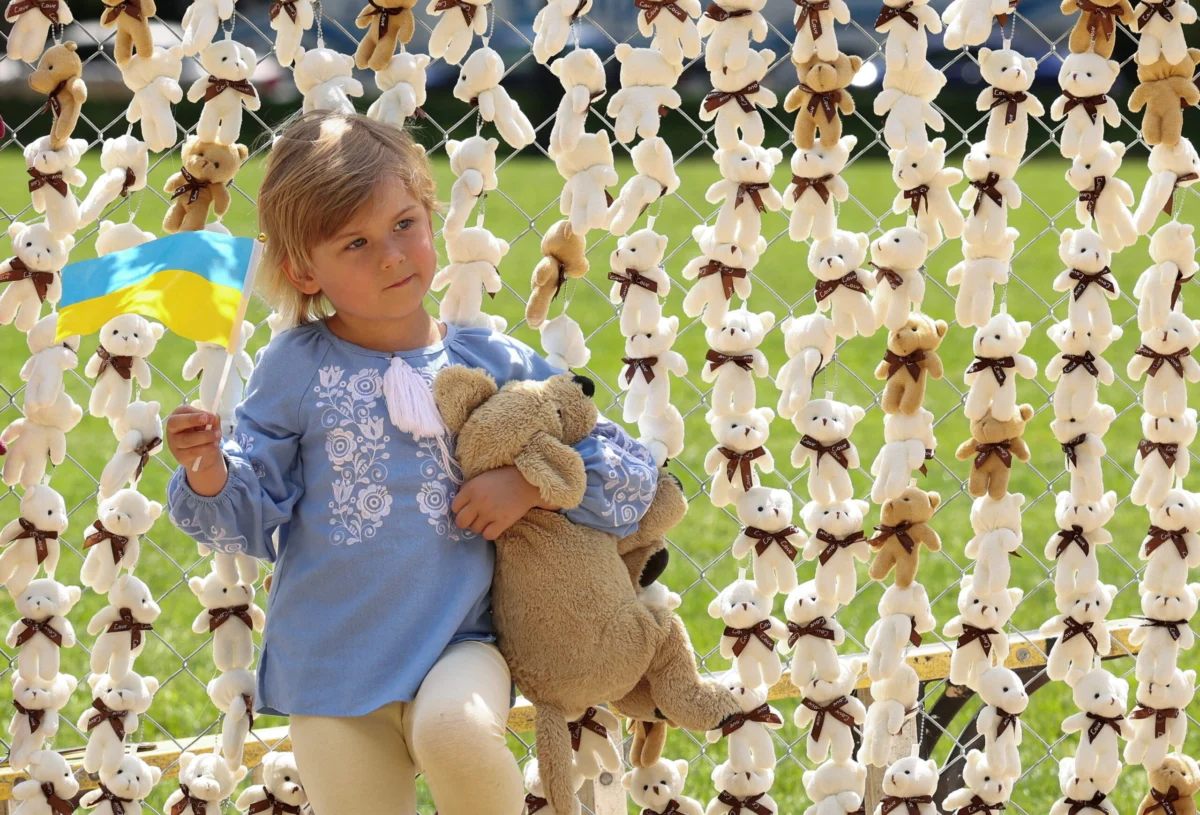
The landscape of the conflict in Ukraine has been defined not only by territorial skirmishes and geopolitical maneuvering but by a profound humanitarian crisis that strikes at the very future of the Ukrainian nation: the systematic removal and relocation of its children. Since the onset of Russia’s full-scale invasion in February 2022—an escalation of an occupation that originally began with the annexation of Crimea in 2014—more than 20,000 Ukrainian children have been forcibly transferred to the Russian Federation or territories under its control. This figure, documented by the Ukrainian government’s "Children of War" portal, represents one of the most harrowing aspects of the ongoing war, involving the separation of families, the circumvention of central authorities in Kyiv, and what international bodies have categorized as potential crimes against humanity.
The initial months of the 2022 invasion were characterized by extreme volatility. In the chaos of rapidly shifting frontlines, communication lines were severed, and childcare institutions in regions like Kherson, Zaporizhzhia, and the Donbas were cut off from the oversight of the Ukrainian Ministry of Social Policy. Taking advantage of this administrative vacuum, Russian occupation forces began the organized transfer of minors across the border. While Moscow has consistently framed these actions as "humanitarian evacuations" intended to protect vulnerable youths from the violence of the "special military operation," a growing body of evidence from international investigators, non-governmental organizations (NGOs), and legal experts suggests a much more coercive and systematic policy of forced assimilation and unlawful deportation.
The Legal Framework and the Violation of International Norms
Under international humanitarian law, specifically the Fourth Geneva Convention of 1949, the forcible transfer of protected persons from occupied territory to the territory of the occupying power is strictly prohibited. While evacuations are permitted under narrow circumstances—specifically when the safety of the population or imperative military reasons demand it—such movements must be temporary, conducted within the occupied territory whenever possible, and must prioritize the preservation of family unity. Most importantly, the law mandates that all evacuees be returned to their homes immediately upon the cessation of hostilities.
International investigations have found that Russia’s actions fail to meet these legal benchmarks. In numerous documented instances, transfers were executed without the informed consent of living parents or legal guardians. Furthermore, the Russian government has actively facilitated the integration of these children into Russian society through legislative changes. In May 2022, President Vladimir Putin signed a decree simplifying the process for orphaned Ukrainian children to obtain Russian citizenship, a move that critics argue was designed to fast-track unlawful adoptions and permanently sever the children’s ties to their homeland and national identity.
A Chronology of the Crisis and International Response
The timeline of the child transfers reveals a coordinated effort that has evolved alongside the military campaign:
- February–March 2022: Large-scale transfers begin during the siege of Mariupol and the occupation of the Kherson and Kharkiv regions. Children are moved to "rehabilitation centers" and summer camps in Crimea and Russia.
- May 2022: Russia streamlines citizenship laws for Ukrainian minors, easing the path for permanent resettlement and adoption by Russian families.
- March 2023: The International Criminal Court (ICC) issues arrest warrants for Russian President Vladimir Putin and Maria Lvova-Belova, the Russian Commissioner for Children’s Rights. The court alleges their personal responsibility for the unlawful deportation of children.
- March 2024: The United Nations Independent International Commission of Inquiry on Ukraine concludes that the deportation of children amounts to a war crime. The report highlights that these removals are part of a "well-planned and systematically executed policy."
- May 2024: The European Union and the United Kingdom announce a new wave of sanctions targeting individuals and entities involved in the "indoctrination and militarization" of Ukrainian children.
- July 2025: In a landmark ruling in the case of Ukraine and the Netherlands v. Russia, the European Court of Human Rights (ECHR) finds the Russian Federation responsible for organized removals and demands cooperation in establishing a safe return mechanism.
The Reality of Indoctrination: The Case of Lesya
The human cost of these policies is best understood through individual testimonies. The Reckoning Project, a global initiative of journalists and lawyers, has documented the case of a 15-year-old girl named Lesya (a pseudonym used for her protection). In 2022, during the occupation of her village in the Kherson region, Lesya was swept up in a "mandatory evacuation." She was loaded onto a truck with 30 other children and transported to a facility in Feodosia, Crimea.
At this facility, the environment was less a "rehabilitation center" and more a site for forced cultural assimilation. Lesya reported a strict routine where children were forced to study from Russian textbooks, perform chores under constant surveillance, and live in a building where windows were sealed shut. Perhaps most disturbingly, the curriculum included military training twice a week. This process of "re-education" is a recurring theme in survivor testimonies, suggesting an intent to erode Ukrainian national identity and replace it with Russian patriotic sentiment. Lesya was eventually reunited with her mother through the intervention of a relative and the NGO Save Ukraine, but her story remains a rare exception.
Data and the Scale of the Displacement
The statistics provided by the Ukrainian government and various monitoring groups paint a stark picture:
- Identified Children: As of mid-2024, the Ukrainian government has identified over 20,000 children who were forcibly removed.
- The "Return" Gap: Despite the efforts of the Ukrainian government, foreign mediators like Qatar and the Holy See, and NGOs, only approximately 2,000 children have been successfully repatriated.
- Sanctions Impact: Over 130 individuals and organizations have been sanctioned by the EU, US, Canada, and Australia for their roles in the deportation and adoption schemes.
- Geographic Scope: Reports indicate that Ukrainian children have been dispersed across at least 43 facilities throughout Russia, from the Black Sea coast to Siberia and the Far East.
Global Reactions and Diplomatic Stalemate
The international community has reacted with a mixture of legal condemnation and targeted economic pressure. The ICC warrants were a significant diplomatic blow to Moscow, restricting the travel of President Putin to countries that are signatories to the Rome Statute. However, Russia, which does not recognize the ICC’s jurisdiction, has dismissed the warrants as "legally null and void."
In Brussels and London, the focus has shifted toward the financial and administrative architecture of the deportations. Recent sanctions have targeted "re-education" camp directors, regional officials who facilitated adoptions, and organizations involved in the "militarization" of minors. Despite these measures, the return process remains agonizingly slow. Russia continues to use the children as a "bargaining chip" in broader geopolitical negotiations, often requiring complex, case-by-case mediation by third-party nations to release even a single child.
Analysis of Implications: The Long-Term Impact
The systematic removal of children has profound implications for the future of Ukraine. Sociologists and legal experts warn of "demographic engineering," where an occupying power seeks to alter the ethnic and cultural composition of a territory by removing its youth. The psychological trauma inflicted on these children—many of whom are told that their parents have abandoned them or that Ukraine no longer exists—will take generations to heal.
Furthermore, the failure of existing international mechanisms to force a mass return of these children exposes a weakness in the global humanitarian order. If a permanent member of the UN Security Council can ignore ECHR rulings and ICC warrants without immediate consequence for its domestic policy on abducted civilians, the precedent for future conflicts is concerning.
Strategic Recommendations for the International Community
To move beyond the current stalemate, experts suggest three primary areas for expanded action:
First, there is an urgent need for a comprehensive, internationally financed tracing mechanism. As children are moved from temporary camps into Russia’s dispersed foster care and adoption systems, they become increasingly difficult to locate. A centralized database, supported by satellite imagery and intelligence sharing, is essential to prevent these children from disappearing permanently.
Second, the principle of universal jurisdiction should be applied more aggressively. States that have incorporated international crimes into their domestic law can and should launch their own prosecutions against Russian officials involved in the abductions. Coordinated efforts through Eurojust could streamline these judicial processes, ensuring that those responsible face the prospect of arrest and extradition across a wide range of territories.
Third, the enforcement of existing sanctions must be tightened. While the Russian economy has been impacted by Western measures, "sanction evasion" remains a significant hurdle. Closing loopholes that allow the Russian administrative state to fund and operate these relocation programs would put direct pressure on the Kremlin to reconsider its stance on the return of Ukrainian minors.
Conclusion: A Moral Imperative
As the war in Ukraine enters its fifth year of broader conflict, the world’s attention risks being diverted by newer crises. However, the issue of abducted children cannot be relegated to the periphery of diplomatic agendas. For the thousands of families still searching for their sons and daughters, every day of delay is a day of lost identity and deepening trauma.
The principle that children belong with their families is a universal human right that transcends political boundaries. The international community’s commitment to this principle will be judged by its ability to bring these 20,000 children home. Ukrainian children are not spoils of war, nor are they bargaining chips; they are the future of a sovereign nation, and their return is a prerequisite for any lasting justice in the region.
