

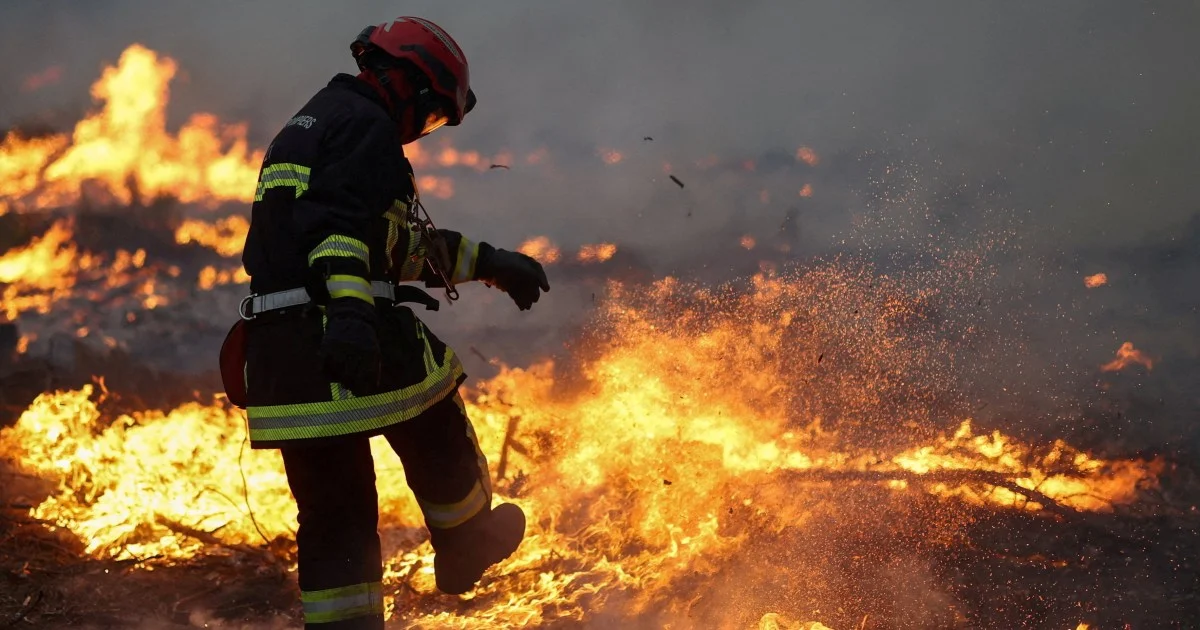
Wildfires are rampaging through vast areas of land in southwestern Europe, forcing France and Spain to evacuate more than 325,000 people from their homes amidst a crisis described as unprecedented in its scale and intensity. This environmental catastrophe unfolds just weeks after record-breaking heatwaves scorched the continent, exacerbating already dry conditions and fueling blazes that have overwhelmed conventional firefighting efforts. Authorities have deployed thousands of firefighters, supported by aerial assets and international assistance, but the sheer force of the fires, compounded by extreme weather phenomena, has pushed emergency services to their limits.
The Escalating Scale of Destruction
The sheer magnitude of the current wildfire crisis is starkly illustrated by the land consumed. France’s Interior Minister, Laurent Nunez, reported on Sunday that approximately 115,000 hectares (284,171 acres) have burned in France since the start of the year. This figure places the current events among the worst fires the country has experienced since World War II, a grim historical comparison underscoring the severity of the ongoing disaster. In Spain, the situation is equally dire, with 119,458 hectares (295,187 acres) of land ravaged by fires as of July 22, according to data from the Copernicus European Forest Fire Information System (EFFIS). Prime Minister Pedro Sanchez highlighted the alarming trend, stating that more than 150,000 hectares have burned across Spain since January – an area six times larger than that destroyed during the same period last year.
These national figures contribute to a broader European trend of escalating wildfire devastation. The United Nations reported that wildfires destroyed 2.2 million hectares (5.4 million acres) of land in Europe in 2025, a significant increase from 1.4 million hectares (3.5 million acres) in 2022. This upward trajectory in burned area paints a concerning picture of a continent increasingly vulnerable to the destructive power of wildfires, driven by a confluence of climatic and land-use factors.
A Chronology of Crisis: France and Spain Under Siege
Since early July, a relentless wave of wildfires has swept across southern and western Europe, with France and Spain bearing the brunt of the devastation. The crisis began to intensify dramatically, leading to widespread evacuations and the deployment of vast resources.
In France, approximately 220,000 people have been evacuated from their homes, particularly from the southwestern Gironde region, which includes popular holiday destinations. The Cap Ferret peninsula, an exclusive holiday spot on France’s southern Atlantic coast, about 70km (43 miles) from Bordeaux, has been particularly ravaged. Al Jazeera’s Nina Montagu-Smith, reporting from Maubec near Toulouse, vividly described the rapid escalation of the situation. Visiting Arcachon, a seaside town across the bay from Cap Ferret, she observed the fires on the peninsula, noting how "within hours, the sky had blackened and the smoke was thick over Arcachon town." The smoke and ash spread rapidly, reaching Libourne, 100km from the fires in Gironde, by Thursday evening as winds picked up. By Sunday night, the smoke was still palpable as far east as Toulouse, indicating the vast atmospheric reach of the blazes.
The wildfires have steadily advanced, spreading through areas surrounding Bordeaux, threatening to engulf the regional capital. Bordeaux Mayor Thomas Cazenave confirmed that the fire was just 15km (nine miles) from the city’s main entrances. Interior Minister Laurent Nunez acknowledged the grave situation, stating on Sunday evening, "We have a fire that is not under control and which is moving in the direction of the city area. The overall situation is very unfavourable, we are in a situation that is unprecedented." So far, 197,000 people have been moved from areas around Bordeaux, including tourist hotspots typically bustling at this time of year. The disruption was so severe it even impacted the Tour de France finale in Paris on Sunday, which was shortened from 133 to 89 kilometres (83 to 55 miles) as security forces were redeployed to assist with firefighting efforts.
In Spain, the crisis has been equally severe, with about 75,000 people evacuated and another 30,000 ordered to shelter in place. A fast-moving wildfire in the Andalusia region tragically claimed at least 12 lives on July 10, highlighting the immediate and deadly threat posed by these blazes. By July 20, the fires had spread hundreds of kilometers, reaching the capital, Madrid. At least 10,000 people have been evacuated from the central region of Madrid due to wildfires. The escalating danger prompted Spanish authorities to declare a national emergency on July 24, with two major blazes described as "out of control."
Over the weekend, a separate wildfire in Spain’s eastern Castellon province consumed more than 4,300 hectares (10,625 acres). Juanfran Perez, the regional leader of Valencia, near the site, articulated the extreme difficulty faced by firefighters: "The fire is out of control, it’s very difficult to extinguish from a technical standpoint, especially because of the adverse weather conditions that will continue throughout the day." The wildfire has since penetrated the Sierra de Espadan natural park, an ecologically significant area characterized by large forests of pine trees and cork oaks, raising concerns about biodiversity loss and long-term ecosystem damage.
The Perilous Phenomenon of Pyrocumulonimbus Clouds
One of the most alarming developments in this wildfire season has been the formation of pyrocumulonimbus clouds, a phenomenon scientists describe as unprecedented in southwestern Europe. According to the British Royal Meteorological Society, these are thunderclouds "created by intense heat from the Earth’s surface." While similar in formation to normal clouds, the crucial difference is that the "intense heat that results in the vigorous updraft comes from fire, either large wildfires or volcanic eruptions."
These formidable clouds pose immense challenges for firefighters, making conditions almost impossible to manage. They can produce bursts of rain, but this rain is often a double-edged sword, capable of carrying embers from the fire and igniting new "spot fires" far from the original source. More ominously, dry lightning from these storms can strike without rain, further exacerbating and spreading the wildfire. A spokesman for France’s National Firefighters Federation of France (FNSPF) elaborated on this danger to AFP, stating, "Lightning forms within the cloud, striking the embers on the ground and further fuelling the fire… It produces a low, rumbling sound. While this type of fire occurs regularly in Canada and Australia, it is unprecedented in France."
The emergence of pyrocumulonimbus clouds has forced a fundamental shift in strategy. The FNSPF spokesman conveyed the grim reality: "We have reached a point of ‘operational impossibility’ that requires us to accept the need for strategic retreat – to understand and acknowledge a natural force beyond our control." He likened the situation to a "war-like scenario where we are under constant bombardment and must get everyone to safety," underscoring the defensive posture firefighters are forced to adopt against a foe of immense natural power.
National and International Mobilization

In the face of such overwhelming devastation, both Spanish and French authorities have acknowledged that local resources are insufficient and have appealed for international assistance.
Spanish Prime Minister Pedro Sanchez visited fire-hit areas in Avila, one of three central provinces (alongside Madrid and Toledo) where over 45,000 hectares (111,000 acres) have burned. He expressed hope for a "window of opportunity this weekend to fight the wildfire and, therefore, to protect lives, protect population centres and, ultimately, to bring this very serious wildfire under control as far as possible." Sanchez also announced that his government would declare a civil protection emergency for the central provinces on Tuesday, a critical step to unlock additional recovery funding for the affected regions.
French Prime Minister Sebastien Lecornu took to X (formerly Twitter) on Saturday, declaring, "The fires which are hitting our country have reached a level that has never been seen before." He convened a second government crisis meeting in as many days to discuss the emergency response. French President Emmanuel Macron also held a cabinet crisis meeting on Monday, signaling the highest level of government engagement in managing the unfolding catastrophe.
The European Union’s civil protection mechanism has been actively monitoring and assisting. Under this framework, Greece and Italy have dispatched firefighting aircraft to Spain, while Portugal has deployed over 100 military personnel along with equipment to aid the efforts. The Spanish interior ministry further confirmed on X that two additional aircraft would arrive "as soon as possible" from Turkey, highlighting the growing international solidarity in confronting this transnational threat.
Underlying Vulnerabilities: Why Containment is Failing
While wildfires are a common occurrence in Europe, particularly in the Mediterranean basin, the increasing difficulty authorities face in containing them points to deeper systemic issues beyond immediate weather conditions. Prime Minister Sanchez explicitly linked the growing scale and intensity of the fires to increasingly extreme weather, stressing the need for policies grounded in climate science.
Eduardo Rojas, chairman of the Board at the Programme for the Endorsement of Forest Certification, told Al Jazeera’s Inside Story program that multiple factors contribute to the wildfires’ severity. He highlighted the "extraordinarily complex" wildland-urban interface in many affected areas. Rojas noted that some regions were "built up in the 60s, 70s, and 80s without a proper city plan and with lack of infrastructure, lack of water availability… and with a lack of knowledge of the neighborhoods." This haphazard development creates significant challenges for emergency responders, leading to "a lack of knowledge about how to deal with them" when fires inevitably occur. He also pointed out that agricultural fires, even from a small lightning strike on dry cereals, can quickly escalate, causing "big damage for farmers." Rojas stressed that these different types of fires – urban-interface, wildland, and agricultural – require distinct strategies due to their incomparable causes and environments.
Laurie Laybourn, executive director of the Strategic Climate Risks Initiative, a non-partisan think tank, further explained to Al Jazeera that governments across the continent are struggling to cope with the rapid pace of climate change. "All governments develop what are called reasonable worst-case scenarios to inform their planning, and in many instances, the events that we’re seeing are going beyond even those," Laybourn stated. This suggests that existing planning tools and analyses are "a step behind how fast climate change and its supercharging of disasters is," leaving authorities ill-prepared for the current reality.
The Overarching Shadow of Climate Change
At the heart of this escalating crisis is climate change. The European Forest Institute defines a wildfire as "a chemical reaction of combustion, which requires a source of heat (lightning, an agricultural ‘burn’ which escapes, or a spark originating in an electric line), oxygen and fuel (forests, shrubs or pastures) to get started." The institute’s July 9 report unequivocally states, "Wildfire risks are increasing worldwide because of climate change and land use change."
The World Health Organization’s regional director for Europe has issued a stark warning, directly attributing the intensification and increasing frequency of wildfires to climate change. Laybourn echoed this sentiment, asserting that there are clear indications that climate change is "supercharging" incidents such as wildfires. While acknowledging the multilayered causes of any disaster, including how land is built and used, he emphasized that "climate change is supercharging the conditions that make us vulnerable to things like wildfires, and that has been something that’s been predicted now for many decades and tragically becoming true in front of our eyes."
Copernicus, the European Union’s climate change service, has confirmed that Europe is now the fastest-warming continent on Earth, with temperatures increasing twice as fast as the global average since 1980. Laybourn explicitly linked this summer’s record-breaking heatwaves to climate change, creating the tinderbox conditions necessary for such extensive and intense fires. He concluded with a potent call to action, warning that "this should be a moment of profound alarm and reflection, particularly for governments." The implication is clear: without urgent and robust action on climate change mitigation and adaptation, such devastating wildfire seasons risk becoming the new, more frequent norm across Europe.
Broader Implications and Future Outlook
The implications of these unprecedented wildfires extend far beyond the immediate destruction of land and property. Environmentally, the loss of vast forest areas will have long-term consequences for biodiversity, carbon sequestration, and soil health. The massive release of smoke and particulate matter impacts air quality across wide regions, posing significant health risks to millions. Economically, the blow to tourism, agriculture (especially in famed regions like Bordeaux’s vineyards), and local infrastructure will be substantial, requiring significant recovery efforts and investment. Socially, the trauma of displacement, the loss of homes, and the constant threat of fire will leave lasting psychological scars on affected communities.
This crisis serves as a stark reminder of Europe’s increasing vulnerability to the impacts of a rapidly changing climate. It highlights the urgent need for comprehensive strategies that not only focus on immediate emergency response but also on long-term prevention, sustainable forest management, resilient urban planning, and aggressive climate action. Governments face the formidable challenge of adapting to a future where extreme weather events, like these supercharged wildfires, are becoming more intense and frequent, demanding a paradigm shift in environmental policy and public preparedness.
