

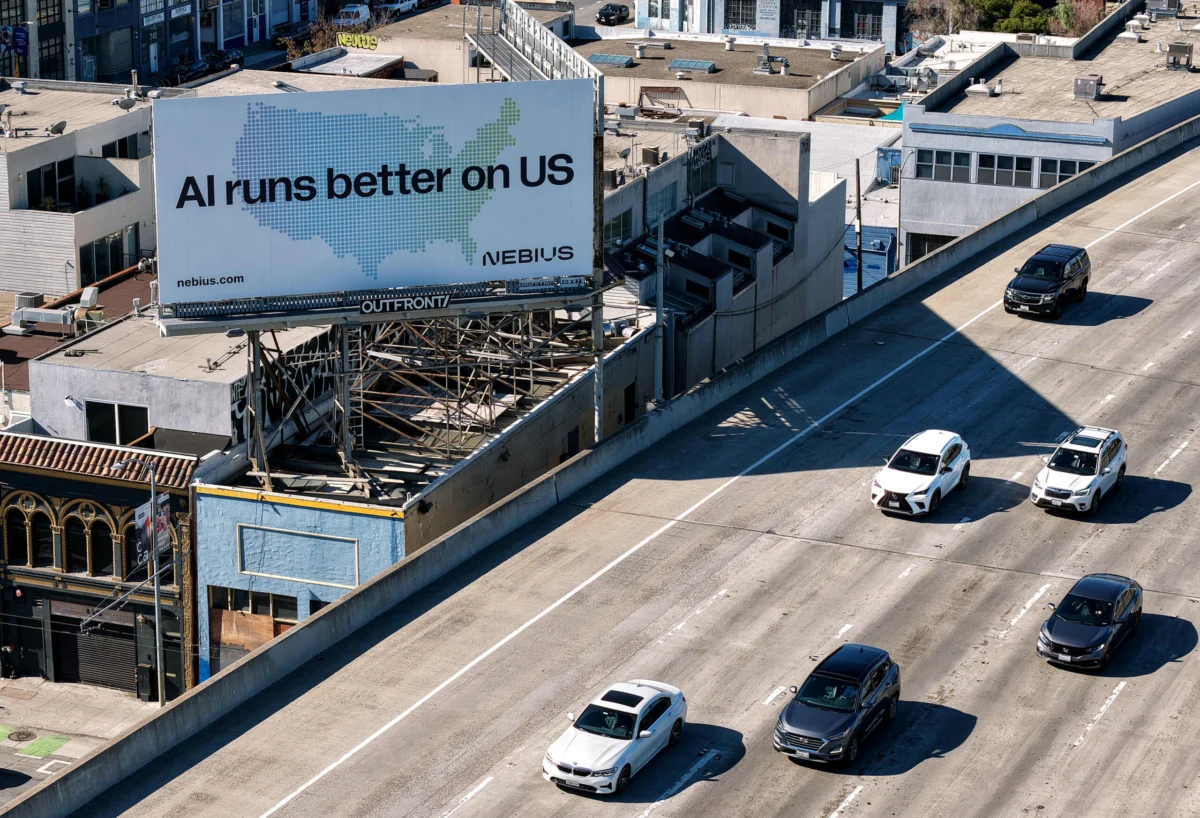
The Dutch cloud computing and artificial intelligence infrastructure firm Nebius Group saw its stock price surge in premarket trading on Thursday following a regulatory filing that revealed a substantial investment from Situational Awareness, a hedge fund led by former OpenAI researcher Leopold Aschenbrenner. According to the Schedule 13G filing submitted to the U.S. Securities and Exchange Commission on Wednesday, Situational Awareness has acquired 12.4 million Class A shares of Nebius, representing a 5.6% ownership stake in the company. The disclosure triggered an immediate 9.6% jump in Nebius’s share price during early trading hours, adding to a remarkable year-to-date rally that has seen the stock appreciate by more than 149%.
This investment marks a significant milestone for Nebius as it attempts to solidify its position as Europe’s premier provider of AI-specialized cloud services. The backing from Aschenbrenner, a figure whose recent exit from OpenAI and subsequent launch of a multi-billion-dollar fund have made him a focal point of the AI investment community, provides a powerful vote of confidence in Nebius’s technical capabilities and strategic direction. Situational Awareness, which manages billions of dollars in assets, focuses specifically on the physical and logistical infrastructure required to support the next generation of artificial intelligence, viewing hardware and energy as the primary bottlenecks to achieving artificial general intelligence (AGI).
The Strategic Significance of the Investment
The entry of Situational Awareness into Nebius’s shareholder registry is not merely a financial transaction but a strategic endorsement of the company’s "GPU-as-a-service" business model. Nebius has pivoted aggressively toward providing the high-performance computing (HPC) power necessary for training large language models (LLMs) and running complex inference tasks. By securing a 5.6% stake, Aschenbrenner’s fund joins a cohort of institutional investors betting that the next phase of the AI boom will shift from software applications to the underlying physical layer—data centers, specialized chips, and energy solutions.
Nebius’s listing in the United States has made it a primary vehicle for Western investors seeking exposure to the European AI infrastructure market. The company’s growth trajectory has been bolstered by a series of high-profile partnerships and capital infusions that have transformed it from a niche player into a central hub for AI compute. The market reaction to the filing reflects a broader trend where "infrastructure-first" funds are scouring the globe for companies capable of deploying Nvidia’s latest H100 and B200 Blackwell chips at scale.
Chronology of Nebius’s Transformation and Growth
To understand the weight of this investment, one must look at the rapid evolution of Nebius over the past year. Formerly a segment of the Russian technology giant Yandex, the company underwent a complex divestment and restructuring process to emerge as an independent, Dutch-based entity focused entirely on Western markets and AI technology.
In March, Nebius reached a watershed moment when it announced a massive $27 billion infrastructure deal with Meta Platforms. Under the terms of this five-year agreement, Nebius committed to providing $12 billion in dedicated capacity and an additional $15 billion in flexible compute capacity to the social media giant. This partnership established Nebius as one of Meta’s key external partners for AI training, placing it in the same league as established American cloud providers.
Shortly after the Meta announcement, Nebius secured a $2 billion investment from Nvidia. This deal was particularly notable because it went beyond simple capital; it included a deep technical collaboration. Nvidia and Nebius agreed to work together on the design of "AI factories," focusing on fleet management, inference optimization, and the physical architecture of data centers optimized for AI workloads. This relationship has ensured that Nebius remains at the front of the queue for the latest semiconductor technology, a critical advantage in a market defined by chip shortages.
More recently, in May, Nebius addressed one of the most pressing challenges facing the industry: energy consumption. The company signed a $2.6 billion agreement with Bloom Energy to deploy solid oxide fuel cell technology. This move is designed to circumvent the long wait times for traditional grid connections and provide a more reliable, sustainable power source for its data centers in both Europe and the United States.
Profiles in AI: Leopold Aschenbrenner and Situational Awareness
The man behind the investment, Leopold Aschenbrenner, has become a polarizing yet influential figure in the Silicon Valley ecosystem. A German-born researcher, Aschenbrenner was a prominent member of OpenAI’s "Superalignment" team, a group tasked with ensuring that future AI systems significantly more intelligent than humans remain safe and controllable. His tenure at OpenAI ended abruptly in 2024 when he was dismissed for allegedly leaking internal information—a claim he has largely contested, suggesting instead that his warnings about security vulnerabilities and the rapid approach of AGI were the true cause of the friction.
Following his departure, Aschenbrenner published a widely read series of essays titled "Situational Awareness," which outlined a vision of the near future where AI progress accelerates at an exponential rate. He argued that the world is unprepared for the massive industrial requirements of this transition, specifically regarding the need for trillions of dollars in investment for power plants and massive compute clusters.
His hedge fund, also named Situational Awareness, was founded to put these theories into practice. The fund’s portfolio is a "who’s who" of the AI supply chain, including holdings in Oracle, Nvidia, ASML, and Micron Technology. By adding Nebius to this list, Aschenbrenner is signaling that he views the Dutch firm as a critical link in the global AI infrastructure chain, particularly as a European alternative to the dominant American "hyperscalers" like Amazon Web Services (AWS) and Microsoft Azure.
Addressing the European Energy and Infrastructure Gap
A significant portion of the bull case for Nebius rests on its ability to navigate the unique challenges of the European market. Europe currently faces electricity prices that are substantially higher than those in the United States, alongside more stringent environmental regulations and a more fragmented power grid. These factors have historically made it difficult for European firms to compete in the high-energy-density world of AI data centers.
Nebius has tackled this head-on through its partnership with Bloom Energy. By utilizing fuel cells that can generate electricity on-site from various fuel sources, including hydrogen, Nebius can bypass the "gridlock" that has delayed data center projects in major hubs like Frankfurt, London, Amsterdam, and Paris. This allows the company to bring capacity online faster than competitors who rely solely on traditional utility providers.
Furthermore, the European Union’s push for "technological sovereignty" has created a favorable political tailwind for Nebius. European enterprises and governments are increasingly wary of relying entirely on American cloud providers for sensitive AI development. As a Dutch-domiciled company with deep roots in high-performance computing, Nebius is positioned as a "sovereign-friendly" option for European entities looking to build AI models within the continent’s regulatory and geographical borders.
Market Reactions and Financial Outlook
While neither Nebius nor Situational Awareness immediately responded to requests for comment regarding the 5.6% stake, the market’s response has been unambiguous. Analysts suggest that the entry of a specialized fund like Situational Awareness often precedes broader institutional interest. The fact that the fund manages billions and focuses on the "physicality" of AI suggests that their due diligence on Nebius’s data center assets and chip supply was exhaustive.
Nebius’s financial performance has been characterized by aggressive reinvestment. The company is currently in a capital-intensive phase, pouring billions into the procurement of Nvidia GPUs and the construction of specialized facilities. However, the $27 billion deal with Meta provides a clear revenue roadmap that mitigates much of the risk associated with such high capital expenditure. With the stock up nearly 150% this year, investors are clearly pricing in a future where Nebius captures a significant slice of the AI compute market.
Broader Implications for the AI Sector
The investment by Situational Awareness in Nebius highlights a maturing of the AI investment landscape. We are moving away from a period of speculative investment in every "AI-powered" startup toward a more disciplined focus on the companies that own the "shovels" in this gold rush. Nebius, with its combination of high-end hardware, innovative energy solutions, and blue-chip partnerships, represents the archetype of the successful AI infrastructure play.
The involvement of Aschenbrenner also brings a layer of "macro" significance to the stock. If his predictions regarding the rapid arrival of AGI and the subsequent need for unprecedented levels of compute power are even partially correct, companies like Nebius are not just service providers; they are the gatekeepers of the most valuable resource of the 21st century.
As the AI industry continues to grapple with bottlenecks in energy, silicon, and physical space, the focus will remain on firms like Nebius that can execute on the ground. The disclosure of a 5.6% stake by one of the most talked-about names in AI research and finance suggests that the race for AI infrastructure is entering a new, more intense phase of competition and consolidation. For now, Nebius stands at the forefront of that race in Europe, backed by the capital and the conviction of those who believe the AI revolution is only just beginning.
