

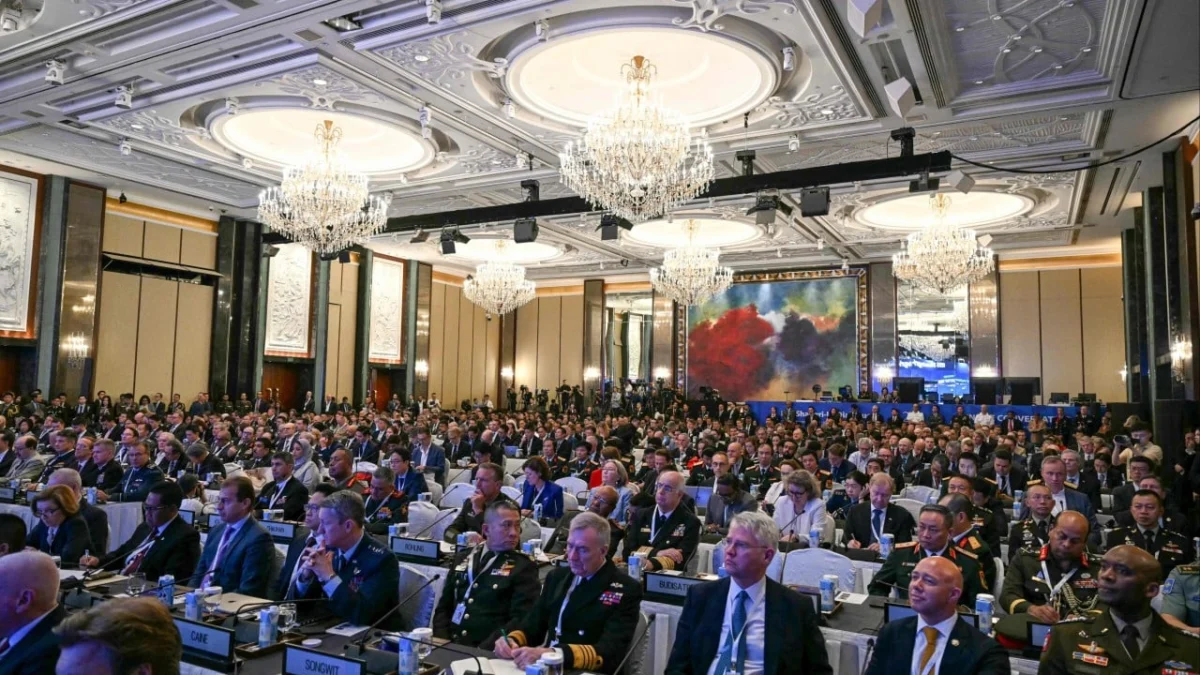
The 23rd edition of the Shangri-La Dialogue convened in Singapore this weekend, serving as a critical nexus for defense ministers, military commanders, and global analysts to navigate an increasingly fractured geopolitical landscape. Against a backdrop of heightening regional tensions and a global energy shock, the summit represents the first significant opportunity for the international community to parse the nuances of United States policy in the Indo-Pacific following the high-stakes summit between President Donald Trump and Chinese President Xi Jinping in Beijing earlier this month. That bilateral meeting, characterized by an agreement to "reset" ties and establish guardrails for dispute management, has cast a long shadow over the proceedings at the Shangri-La Hotel, where delegates are searching for concrete evidence of a lasting de-escalation.
United States Defense Secretary Pete Hegseth is scheduled to deliver a pivotal keynote address on Saturday morning. His speech is widely anticipated as a barometer for the Trump administration’s second-term security architecture, particularly regarding the sustainability of the "reset" with Beijing and its implications for traditional American allies in the region. Hegseth’s presence comes at a time of profound global instability, exacerbated by the ongoing conflict between the United States and Iran, a war that has severely disrupted global supply chains and precipitated the most acute energy crisis since the 1970s.
The Context of the Beijing Reset and Regional Anxiety
The Shangri-La Dialogue arrives just weeks after the Trump-Xi summit in Beijing, an event that many observers viewed as a pragmatic attempt to prevent a total decoupling of the world’s two largest economies. While the rhetoric emerging from Beijing suggested a mutual desire to "manage competition," the reality on the ground in the Indo-Pacific remains fraught with friction. American allies, including Japan, Australia, and the Philippines, are watching Singapore closely to ensure that the US-China "reset" does not come at the expense of their own security interests.
Secretary Hegseth’s task is to balance the administration’s transactional "America First" approach with the strategic necessity of maintaining a robust alliance network. A year ago, Hegseth used this same forum to issue a blunt ultimatum to regional partners, demanding significant increases in domestic military spending to offset the costs of American protection. This year, the focus has shifted toward "integrated deterrence" and the role of emerging technologies, such as artificial intelligence, in maintaining a competitive edge over the People’s Liberation Army (PLA).
China’s Notable Absence and Parallel Diplomacy
For the second consecutive year, Chinese Defense Minister Dong Jun has declined to attend the forum. Beijing has long viewed the Shangri-La Dialogue, organized by the International Institute for Strategic Studies (IISS), as a Western-centric platform designed to facilitate US-led narratives and "gang up" on Chinese interests. Dong’s absence is a calculated diplomatic signal, reflecting Beijing’s preference for its own security forums, such as the Xiangshan Forum, and its ongoing efforts to cultivate bilateral security ties within Southeast Asia outside of US-mediated frameworks.
In recent years, China has intensified its diplomatic outreach to ASEAN (Association of Southeast Asian Nations) members, offering infrastructure investment through the Belt and Road Initiative (BRI) alongside expanded military exercises. By skipping the Singapore summit, Beijing effectively avoids direct public confrontation with US officials while continuing its "quiet diplomacy" in the region. However, this absence also limits China’s ability to counter the narratives presented by Washington and its partners regarding the South China Sea and the Taiwan Strait.
The Shadow of the US-Iran Conflict and the Global Energy Crisis
Perhaps the most significant external factor looming over this year’s dialogue is the state of hostilities between the United States and Iran. The conflict has moved beyond localized skirmishes into a full-scale regional war, resulting in the closure of key maritime transit points and a catastrophic spike in global crude oil prices. For the Indo-Pacific—a region heavily dependent on energy imports from the Middle East—the war has created an atmosphere of economic desperation.
Delegates in Singapore are expected to pressure Secretary Hegseth for a timeline on the resolution of the Middle East conflict. The "energy crisis of the decade" has forced nations like Japan and Vietnam to re-evaluate their strategic reserves and accelerated the push for nuclear and renewable energy transitions. Hegseth is expected to argue that American military involvement in the Middle East does not diminish its "Pacific pivot," though skeptical analysts point to the strain on the US defense industrial base as evidence to the contrary.
Key Flashpoints: The South China Sea and Taiwan
Despite the "reset" in Beijing, the South China Sea remains a volatile theater of operations. The Philippines, under the administration of Ferdinand Marcos Jr., has taken a more assertive stance against Chinese maritime claims, leading to frequent "gray zone" confrontations at Second Thomas Shoal and Scarborough Shoal. Manila’s representatives at the dialogue are expected to seek renewed assurances of the US commitment to the Mutual Defense Treaty.
On the issue of Taiwan, the rhetoric remains cautious but firm. Secretary Hegseth is anticipated to reiterate the US policy of maintaining the status quo while continuing to authorize significant arms sales to Taipei. The challenge for the US delegation is to reassure Taiwan of continued support without violating the spirit of the recent "reset" with President Xi. For Beijing, any perceived shift toward Taiwanese independence remains a "red line" that could instantly nullify the progress made during the Beijing summit.
The Rise of AI Rivalry in Modern Warfare
A new and rapidly evolving theme at this year’s dialogue is the militarization of Artificial Intelligence. Both the US and China are locked in an arms race to integrate AI into autonomous weapons systems, cyber defense, and surveillance. Hegseth is expected to address the ethical and strategic risks of AI, while simultaneously emphasizing that the US will not cede the technological high ground.
The rivalry in AI is inextricably linked to the global semiconductor supply chain. With the US imposing stricter export controls on high-end chips, the "tech war" continues to simmer beneath the surface of diplomatic pleasantries. Regional players, particularly Singapore and Malaysia, which play vital roles in the global electronics supply chain, are increasingly concerned about being caught in the crossfire of "technological decoupling."
Chronology of the Shangri-La Dialogue and Key Milestones
To understand the weight of this year’s meeting, it is essential to look at the evolution of the Shangri-La Dialogue since its inception in 2002:
- 2002: The inaugural dialogue is held, establishing a rare venue where defense chiefs from across the Asia-Pacific can meet face-to-face.
- 2011: US Secretary of Defense Robert Gates uses the forum to formally announce the "Pivot to Asia," signaling a shift in American strategic focus away from the Middle East.
- 2017: The forum sees heightened tensions over North Korea’s nuclear program and China’s land reclamation in the South China Sea.
- 2023: Secretary Pete Hegseth delivers his first address, emphasizing "burden sharing" and demanding that allies increase defense budgets to at least 2% of GDP.
- 2024 (Current): The 23rd edition focuses on the aftermath of the Trump-Xi summit and the global fallout of the US-Iran war.
Data and Defense Expenditure Trends
Recent data from the Stockholm International Peace Research Institute (SIPRI) underscores the high stakes of the Singapore meetings. Global military expenditure reached an all-time high of $2.44 trillion last year. In the Indo-Pacific, spending has surged:
- Japan: Has committed to doubling its defense spending to 2% of GDP by 2027, marking its largest military buildup since World War II.
- Australia: Is significantly increasing investment in long-range strike capabilities and nuclear-powered submarines under the AUKUS pact.
- The Philippines: Has increased its defense budget by over 15% year-on-year to modernize its navy and air force.
- China: Continues to increase its official defense budget by approximately 7% annually, though external analysts suggest actual spending is significantly higher.
These figures illustrate a region in the midst of an arms race, driven by a lack of trust in the "rules-based order" and the perceived volatility of superpower relations.
Official Responses and Diplomatic Perspectives
Ahead of the keynote, various regional officials have offered their perspectives. A spokesperson for the Singapore Ministry of Defence noted that the dialogue remains "a vital platform for open and frank discussion," emphasizing that "in times of global crisis, dialogue is not a luxury but a necessity."
Australian officials have indicated that their primary goal is to ensure that the US remains "forward-deployed and engaged" in the Pacific, despite the distractions of the Middle Eastern theater. Meanwhile, representatives from Vietnam and New Zealand are expected to advocate for "ASEAN Centrality," a concept that emphasizes the role of Southeast Asian nations in managing their own regional security without being forced to choose sides between Washington and Beijing.
Broader Implications and Strategic Outlook
The outcomes of the 23rd Shangri-La Dialogue will likely define the security architecture of the Indo-Pacific for the remainder of the decade. If Secretary Hegseth can successfully articulate a policy that balances the Beijing "reset" with firm support for regional allies, it may lead to a period of "competitive coexistence." However, if the US continues to prioritize its conflict with Iran at the expense of its Pacific commitments, a power vacuum may emerge that Beijing is more than willing to fill.
The energy crisis also introduces a wildcard. As economies struggle with high fuel costs and inflation, the domestic political will to maintain high defense spending may waver among US allies. The Shangri-La Dialogue serves as the ultimate testing ground for whether the current "reset" between the world’s superpowers is a genuine path toward peace or merely a temporary pause in an inevitable march toward conflict.
As the three-day event progresses, the world will be watching to see if the "spirit of Singapore"—one of cooperation and open communication—can prevail over the forces of fragmentation that currently dominate the global stage. With reporting by Albee Zhang, Amber Wang, Alcott Wei, Yuanyue Dang, and Kolette Lim, the international community awaits the definitive word from the podium on Saturday morning.
