

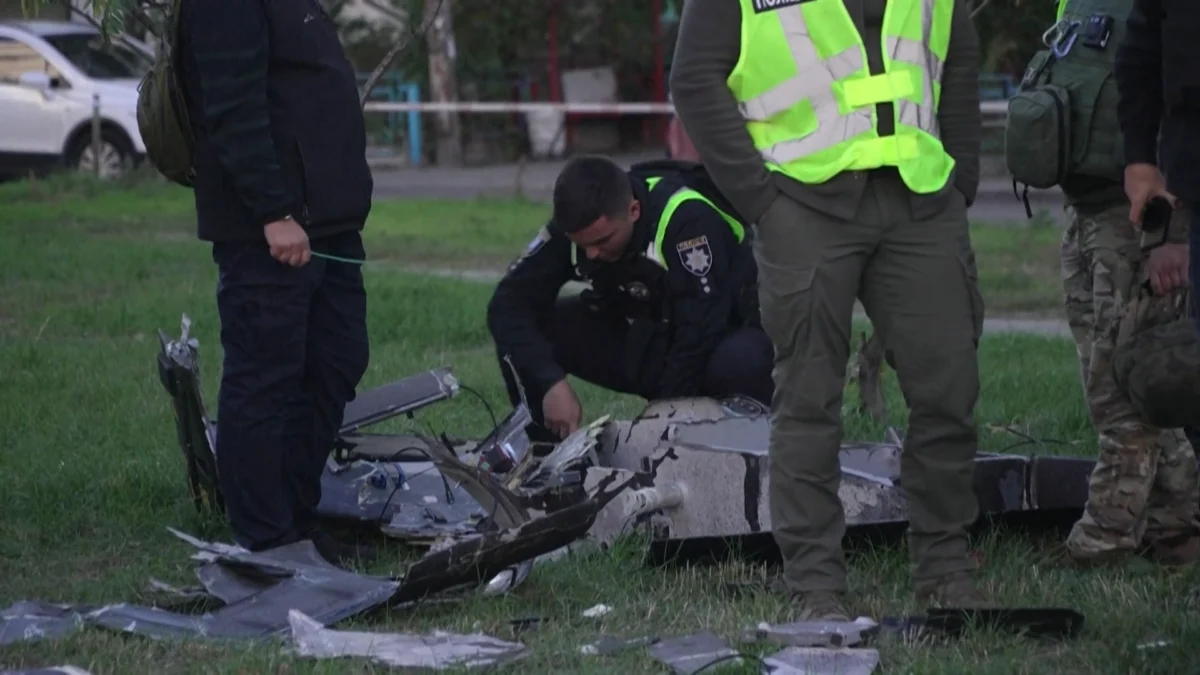
In an incident that has once again highlighted the precarious nature of life in the Ukrainian capital, a Russian long-range attack drone plummeted into a children’s playground within a densely populated residential courtyard on Monday. The event, which occurred in broad daylight on September 30, 2026, left residents of the Kyiv district in a state of shock, though the overwhelming sentiment remained one of profound relief. Despite the high-velocity impact, the drone’s explosive payload failed to detonate, averting what officials described as a potential mass-casualty event in a space specifically designed for families and young children.
The drone, identified by local authorities as a variant of the Shahed-series loitering munitions frequently utilized by Russian forces, came to rest amid colorful slides and swing sets. The sight of the dark, triangular fuselage nestled in the sand of a play area served as a chilling reminder of the ongoing aerial campaign targeting Ukrainian urban centers. Within minutes of the crash, the area was cordoned off by national police and military personnel, while specialized bomb disposal units were dispatched to neutralize the threat.
Detailed Chronology of the September 30 Incident
The sequence of events began in the early hours of September 30, when Ukrainian Air Force monitors detected several groups of unmanned aerial vehicles (UAVs) launched from Russian territory, specifically from the Primorsko-Akhtarsk and Kursk regions. By 9:00 AM, air raid sirens were sounding across northern and central Ukraine as the drones bypassed primary interceptor zones.
At approximately 10:15 AM, Kyiv’s local air defense systems were activated. Residents reported hearing the distinct "moped-like" drone engine sounds followed by the rapid fire of anti-aircraft cannons and the launch of interceptor missiles. Unlike many previous attacks that occurred under the cover of darkness, this incursion took place during the morning rush, as parents were walking children to school and residents were commuting to work.
At 10:42 AM, eyewitnesses in a northern Kyiv residential district reported seeing a low-flying UAV oscillating erratically—a behavior often associated with either technical malfunction or the influence of electronic warfare (EW) jamming. Moments later, the craft lost altitude rapidly, clipped the edge of a nine-story apartment building, and spiraled into the central courtyard. The impact occurred at 10:45 AM, directly on the soft rubberized surfacing of a modern playground.
By 11:00 AM, the State Emergency Service of Ukraine (SESU) had arrived on the scene. Finding the 50-kilogram warhead still intact, technicians began the delicate process of stabilization. By early afternoon, the debris had been safely removed to a secure facility for further forensic analysis, and the air raid alert for the capital was officially lifted.
Technical Analysis and the Role of Electronic Warfare
The failure of the drone to explode upon impact has become a subject of intense interest for military analysts and technical experts. Typically, loitering munitions of this class are equipped with multiple redundant fuzing mechanisms, including impact sensors and proximity fuzes designed to ensure detonation even if the craft does not hit a solid target directly.
Preliminary assessments by Ukrainian defense experts suggest three primary possibilities for the failure. The first is a mechanical defect in the fuzing system, potentially linked to the rapid mass production of these units, which has led to documented fluctuations in quality control. The second possibility involves the successful intervention of Ukrainian electronic warfare units. In 2026, Kyiv’s "electronic dome" has become increasingly sophisticated, capable of severing the GPS links and internal guidance systems of incoming drones. If the drone’s "brain" is effectively neutralized, it may fail to send the necessary signal to the detonator upon impact.
The third possibility is the angle of impact. If the drone struck the ground in a way that did not trigger the primary nose-mounted impact sensor—perhaps by hitting a soft surface like a sandbox or rubber matting—it might have prevented the kinetic energy required to initiate the chemical chain reaction within the warhead.
Supporting Data: The 2026 Aerial Campaign
The incident on September 30 is part of a broader, intensifying trend in the conflict. Data provided by the Ukrainian General Staff and independent monitoring groups like the Kyiv School of Economics (KSE) Institute shows that 2026 has seen a significant uptick in the volume of drone strikes compared to previous years.
In September 2026 alone, it is estimated that Russia launched over 1,800 loitering munitions toward Ukrainian targets, representing a 20% increase over the monthly average of 2025. Of these, approximately 85% were successfully intercepted by air defense systems, including mobile fire groups, Gepard anti-aircraft guns, and advanced Western-supplied systems like the IRIS-T and NASAMS.
However, the "leakage" rate—the percentage of drones that bypass defenses or crash due to EW—remains a critical concern. In the third quarter of 2026, nearly 12% of drones that reached the Kyiv metropolitan area resulted in "kinetic events," which include both successful strikes on targets and crashes into civilian infrastructure. The playground incident marks the fourteenth time in 2026 that a drone has landed in a residential "green zone" or recreational area within the city limits.
Official Responses and Reactions
The Ukrainian government was quick to condemn the incident, using it as a focal point to reiterate the need for continued international support in air defense. President Volodymyr Zelenskyy, in an afternoon address, highlighted the playground crash as an example of "unfiltered terror."
"When a weapon of war lands where children play, there is no longer any room for debate about the nature of this conflict," the President stated. "This was not a military objective. This was a residential courtyard. The fact that it did not explode is a miracle, but we cannot rely on miracles for the safety of our citizens."
Kyiv Mayor Vitali Klitschko visited the site shortly after the debris was cleared. He praised the rapid response of the emergency services and noted that the city’s psychological support teams were being deployed to assist the residents of the apartment block. "People are relieved, yes, but they are also deeply shaken. You cannot look at a playground the same way after seeing a bomb sitting next to a slide," Klitschko told reporters.
International reaction was similarly pointed. A spokesperson for the United Nations Human Rights Monitoring Mission in Ukraine (HRMMU) noted that the placement of such weapons in residential areas constitutes a violation of international humanitarian law, specifically the principle of distinction, which requires warring parties to distinguish between civilian objects and military objectives at all times.
Broader Impact and Implications for Urban Safety
The psychological impact of "silent" or "failed" munitions is a burgeoning field of study for those monitoring the Ukrainian conflict. While an explosion causes immediate devastation, the presence of unexploded ordnance (UXO) in civilian spaces creates a lingering sense of dread. For the residents of the Kyiv courtyard, the playground has been transformed from a place of leisure into a site of potential trauma.
Furthermore, this incident underscores the logistical challenges of defending a major metropolis. As Russia continues to evolve its tactics—using decoys, low-altitude flight paths, and carbon-fiber materials to reduce radar cross-sections—the burden on city-wide defense becomes heavier. The playground incident suggests that even a "successful" defense, such as forcing a drone down through electronic jamming, can result in dangerous debris falling into populated areas.
Strategically, the event may accelerate calls for "passive defense" measures in Ukrainian cities. This includes the installation of reinforced overhead netting in public spaces and the continued expansion of the "Point of Invincibility" network, which provides hardened shelters for civilians during prolonged alerts.
Conclusion
The crash of the Russian drone on September 30, 2026, will likely be remembered as a narrow escape for the people of Kyiv. However, in the context of the wider war, it serves as a stark metric of the risks faced by non-combatants. As the conflict continues to drive technological innovation in both attack and defense, the boundary between the front line and the domestic sphere remains dangerously blurred.
The safe removal of the drone by bomb disposal experts prevented a tragedy, but the physical and symbolic presence of a weapon of war in a children’s play area remains an indelible image of the 2026 campaign. For the families of Kyiv, the incident is a reminder that while the city’s skies are heavily guarded, the threat from above remains a constant, daily reality that requires not just military vigilance, but an enduring resilience.
