

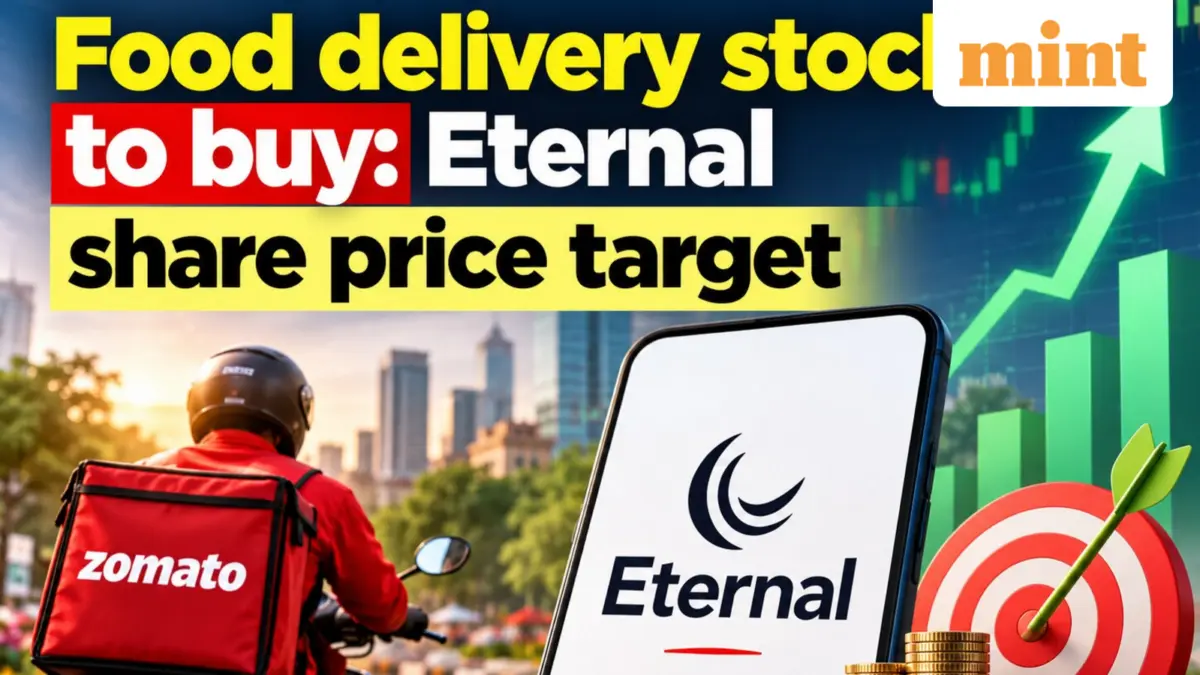
The Indian equities market has witnessed a remarkable resurgence in new-age technology stocks, with Eternal Limited, the parent entity of the food delivery and quick-commerce giant Zomato, emerging as a standout performer. Over the last six months, Eternal’s share price has appreciated by approximately 36%, reflecting a shift in investor sentiment from skepticism regarding profitability to confidence in the company’s multi-layered growth strategy. As of the close of trading on Friday, October 9, 2026, Eternal shares settled at ₹323.35 on the Bombay Stock Exchange (BSE). Despite the volatility inherent in the tech sector, institutional analysts remain bullish, with Joindre Capital Services Limited recently issuing a "Buy" rating and a target price of ₹390, suggesting a potential upside of 22.1% from current levels.
This bullish outlook is underpinned by three primary pillars: the explosive growth of the quick-commerce division, Blinkit; the successful launch and integration of the "District" app for the "going-out" segment; and a sustained improvement in operating efficiencies across the board. While the stock has seen fluctuations over a one-year horizon, its three-year trajectory remains stellar, delivering a staggering 211% return to long-term shareholders.
The Quick-Commerce Engine: Blinkit’s Margin Evolution
A significant portion of Eternal’s recent valuation spike is attributed to the performance of Blinkit, the company’s quick-commerce arm. Once considered a high-burn experiment, Blinkit has transformed into a vital growth engine that is increasingly contributing to the group’s bottom line. According to the latest brokerage report from Joindre Capital, management has revised its long-term adjusted EBITDA (Earnings Before Interest, Taxes, Depreciation, and Amortization) margin guidance for Blinkit upward. Previously pegged at a range of 5% to 6%, the guidance now sits firmly at the 6% mark.
This upward revision is not merely cosmetic; it is supported by structural changes in how the company manages its "dark stores" (distribution centers). Eternal is shifting toward larger store formats and increasing its capital expenditure (capex) per store. This strategy allows for a wider SKU (Stock Keeping Unit) count, moving beyond simple groceries into high-margin categories such as electronics, beauty products, and home essentials. By increasing store density and improving the productivity of delivery partners through better algorithmic routing, the company is achieving higher throughput without a proportional increase in operational costs.
Analysts note that Blinkit’s success is rooted in execution rather than price wars. While competitors often rely on deep discounting to lure customers, Eternal has focused on "winning through density." By having a store in closer proximity to the consumer than any competitor, they ensure the 10-minute delivery promise remains a reality, which in turn drives higher customer retention and frequency of orders.
Diversification Strategy: The Rise of the ‘District’ App
Beyond food delivery and groceries, Eternal is aggressively capturing the "experience economy" through its new "District" application. This platform serves as a consolidated hub for movie tickets, live events, sports venue bookings, and dining out. The strategic intent behind District is to create a closed-loop ecosystem where a user who orders food through the main app during the week is funneled into booking a concert or a dinner reservation through District over the weekend.
Joindre Capital highlights that the "going-out" segment represents a massive untapped opportunity in urban India, where discretionary spending on entertainment is rising at a double-digit CAGR (Compound Annual Growth Rate). By leveraging the existing massive user base of the food delivery platform, Eternal reduces its customer acquisition costs (CAC) for the District app, providing a competitive advantage over standalone ticketing or reservation platforms. This synergy is expected to bolster the company’s overall margins, as event ticketing and dining reservations typically carry higher commissions and lower fulfillment costs compared to physical delivery.
Financial Performance and Market Chronology
To understand the current enthusiasm for Eternal, one must look at the stock’s performance timeline. The company’s journey on the public markets has been a rollercoaster of investor sentiment:
- Three-Year Horizon: The stock has delivered a massive 211% return, vindicating early believers in the platform’s scalability.
- Two-Year Horizon: A steady 15.6% return, reflecting a period of consolidation and the integration of the Blinkit acquisition.
- One-Year Horizon: A slight dip of 6.37%, largely due to global macroeconomic pressures and a rotation out of growth stocks during high-interest-rate environments.
- Recent Momentum: In 2026 alone, the stock has climbed 14%, with a 35.92% surge occurring in the last six months and a 10.64% gain in the last quarter.
The recent closing price of ₹323.35 follows a week where the stock gained nearly 3%, indicating strong buying support even at elevated valuations. The market capitalization of the company now reflects its status as a mature player in the digital services space, rather than a speculative startup.
Comparative Analysis and Competitive Risks
While the outlook is predominantly positive, the road ahead is not without obstacles. The quick-commerce sector in India is becoming increasingly crowded. Competitors such as Swiggy (post its own landmark IPO), Zepto, and Tata-owned BigBasket are all vying for the same urban wallet share.

The key risk identified by analysts is the intensity of this competition. If competitors opt for aggressive capital burning to gain market share, it could force Eternal to increase its marketing spend, thereby delaying its margin expansion goals. However, Eternal’s management has indicated that they will not engage in irrational pricing. Instead, they are betting on "operating efficiency" and "stronger customer retention."
Data suggests that Eternal’s customer retention rates have improved significantly over the last four quarters. This is attributed to the "Gold" loyalty program, which creates a sticky user base that is less likely to switch platforms for a minor price difference. The ability to maintain this loyalty while simultaneously increasing the take-rate (the commission charged to restaurants and merchants) will be the ultimate test of the company’s pricing power.
Valuation Methodology: Why ₹390?
Joindre Capital’s target price of ₹390 is based on a Sum-of-the-Parts (SOTP) valuation. This methodology is often used for conglomerates or multi-business entities like Eternal, where different segments have different growth profiles and risk factors.
- Food Delivery: Valued based on a multiple of adjusted EBITDA, reflecting its status as a mature, cash-generating business.
- Quick Commerce (Blinkit): Valued on a Price-to-Sales (P/S) or EV/Sales basis, given its high growth rate and its path toward the newly guided 6% EBITDA margin.
- Going-Out (District): Valued based on the potential Gross Order Value (GOV) it can capture in the entertainment and dining sector.
By aggregating these valuations, analysts arrive at a fair value that is significantly higher than the current market price. The 22.1% projected upside assumes that the company will continue to meet its quarterly guidance and that the macro environment for urban consumption remains stable.
Broader Implications for the Tech Sector
The performance of Eternal is often seen as a bellwether for the broader Indian "new-age" tech sector. Its ability to pivot from a loss-making entity to a company with clear margin guidance and diversified revenue streams has provided a blueprint for other startups. If Eternal reaches its target price of ₹390, it will likely trigger a re-rating of other platforms in the logistics, e-commerce, and fintech sectors.
Furthermore, the emphasis on "operating efficiency" over "growth at all costs" marks a coming-of-age for the Indian tech ecosystem. Investors are no longer satisfied with high GMV (Gross Merchandise Value) numbers; they demand a clear path to free cash flow. Eternal’s focus on capex productivity and store-level economics is a direct response to this demand.
Conclusion and Outlook
As Eternal Limited moves into the final quarter of 2026, the company finds itself in a strong position. With a 36% gain in the last six months, the stock has momentum on its side. The integration of Blinkit has proven to be a masterstroke, and the early signs from the District app suggest another successful vertical is in the making.
However, investors must remain cognizant of the "Key Concern" highlighted by Joindre Capital: the execution risk in a hyper-competitive market. Winning in quick commerce requires a flawless supply chain and a deep understanding of local micro-markets. While Eternal has shown it can execute at scale, the entry of deep-pocketed conglomerates and well-funded startups ensures that the battle for India’s digital doorstep is far from over.
For now, the consensus among experts is clear: with improving customer retention, better operating leverage, and a clear expansion strategy, Eternal remains a "Buy." The journey toward the ₹390 mark will be closely watched by institutional and retail investors alike, as it represents not just the growth of a single company, but the maturing of India’s digital economy.
Disclaimer: This analysis is based on market reports and brokerage views. It is intended for informational purposes only and does not constitute financial advice. The stock market involves significant risk; please consult with a certified financial advisor before making investment decisions.
