

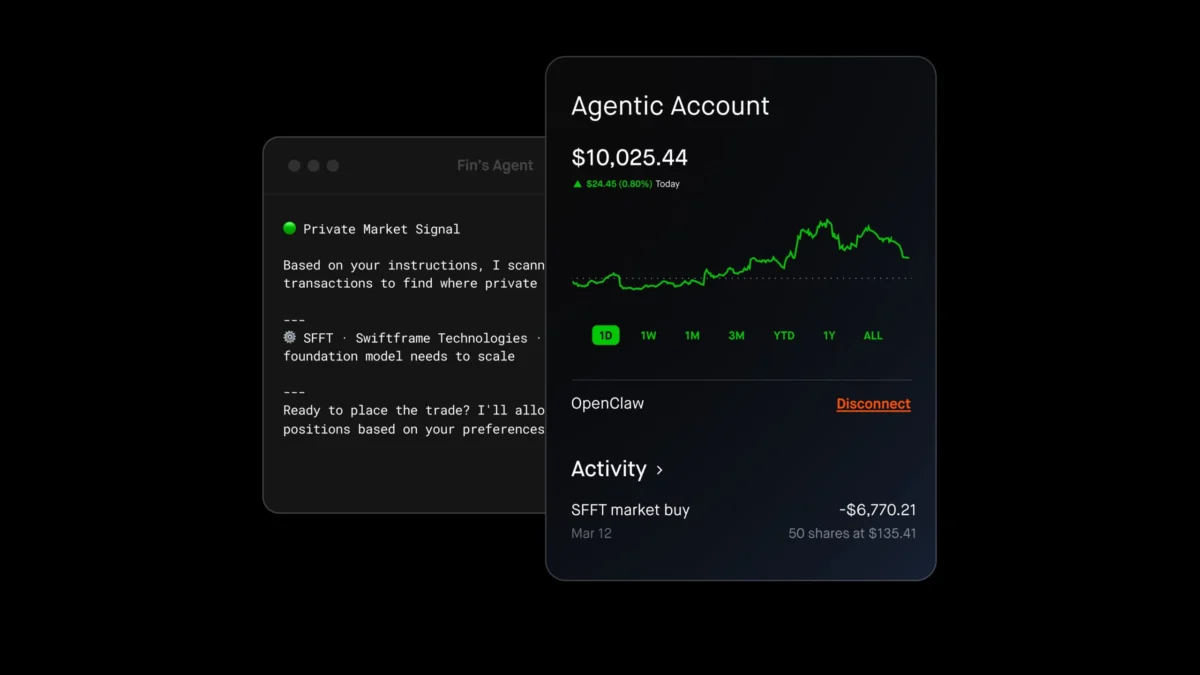
Robinhood Markets Inc. has officially announced a significant expansion of its artificial intelligence capabilities, introducing a suite of tools that allow AI agents to trade stocks and execute financial transactions on behalf of users. The move, unveiled on Wednesday, marks a pivotal shift for the retail brokerage as it transitions from a user-directed trading platform to an ecosystem where autonomous software can manage portfolios and handle payments. This rollout includes the launch of dedicated accounts for AI agents and a first-of-its-kind virtual credit card specifically designed for agentic use, signaling Robinhood’s intent to lead the "agentic economy" within the financial services sector.
The new features are built on the premise that the next phase of the AI revolution will move beyond simple text generation toward "agency"—the ability for AI to perform multi-step tasks in the physical and digital world. By providing AI agents with their own financial "passports" and "wallets," Robinhood is addressing a primary bottleneck in current AI development: the inability of large language models (LLMs) to interact securely with the traditional financial system.
The Mechanics of Agentic Trading and Dedicated Wallets
Under the new framework, Robinhood users can establish separate accounts specifically for their AI agents. These accounts are linked to a dedicated wallet, which serves as a sandbox for the agent’s activities. This architectural choice is a critical safety measure; while an AI agent can read and analyze a user’s primary portfolio to understand their overall financial health, risk tolerance, and sector exposure, it is restricted to using only the pre-loaded funds within its dedicated wallet. This "air-gapping" ensures that an autonomous agent cannot inadvertently liquidate a user’s entire life savings or execute trades that exceed a predetermined budget.
The integration is powered by the Model Context Protocol (MCP), an open standard that facilitates seamless communication between AI models and third-party data sources or tools. By connecting their agents to Robinhood’s MCP service, users enable their AI to perform complex analytical tasks. These include identifying concentration risks, scanning analyst notes for sentiment, and detecting emerging investment opportunities across various market sectors.
Currently in its beta phase, the agentic trading feature is limited to equities. However, Robinhood has confirmed plans to rapidly expand these capabilities. In the coming months, the company intends to add support for options, cryptocurrencies, futures, event contracts, and prediction markets. This roadmap suggests a future where retail investors could deploy specialized AI agents to manage complex hedging strategies or participate in 24/7 crypto markets while they sleep.
The Virtual Agentic Credit Card: Bridging AI and Commerce
In a parallel move that extends Robinhood’s reach into the payments space, the company introduced a virtual credit card designed for AI agents. This product is currently exclusive to Robinhood Gold Card holders, who can link their accounts to the new virtual card. By connecting an AI agent to Robinhood’s banking MCP server, users allow the software to make real-world payments for services, subscriptions, or goods.
The implications of an agentic credit card are vast. For instance, an AI agent could be tasked with managing a user’s SaaS subscriptions, automatically paying for necessary tools while canceling those that are underutilized. Alternatively, a research agent could use the card to pay for one-off access to premium financial data or paywalls to gather information for its trading strategy.
To mitigate the risks associated with autonomous spending, Robinhood has implemented granular controls. Users can set strict monthly spending limits on the virtual card and choose whether the agent requires manual approval for every transaction or can operate autonomously within certain thresholds. The company also announced that its upcoming Robinhood Platinum Card, slated for launch later this year, will feature similar agentic support upon its debut.
Safety, Security, and Fraud Prevention
The prospect of autonomous software managing money naturally raises significant security and regulatory concerns. Robinhood has sought to address these through a "human-in-the-loop" philosophy combined with automated safeguards. Users receive real-time notifications for every trade or payment executed by their AI agent, allowing for immediate oversight through the Robinhood app interface.
For certain high-value or high-risk trades, the system generates a preview that requires explicit user approval before execution. Furthermore, Robinhood has deployed a specialized fraud detection team to monitor agentic activity. This team is tasked with identifying suspicious patterns and assisting users in resolving disputes that may arise from unauthorized or erroneous agent actions.

From a regulatory standpoint, Robinhood’s approach seeks to balance innovation with compliance. By maintaining the user as the ultimate arbiter of the agent’s permissions, the company navigates the complex legal landscape governing investment advice and discretionary trading. Industry analysts note that as these tools become more prevalent, regulators like the SEC and FINRA will likely scrutinize the "black box" nature of AI decision-making in retail markets.
A Chronology of Robinhood’s AI Evolution
The launch of agentic trading is the culmination of a multi-year strategic pivot toward artificial intelligence. While Robinhood rose to prominence as a mobile-first brokerage that democratized access to the stock market, its recent history has been defined by a race to integrate sophisticated technology for its 24 million users.
- 2023: Robinhood introduced its first AI assistant, designed to offer basic investment advice and answer user queries regarding market movements and account details.
- July 2024: The company acquired Pluto Capital Inc., an AI-powered investment research platform. Pluto’s technology provided the foundation for the advanced data processing and personalized insights now being utilized by Robinhood’s AI agents.
- May 2025 (Current): The launch of the MCP service and agentic trading represents the transition from "passive AI" (advice) to "active AI" (execution).
Abhishek Fatehpuria, VP of Product at Robinhood, emphasized that these developments are a direct response to user behavior. "We’ve heard a lot of demand from our customers to bring their own tools, LLMs, and agents, and connect them to Robinhood," Fatehpuria stated. This "Bring Your Own Agent" (BYOA) philosophy allows power users to leverage sophisticated models like GPT-4, Claude, or custom-built LLMs to interact with their Robinhood accounts.
Competitive Landscape and the "Agent Economy"
Robinhood is not alone in its pursuit of autonomous finance. The broader tech industry is currently engaged in an arms race to build the infrastructure for the "agent economy."
- Stripe: The payments giant recently launched tools allowing AI agents to hold and spend money, targeting developers who are building autonomous businesses.
- Amazon and Google: Both companies are integrating payment capabilities into their respective AI ecosystems (Bedrock and Gemini) to allow agents to complete shopping journeys and manage enterprise procurement.
- Startups: Newer players like Prava Pay and various DeFi protocols are experimenting with "smart accounts" that allow for autonomous, programmatic money movement.
What distinguishes Robinhood’s entry is its focus on the retail investor. By merging high-frequency data analysis with the ability to execute trades in a regulated brokerage environment, Robinhood is effectively providing retail users with the types of algorithmic tools previously reserved for institutional hedge funds.
Market Analysis: The Impact on Retail Investing
The introduction of AI agents into retail trading could have profound implications for market volatility and liquidity. On one hand, AI agents can act rationally, executing trades based on data rather than the emotional "FOMO" (fear of missing out) that often characterizes retail surges. This could lead to more stable, informed participation from the retail sector.
On the other hand, the mass deployment of AI agents could lead to "flash" movements if multiple agents react to the same data signals simultaneously. Furthermore, the barrier to entry for complex trading strategies—such as delta-neutral hedging or sophisticated options spreads—will be significantly lowered, potentially increasing the risk profile of the average retail account.
Financial analysts also point to the potential for a shift in the "subscription economy" of fintech. By locking agentic features behind the Robinhood Gold and Platinum tiers, Robinhood is diversifying its revenue streams away from mere transaction flow and toward high-value, recurring subscription revenue.
Looking Ahead: The Future of Autonomous Finance
As Robinhood moves its agentic tools from beta to a wider release, the focus will likely shift to the interoperability of these agents across different financial platforms. The use of the Model Context Protocol suggests an industry-wide push for a standardized way for AI to "talk" to banks and brokerages.
For the average user, the promise of these tools is a reduction in the "cognitive load" of financial management. Instead of spending hours researching stocks or manually tracking expenses, users can act as "portfolio managers," overseeing a fleet of specialized agents that handle the granular execution of their financial goals.
The launch of agentic trading and virtual cards represents more than just a new feature set; it is a fundamental bet on the future of how humans interact with money. In the vision put forth by Robinhood, the future of finance is not just digital or mobile—it is autonomous. As these tools evolve, the line between a personal assistant and a financial advisor will continue to blur, ushering in a new era of automated wealth management for the masses.
