

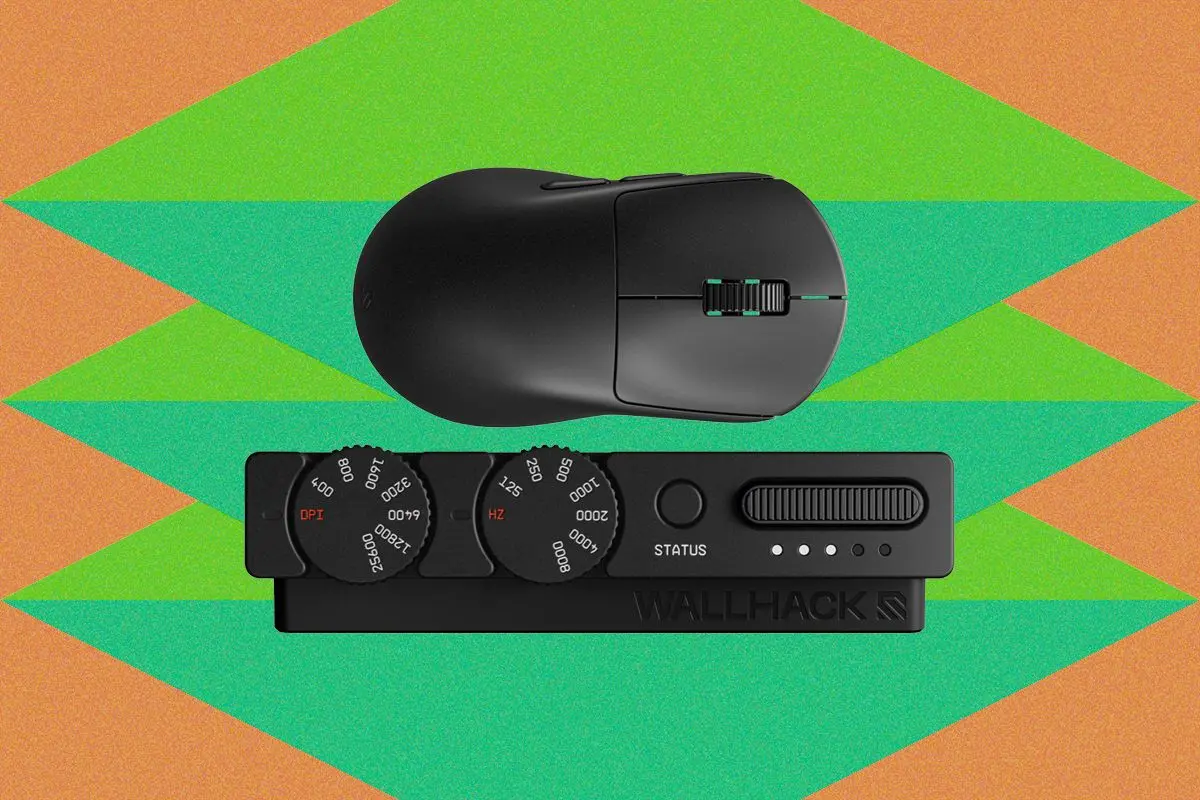
The landscape of professional gaming peripherals has undergone a radical transformation over the last five years, moving from heavy, feature-laden devices to ultralight, minimalist tools designed for peak competitive performance. Within this hyper-competitive market, Wallhack—a company previously recognized under the brand name SkyPAD for its glass mousepads—has introduced the M-001. This gaming mouse represents a departure from the industry’s reliance on carbon fiber or injection-molded plastics, opting instead for a magnesium alloy chassis and a revolutionary approach to battery management. By integrating a tactile, mechanical control hub and a hot-swappable battery system, the M-001 attempts to bridge the gap between high-end industrial design and the rigorous demands of the e-sports community.
Engineering and Structural Integrity: The Magnesium Advantage
The most immediate distinction of the Wallhack M-001 is its construction. While the majority of the market utilizes ABS plastic to achieve weight targets, Wallhack has utilized a magnesium alloy shell. This material choice allows the device to maintain a weight of approximately 53.6 grams while offering structural rigidity that plastic cannot replicate. Unlike many "honeycomb" designs that feature cutouts to reduce mass, the M-001 features a solid top shell, preventing the ingress of dust and debris while providing a premium, cool-to-the-touch metallic feel.

The internal architecture of the M-001 draws inspiration from high-performance automotive engineering. Specifically, the mouse utilizes the Printed Circuit Board (PCB) as a "stressed member" of the frame. This technique, famously used in the Ferrari F50 where the engine block serves as a structural component of the chassis, allows Wallhack to eliminate a traditional bottom plate. Instead, a thin perimeter frame holds the mouse feet (skates) in place, leaving the internal circuitry and the battery compartment visible from the underside. This design choice simultaneously reduces weight and increases the overall stiffness of the device, ensuring there is no "creaking" or shell flex during intense gaming sessions.
The Evolution of Power Management: Hot-Swappable Innovation
In the pursuit of lighter weights, many manufacturers have moved toward smaller, non-replaceable internal batteries, often sacrificing longevity for a lower gram count. Wallhack has challenged this trend by reintroducing replaceable power cells, but with a modern, high-precision execution. The M-001 features a hot-swappable battery system that operates via a spring-loaded ejector mechanism, similar to the tactile click of an SD card or a Nintendo Switch cartridge.
This system offers several functional advantages:

- Infinite Runtime: Because the mouse ships with multiple batteries and a charging slot in the external dongle, a user can swap a depleted cell for a fully charged one in seconds, eliminating the need for a charging cable.
- Weight Customization: The use of small, modular batteries keeps the mouse’s center of gravity low and the overall weight competitive with fixed-battery rivals.
- Longevity: Lithium-ion batteries inevitably degrade over hundreds of charge cycles. By making the battery easily replaceable, Wallhack ensures the M-001 does not become "e-waste" when the original cell loses its capacity.
However, this design necessitates a significant trade-off: the M-001 lacks a USB-C port on the mouse itself. It is a "wireless-only" device that cannot be used in a wired configuration. While this reinforces the structural integrity of the front of the mouse and simplifies the internal wiring, it means the mouse is entirely dependent on the proprietary dongle and battery system for operation.
The Tactical Hub: A New Standard for Connectivity
Perhaps the most innovative aspect of the Wallhack M-001 package is the 2.4G wireless dongle. In most gaming setups, the dongle is a utilitarian plastic nub hidden behind a monitor. Wallhack has reimagined this component as a desktop centerpiece. Crafted from the same gunmetal-finished magnesium as the mouse, the dongle is a weighted wedge that serves as both a receiver and a control station.
The hub features two dedicated mechanical dials that allow for on-the-fly adjustments without the need for software:

- DPI Dial: Adjusts the sensor sensitivity from 400 to 25,600 DPI.
- Polling Rate Dial: Adjusts the communication frequency between the mouse and the PC, ranging from 125 Hz to a class-leading 8,000 Hz.
The inclusion of these physical controls addresses a common frustration among competitive players: the need to alt-tab out of a game to adjust settings in a bloated software suite. The dials provide a satisfying ratcheting tactile response, ensuring that adjustments are intentional. Furthermore, the dongle includes an integrated charging slot for the spare battery, ensuring that a fresh power source is always within reach.
Technical Specifications and Sensor Performance
Under the hood, the M-001 utilizes the Pixart PAW3950 sensor. While this sensor is a refined version of the technology found in high-end mice from 2022 and 2023, it remains a top-tier performer in the current market. It offers a maximum sensitivity of 26,000 DPI and a tracking speed of 750 IPS (inches per second).
The mouse supports an 8,000 Hz polling rate, which reduces input latency to 0.125 milliseconds. While the benefits of 8K polling are most noticeable on high-refresh-rate monitors (240Hz and above), it provides a measurable smoothness in cursor movement and click response. The primary buttons utilize Omron Optical switches, which eliminate the "double-clicking" issues associated with traditional mechanical switches by using a light beam to register inputs. The side buttons use Omron blue-dot mechanical switches, providing a crisp, tactile click for secondary in-game actions.

Software Ecosystem: Wallhack Terminal
Following the modern trend of "web-first" peripherals, Wallhack has eschewed traditional downloadable drivers in favor of the Wallhack Terminal. This browser-based customization tool uses a minimalist, text-driven interface reminiscent of a command-line environment.
The Terminal allows users to fine-tune aspects of the mouse that the physical dials cannot reach, such as:
- Lift-Off Distance (LOD): Adjustable by millimeter increments to suit different mousepad surfaces.
- Motion Sync: Synchronizes sensor data with the PC’s polling events for smoother tracking.
- Angle Snapping and Acceleration: For users who require specific cursor behavior for productivity or niche gaming genres.
The use of a web-based client ensures that the mouse remains "driverless" and does not consume system resources in the background, a priority for users who want to maximize their PC’s gaming performance.

Comparative Market Analysis
To understand the M-001’s position, it must be compared to the "Big Three" of the ultralight gaming world: the Razer Viper V4 Pro, the Logitech G Pro X Superlight 2, and the Finalmouse UltralightX.
| Feature | Wallhack M-001 | Razer Viper V4 Pro | Logitech GPX 2 | Finalmouse ULX |
|---|---|---|---|---|
| Material | Magnesium Alloy | ABS Plastic | ABS Plastic | Carbon Fiber Composite |
| Weight | 53.6g | 54g | 60g | 35g – 42g |
| Max Polling | 8,000 Hz | 8,000 Hz | 4,000 Hz | 8,000 Hz |
| Battery | Hot-Swappable | Internal (USB-C) | Internal (USB-C) | Internal (USB-C) |
| Sensor | PAW3950 | Focus Pro 35K | HERO 2 | PAW3950 |
The M-001 occupies a unique niche. It is heavier than the carbon-fiber Finalmouse but offers a more substantial, premium feel. It matches the polling rate of Razer’s flagship but differentiates itself through its physical control dials and magnesium construction. For many enthusiasts, the decision will come down to the "tactile experience"—the M-001 is designed for those who value the mechanical feel of their gear as much as the raw specifications.
Timeline and Brand Transition
The release of the M-001 marks a pivotal moment for Wallhack. Originally founded as SkyPAD, the company built a cult following by producing tempered glass mousepads that offered near-zero friction. In early 2024, the company rebranded to Wallhack, signaling an expansion into a broader range of high-performance gaming hardware.

The development of the M-001 reportedly took over 18 months, with the engineering team focusing on the challenges of magnesium casting and the implementation of the SD-card style battery ejector. The launch of the M-001 is the first step in Wallhack’s ecosystem strategy, where the mouse, the glass pad, and the tactile dongle work in tandem to provide a unified aesthetic and functional experience.
Broader Implications for the Peripheral Industry
The Wallhack M-001 reflects a growing trend toward "boutique" electronics—devices that prioritize high-quality materials and innovative mechanical solutions over mass-market cost-cutting. By removing the USB port and focusing on a hot-swappable battery, Wallhack is betting that high-end users are willing to trade universal compatibility for specialized performance.
Furthermore, the success of the tactile dongle may prompt larger manufacturers like Logitech or SteelSeries to rethink their own connectivity solutions. As gaming setups become more minimalist, the "hub" that sits on the desk is increasingly viewed as an opportunity for functional design rather than just a necessary piece of plastic.

Conclusion
The Wallhack M-001 is a statement piece in the gaming peripheral market. While its high price point and the use of a slightly older sensor (compared to the absolute bleeding-edge 35K sensors) may deter the most budget-conscious gamers, its build quality and innovative features offer a level of "fun" and engagement rarely found in modern hardware. It is a device built for the "enthusiast" category—users who appreciate the engineering of a stressed-member PCB and the mechanical click of a battery swap. As Wallhack continues to evolve from a niche pad manufacturer to a hardware powerhouse, the M-001 stands as a robust foundation for their future ambitions in the competitive gaming space.
