

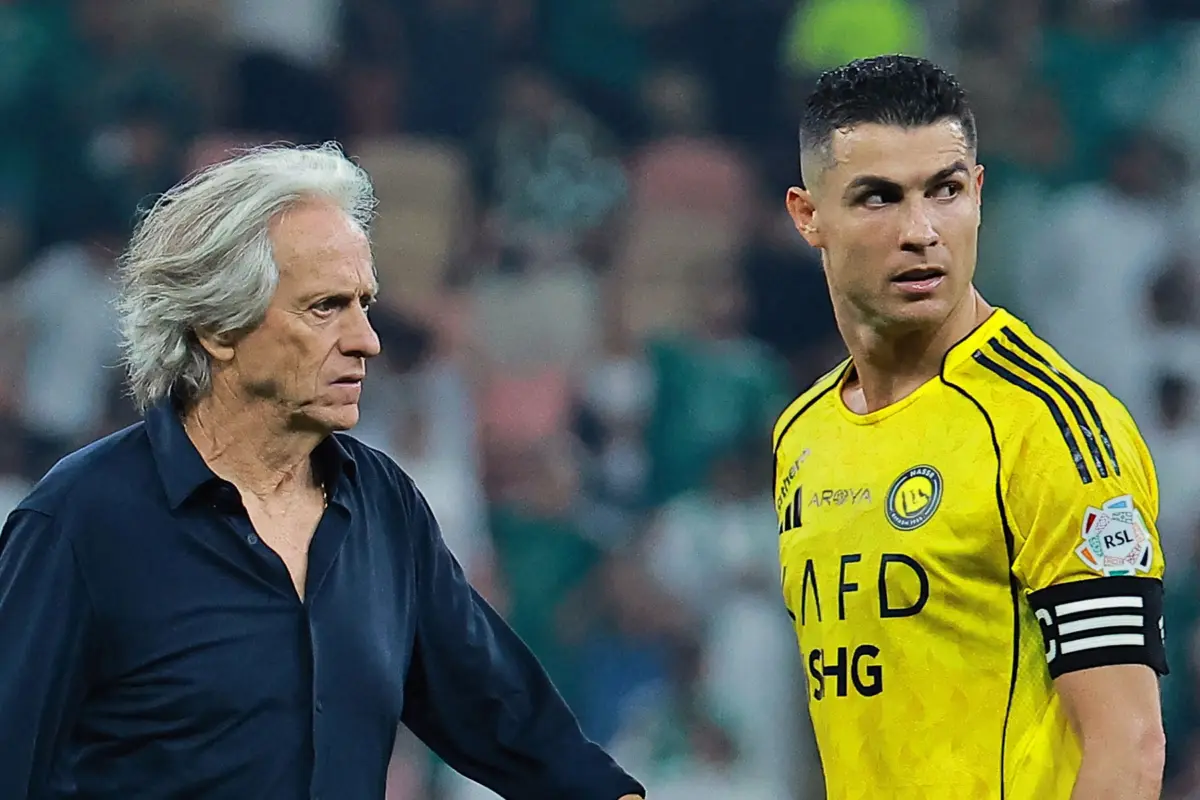
The atmosphere surrounding the Portuguese national football team has taken a sharp turn toward the personal following a heavy defeat in the UEFA Nations League, as head coach Jorge Jesus finds himself embroiled in a public dispute involving the family of the nation’s greatest-ever player. Addressing the media ahead of Portugal’s final group stage fixture against Wales in Cardiff, the 72-year-old tactician expressed a mixture of weariness and defiance when asked to respond to scathing remarks made by Dolores Aveiro, the mother of Cristiano Ronaldo.
The tension follows Portugal’s first significant setback in the post-Ronaldo era: a staggering 4-1 loss to Denmark. The defeat has reignited a fierce national debate regarding the decision to move on from the 41-year-old forward, who recently announced his retirement from international football following a high-profile fallout with Jesus. For the head coach, the shadow of the five-time Ballon d’Or winner remains the primary narrative, overshadowing the team’s tactical evolution and their current standing in the Nations League.
The Catalyst of Conflict: Dolores Aveiro’s Public Intervention
The current friction was sparked by comments from Dolores Aveiro, who has long been a vocal protector of her son’s legacy. Following the 4-1 thrashing at the hands of Denmark, Aveiro took to social media and public channels to express a sense of vindication. She stated that she was "glad" to see Jorge Jesus suffer his first defeat as national team manager, claiming that her son had been "deceived" by the former Benfica and Al-Hilal boss.
When confronted with these remarks during Tuesday’s press conference, Jesus did not hide his frustration. "Now I have to respond to Cristiano Ronaldo’s mother?" he asked rhetorically, signaling his exasperation with the line of questioning. "I don’t know when it is going to stop. If you guys ask the questions, I have to answer. If you ask about Ronaldo next year, I will answer."
The exchange highlighted the immense pressure on Jesus to justify a future without Ronaldo, particularly when results falter. While the coach attempted to pivot the conversation back to the upcoming match against Wales, the narrative of a "betrayed" legend continues to dominate the Portuguese sports press.
A Chronology of the Fallout: From Al-Nassr to Retirement
To understand the current animosity, one must look back at the relationship between Jorge Jesus and Cristiano Ronaldo, which predates Jesus’s appointment as the Portugal head coach. The two worked together at the Saudi Arabian club Al-Nassr, where the initial seeds of discord were reportedly sown. While they initially maintained a professional veneer, reports of tactical disagreements regarding Ronaldo’s role in a high-pressing system began to surface.
The situation reached a breaking point during the September international break in a Nations League fixture against Norway. The timeline of the collapse is as follows:
- September 2026: During a match against Norway, Jesus instructed Ronaldo to warm up early in the second half. Despite the superstar spending a significant amount of time on the touchline, Jesus opted not to introduce him as a substitute.
- Post-Match Accusations: Ronaldo reportedly felt humiliated by the incident, later accusing Jesus of "broken promises" regarding his playing time and his role within the squad as he neared the end of his career.
- The Walkout and Suspension: In a rare display of public dissent, Ronaldo left the team camp prematurely. The Portuguese Football Federation (FPF) subsequently handed the captain a 30-day suspension and a fine for the breach of protocol.
- The Retirement: Although an apology was issued and a return was expected for the November fixtures, Ronaldo instead chose to "bring down the curtain" on his 23-year international career, citing a desire to focus on his final years in club football and a lack of alignment with the current coaching staff.
Ronaldo’s departure ended an era of unprecedented individual success. He left the international stage with a world-record 234 appearances and 146 goals, figures that cemented his status as a global icon but also created a vacuum that Jorge Jesus is now struggling to fill.
Statistical Analysis: Life Without the Talisman
Prior to the Denmark defeat, the "Jorge Jesus era" had actually begun with significant promise. Portugal secured four consecutive victories in the Nations League, playing a brand of football that focused on collective pressing and fluid movement—traits that critics often argued were hindered by Ronaldo’s lack of mobility in his later years.
However, the 4-1 loss to Denmark exposed a lack of leadership and a clinical edge in the final third. The following data points illustrate the transition the squad is currently navigating:
- Goal Distribution: In the four wins preceding the Denmark game, Portugal’s goals were spread across six different players, suggesting a more egalitarian attack.
- Defensive Vulnerability: The four goals conceded against Denmark represented the most goals Portugal has allowed in a single match since the 2022 World Cup cycle.
- The Mobility Argument: Tactical maps from the Denmark game showed a high defensive line that was repeatedly exploited on the counter-attack, leading some analysts to argue that while the team is faster without Ronaldo, they are also more structurally fragile.
Jesus addressed this during his press conference, noting, "After the game against Denmark, everyone is asking me about different individuals, not about the team or winning here. We played one bad game and it’s harder to move on when we have a result like that."
Perspectives from the Opposition: Craig Bellamy’s Assessment
The drama has not gone unnoticed by Portugal’s upcoming opponents. Wales manager Craig Bellamy, speaking to the media in Cardiff, offered a poignant perspective on the situation. Bellamy, who faced Ronaldo several times during his own playing career in the Premier League, noted the irony of the current criticism directed at the Portuguese camp.
"You were all having a go at him for playing, and then as soon as he retires, suddenly it’s all hell breaking loose!" Bellamy remarked. "He is one of the best players that has ever played the game. We’re all going to miss him."
Bellamy’s comments underscore a sentiment shared by many in the international football community: that the transition away from a player of Ronaldo’s stature is rarely a smooth or linear process. For Wales, the absence of Ronaldo represents a tactical relief, even as they sit at the bottom of Group A4 and face relegation from the top tier of the Nations League.
Implications for the Future of Portuguese Football
The immediate task for Jorge Jesus is to secure at least a point in Cardiff. A draw or a win against Wales would ensure Portugal finishes top of Group A4, securing a favorable draw for the knockout stages. However, the broader implications of the "Ronaldo vs. Jesus" narrative could have long-term effects on the team’s morale and the coach’s job security.
The Portuguese Football Federation currently finds itself in a delicate position. While they have publicly backed Jesus and his vision for a modernized, high-tempo squad, the influence of the Ronaldo family and the immense public affection for the former captain cannot be ignored. If the team fails to perform in the upcoming knockout rounds, the narrative of "deception" and "mistreatment" of a national hero will likely intensify.
Furthermore, the "Dolores Aveiro factor" introduces a unique element of public relations pressure. In Portugal, the family of top-tier athletes often holds significant sway over public opinion. By framing the retirement as a result of being "deceived" by the coach, the family has effectively placed the burden of proof on Jesus. Every loss will now be viewed through the lens of what might have been had Ronaldo stayed.
Conclusion: A Search for Identity
As Jorge Jesus prepares his side for the atmosphere of the Cardiff City Stadium, his primary challenge is to forge a new identity for a squad that has been defined by a single individual for over two decades. The 72-year-old coach is a veteran of the game, known for his tactical discipline and his uncompromising personality, but even he seems taken aback by the persistence of the Ronaldo ghost.
The match against Wales is more than just a quest for a Nations League point; it is an opportunity for the "new" Portugal to prove that the Denmark result was an anomaly rather than a symptom of a deeper crisis. For Jesus, the goal is clear: to make the football the story again. Whether the Portuguese public and the media are ready to let go of the Ronaldo era, however, remains to be seen. As Jesus himself noted, the questions are likely to continue well into next year, and perhaps as long as he remains in the dugout.
