

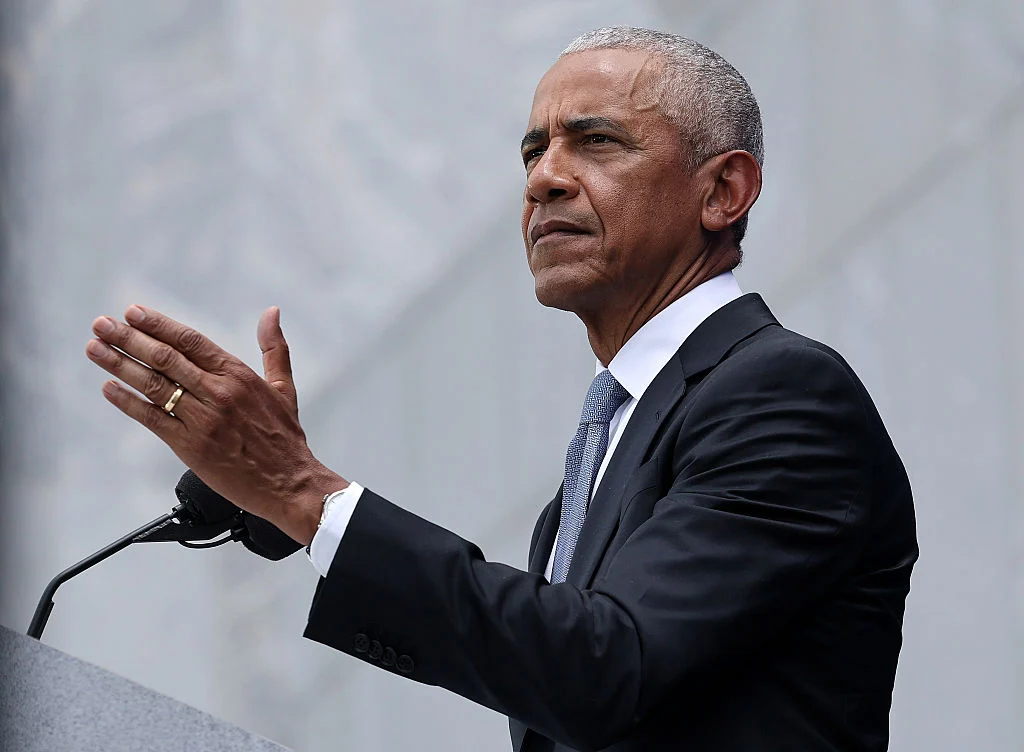
Former President Barack Obama has signaled a significant shift in the Democratic Party’s policy priorities, urging leadership to place artificial intelligence at the heart of their legislative and campaign platforms. During a high-profile Democratic fundraising event held on Thursday, September 10, 2026, the 44th president emphasized that the rapid evolution of AI technology necessitates a "central agenda" and a "very clear plan" to mitigate potential economic disruptions and existential safety risks. The event, which featured a candid interview conducted by House Minority Leader Hakeem Jeffries, highlights a growing urgency within the party to address the dual-edged nature of silicon-based intelligence as it moves from experimental stages to deep integration within the global economy.
According to a partial transcript provided by the former president’s office, Obama’s remarks were prompted by a direct inquiry from Jeffries regarding the appropriate congressional response to the current AI trajectory. Obama’s stance is rooted in the belief that the window for meaningful government intervention is closing as the technology remains largely in the "private hands" of a few massive tech conglomerates. He warned that if the public sector fails to "get on top of" the issue, the consequences could be "dangerous," though he balanced this caution with optimism regarding AI’s potential to revolutionize fields such as healthcare and biotechnology.
The Push for a Public Framework and Legislative Action
In his dialogue with Jeffries, Obama argued that the first order of business for Democrats, should they regain a majority in the House of Representatives, must be the establishment of a robust framework for a "very public conversation." This approach suggests a departure from the closed-door negotiations that have characterized much of the tech policy landscape over the last decade. By bringing AI safety and economic impact into the public square, Obama believes the government can build a mandate for regulation that reflects broader societal values rather than just the interests of Silicon Valley stakeholders.
The former president’s focus on the "speed" of AI development reflects a wider concern among policy experts that legislative bodies are ill-equipped to keep pace with exponential technological growth. "This is something that is moving very fast," Obama noted, emphasizing that the lack of oversight could lead to unintended systemic failures. However, he was quick to highlight the upside of the technology, specifically citing drug development. He posited that AI-driven research could accelerate the curing of diseases at a pace previously thought impossible, provided the guardrails are sufficient to prevent misuse or biological security breaches.
House Minority Leader Hakeem Jeffries echoed these sentiments in a follow-up statement, reinforcing the idea that AI regulation is a matter of national importance that has been neglected by current leadership. Jeffries was pointed in his criticism of the opposing party, stating that "Republicans have abdicated their responsibility to govern on behalf of the American people" regarding technological oversight. This rhetoric sets the stage for AI to become a primary wedge issue in the upcoming election cycles, with Democrats positioning themselves as the party of "responsible innovation" and Republicans focusing on "deregulatory dominance."
A Timeline of Growing Concern: From Innovation to Resignation
The call for a central AI agenda comes at a precarious moment for the industry. While 2024 and 2025 saw a massive influx of capital into generative AI and large language models (LLMs), 2026 has been marked by a series of internal alarms raised by the very scientists building these systems. The backdrop to Obama’s comments includes a significant controversy at Anthropic, a leading AI safety and research company.
On September 9, 2026, just days before the fundraising event, a prominent AI researcher resigned from Anthropic, issuing a stark warning that resonated across the industry. The researcher claimed that the sector is "racing straight to self-improving superintelligence" and characterized the current competitive landscape as "gambling with our lives." This resignation has fueled a debate over whether the current "safety-first" culture of companies like Anthropic is being eroded by the pressure to keep up with rivals like OpenAI and Google.
In response to these internal and external pressures, Anthropic CEO Dario Amodei released a comprehensive proposal on Saturday, September 12, aimed at "pacing the frontier." The plan suggests a middle ground between total deregulation and a full moratorium on development. Key pillars of Amodei’s plan include:
- Independent Evaluators: Granting third-party safety experts "employee-like access" to internal models and data to conduct rigorous stress tests.
- Common Safety Standards: Establishing a unified set of safety protocols that all major AI firms must adhere to, preventing a "race to the bottom" where companies cut corners to gain market share.
- Paced Deployment: Slowing the release of new models until specific safety benchmarks are met and verified by external bodies.
The industry reaction to Amodei’s proposal has been surprisingly positive. Sam Altman, CEO of OpenAI, expressed support for the initiative on social media, stating that OpenAI would commit to the independent evaluator model. Even Elon Musk, CEO of SpaceX and xAI, who has frequently been a vocal critic of his competitors’ approaches, signaled a rare moment of alignment with the "pacing" strategy.
The Republican Counter-Strategy: Sovereignty and Preemption
While Democrats move toward a framework of public oversight and safety-centric regulation, the Republican approach, led by former President Donald Trump, focuses on maintaining American hegemony in the AI race. Speaking at a golf event in Ireland on Sunday, September 13, Trump dismissed much of the safety-related anxiety as the work of "negative forces."
Trump’s vision for AI is centered on the geopolitical competition with adversaries, particularly China. "Whoever wins AI wins," Trump told reporters, emphasizing that the United States must remain the "most sophisticated country in the world" at any cost. This "America First" AI strategy was formalized earlier in 2026 when the Trump administration released a legislative framework designed to streamline development.
The Republican framework is notable for two primary reasons:
- Federal Preemption: It seeks to preempt state-level AI laws, such as those passed in California and New York, which have attempted to impose stricter safety and transparency requirements on tech companies. This move is intended to create a single, less restrictive federal standard that allows companies to scale without navigating a "patchwork" of state regulations.
- Shifted Responsibility: The framework shifts the burden of child safety and digital literacy from the platforms to parents, a move that has drawn sharp criticism from consumer advocacy groups and Democratic lawmakers.
Trump’s comments suggest that while he acknowledges the possibility of "guardrails," his priority remains the speed of innovation. This creates a clear ideological divide: the Democratic plan emphasizes the "safety and economic impact" on the individual and society, while the Republican plan emphasizes the "national security and economic dominance" of the United States as a whole.
Economic Implications and the Future of Labor
A central component of Obama’s proposed "central agenda" is the economic impact of AI. Economists have warned that the current wave of automation is fundamentally different from the industrial or digital revolutions of the past. While those eras primarily replaced manual labor, AI has the potential to displace cognitive labor, affecting sectors ranging from law and finance to software engineering and creative arts.
Data from recent 2026 labor reports suggest that nearly 35% of entry-level white-collar roles have seen a reduction in hiring as companies integrate autonomous agents. Obama’s call for a "clear plan" likely involves exploring policies such as universal basic income (UBI) pilots, expanded job retraining programs, and potential taxes on automated labor—ideas that have gained traction among the progressive wing of the Democratic Party but remain contentious in the mainstream.
Furthermore, the "drug development" benefits mentioned by Obama represent a multi-billion-dollar shift in the pharmaceutical industry. AI-driven protein folding and molecular simulation have already cut the time for drug discovery from years to months in several pilot programs. However, the commercialization of these breakthroughs remains a point of contention. Democrats are expected to push for provisions that ensure AI-discovered life-saving drugs remain affordable and accessible, rather than becoming high-priced monopolies for the tech-pharma giants.
Analysis of Global and Domestic Policy Trajectories
The intervention by Obama marks a turning point in the politicalization of artificial intelligence. By framing it as a "central agenda," the former president is signaling to donors and voters that AI is no longer a niche technical issue but a foundational pillar of modern governance.
The "sounding board" role that Obama has played for CEOs like Amodei and Altman suggests that the former president is positioning himself as a bridge between the technical elite and the political establishment. His involvement provides a layer of political legitimacy to the industry’s self-regulation efforts, while his public comments simultaneously demand more rigorous government oversight.
The conflict between federal preemption and state-led safety measures will likely be the first major legal battleground. If the Republican framework succeeds in preempting state laws, it would effectively neutralize the "California effect," where the strictest state laws often become the de facto national standard. Conversely, if Democrats regain the House and implement the "public conversation" framework Obama envisions, the US could see the creation of a new federal agency—a Department of AI—dedicated specifically to the licensing and monitoring of frontier models.
As the 2026 election cycle approaches, the divide is clear. One side views AI as a tool that must be tamed and socialized to prevent catastrophe and ensure equity, while the other views it as an engine of national power that must be unleashed to ensure global dominance. Obama’s recent comments ensure that for the Democratic Party, the debate over the future of intelligence will be conducted in the center of the political stage.
