

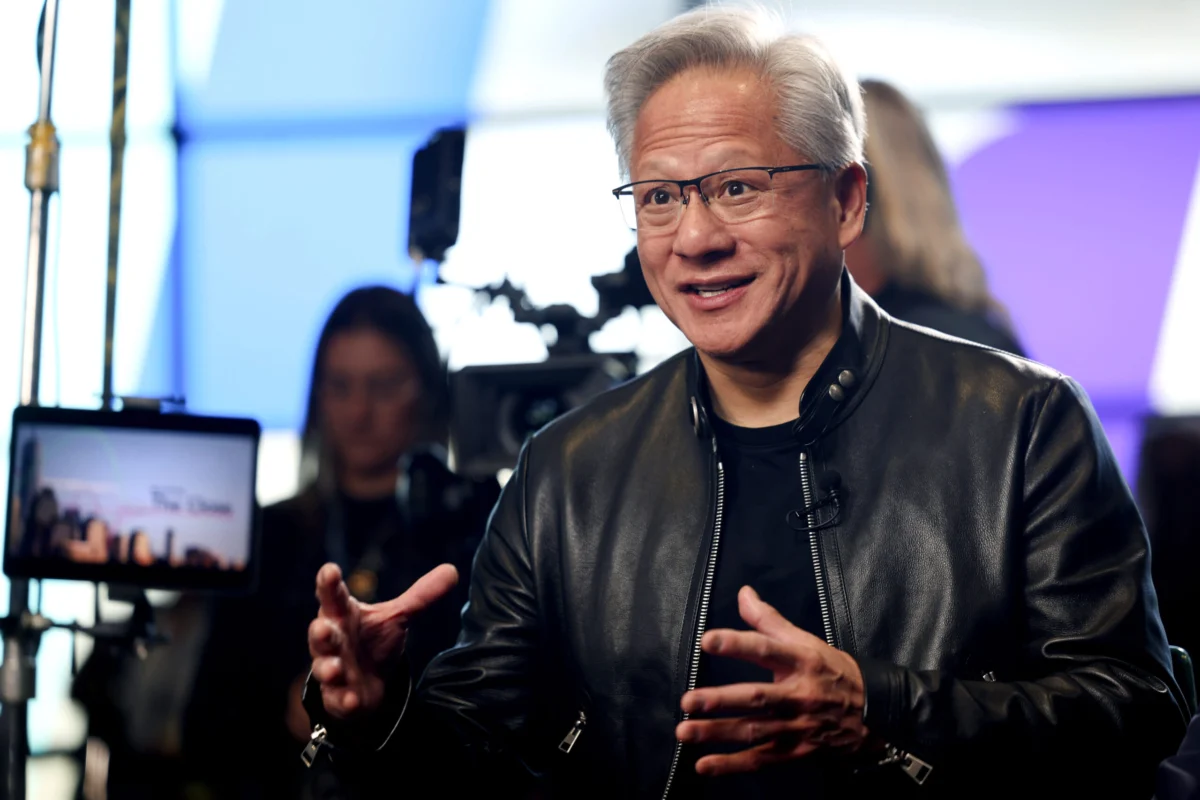
Nvidia founder and Chief Executive Officer Jensen Huang has formally acknowledged that the Silicon Valley giant has largely ceded its once-dominant position in the Chinese artificial intelligence semiconductor market to domestic rival Huawei. This admission comes as a direct consequence of escalating United States export controls that have fundamentally reshaped the global technology sector, forcing a strategic "evacuation" of one of the world’s most lucrative markets for high-end computing hardware. Despite this significant geopolitical setback, Nvidia continues to report record-breaking financial results, driven by insatiable global demand for AI infrastructure, even as the company advises its investors to expect no near-term recovery of its business within mainland China.
The shift in the competitive landscape was highlighted during Nvidia’s latest quarterly earnings call and subsequent public commentary, where the company reported a staggering 85% year-over-year surge in revenue, reaching $81.62 billion compared to $44.06 billion during the same period in the previous fiscal year. While these figures underscore Nvidia’s role as the primary architect of the global AI revolution, the "China gap" remains a poignant reminder of the friction between national security policy and international commerce. Huang’s comments suggest a pragmatic acceptance of the new status quo, noting that the vacuum left by Nvidia is being rapidly and effectively filled by Huawei and a burgeoning ecosystem of local Chinese chipmakers.
The Financial Performance and the China Disconnect
Nvidia’s fiscal performance for the first quarter of 2027 has defied even the most optimistic market expectations. The company’s revenue of $81.62 billion was bolstered by an unprecedented demand for its Data Center products, which now form the backbone of generative AI training and inference for cloud service providers and sovereign nations alike. In addition to the revenue growth, Nvidia announced a massive $80 billion share buyback program and a significant increase in its dividend, signaling immense confidence in its cash flow and long-term trajectory.
However, the shadow of China loomed large over the financial success. Historically, the Chinese market accounted for approximately 20% to 25% of Nvidia’s total data center revenue. Following the tightening of export licenses by the U.S. Department of Commerce—particularly under the directive issued in April 2026—Nvidia has seen its ability to ship high-performance silicon to the region virtually vanish. The company had previously attempted to navigate these restrictions by developing "trimmed-down" versions of its chips, such as the H20, which were designed to fall just below the performance thresholds set by Washington. Yet, as the regulatory floor continues to rise, even these modified products face uncertain futures.
Huang’s recent dialogue with analysts and media outlets indicates a shift in messaging. Rather than expressing hope for a regulatory breakthrough, he has instructed stakeholders to "expect nothing" regarding the resumption of advanced chip sales to China. By removing China from its growth projections, Nvidia aims to insulate its stock price from the volatility of U.S.-China trade relations, focusing instead on the massive "sovereign AI" movement in Europe, the Middle East, and other parts of Asia.

The Rise of Huawei and the Domestic Ecosystem
The primary beneficiary of Nvidia’s forced retreat is Huawei Technologies. Once primarily known for its telecommunications equipment and smartphones, Huawei has pivoted aggressively toward AI semiconductors through its Ascend line of processors. Huang described Huawei as "very, very strong," noting that the company had experienced a record year and is poised for an "extraordinary" year ahead.
Huawei’s Ascend 910B and 910C chips have become the de facto standard for Chinese tech giants like Alibaba, Tencent, and Baidu, who are no longer able to procure Nvidia’s flagship H100 or Blackwell-series processors in bulk. While industry experts suggest that Huawei still faces challenges regarding software maturity and manufacturing yields—largely due to restrictions on advanced lithography equipment—the sheer necessity of the Chinese market has accelerated the adoption of its ecosystem.
The "evacuation" of the market by Nvidia has created a protected incubator for Chinese semiconductor firms. Beyond Huawei, companies like Biren Technology and Moore Threads are receiving increased domestic investment and policy support. This development represents the realization of Beijing’s long-term goal of semiconductor self-sufficiency, a goal that was arguably accelerated by the very export controls intended to slow China’s technological ascent.
Chronology of Export Restrictions and Diplomatic Efforts
The current state of affairs is the result of a multi-year escalation in trade tensions. The timeline of these restrictions provides critical context for Nvidia’s current predicament:
- October 2022: The U.S. Bureau of Industry and Security (BIS) implements broad controls on the export of advanced computing chips and semiconductor manufacturing equipment to China, targeting Nvidia’s A100 and H100 GPUs.
- October 2023: Regulations are updated to close "loopholes," affecting lower-tier chips and preventing the transshipment of technology through third-party countries.
- April 2026: The Trump administration issues a new directive requiring specific, individual licenses for the export of any high-performance AI silicon to China and several other "countries of concern." This move effectively halts Nvidia’s standard shipping pipelines.
- May 2026: Jensen Huang attends a high-level summit in Beijing during a visit by U.S. President Donald Trump. While the visit was seen as a potential de-escalation point, trade representatives later confirmed that chip export controls were not on the negotiating table.
- Mid-May 2026: Reports emerge that the U.S. Commerce Department granted limited, one-time approvals for specific firms like Alibaba and ByteDance to purchase Nvidia’s H200 chips, though these are viewed as exceptions rather than a change in policy.
Despite being a guest at the Great Hall of the People in Beijing, Huang’s presence did not result in a policy pivot. The U.S. trade representative’s stance remains firm: AI chips are considered dual-use technology with significant military applications, and the priority remains "de-risking" the supply chain rather than facilitating high-tech trade.
The Five-Layer Cake: Nvidia’s New Strategic Framework
To compensate for the loss of the Chinese market and to prepare for a future where Nvidia could be a "many times larger company," Huang has introduced a strategic conceptualization of the AI industry known as the "five-layer cake." This framework illustrates Nvidia’s transition from a mere chip designer to a comprehensive platform provider.

- Energy: Recognizing that AI data centers are massive consumers of power, Nvidia is increasingly involved in optimizing the energy efficiency of its hardware and collaborating on data center power management solutions.
- Chips: This remains the core, with the transition from the Hopper architecture to Blackwell and beyond, maintaining a lead in performance-per-watt.
- Infrastructure: Nvidia is expanding its footprint in networking (through Mellanox) and full-stack rack designs, ensuring that the entire data center operates as a single, cohesive "AI factory."
- Models: Through platforms like DGX Cloud and various software libraries, Nvidia is providing the tools necessary for companies to build and fine-tune large language models (LLMs).
- Applications: The company is moving up the value chain by offering industry-specific AI solutions in healthcare, automotive (autonomous driving), and robotics.
Huang emphasized that the company’s massive cash reserves are being funneled back into the supply chain. "As we’re growing hundreds of billions of dollars at a time, we have to support our supply chain so that they are able to support our growth," Huang stated. This includes multi-billion dollar prepayments to manufacturing partners like TSMC and packaging providers to ensure that Nvidia remains the first in line for the world’s most advanced production capacity.
Implications for the Global AI Race
The "concession" of the Chinese market to Huawei marks a definitive bifurcation of the global technology landscape. We are witnessing the emergence of two distinct AI ecosystems: one centered around Nvidia and Western standards, and another centered around Huawei and Chinese domestic standards.
For Nvidia, the loss of China is currently being masked by the explosive growth in other regions. However, in the long term, the presence of a well-funded, highly motivated competitor like Huawei—operating in a massive, captive market—could eventually lead to a challenge on the global stage. If Huawei can refine its AI software stack (CANN) to rival Nvidia’s CUDA, it may begin to find customers in non-aligned markets in the Global South.
For the United States, the policy is a gamble. While it successfully restricts China’s access to the most advanced Western silicon in the short term, it has removed the "incumbency advantage" that Nvidia once held. By forcing Chinese firms to use domestic hardware, the U.S. has inadvertently created the very market conditions necessary for Huawei to achieve the scale required to innovate.
Conclusion and Future Outlook
Jensen Huang’s admission that Nvidia has "largely conceded" the Chinese market is a rare moment of corporate candor that reflects the gravity of current geopolitical realities. Nvidia is a company at its zenith, boasting financial metrics that are the envy of the corporate world, yet it is simultaneously a company that has been forced to abandon one of its foundational growth engines.
As Nvidia pivots toward its "five-layer cake" strategy and doubles down on its supply chain, the tech world will be watching to see if the rest of the world’s demand can continue to outpace the lost potential of the Chinese market. For now, the message to investors is clear: Nvidia’s future is being built without China, and the "extraordinary year" predicted for Huawei suggests that the semiconductor iron curtain has officially descended. The global AI race has entered a new, more fragmented chapter, where the battle for silicon supremacy is as much about geography and diplomacy as it is about transistors and flops.
