

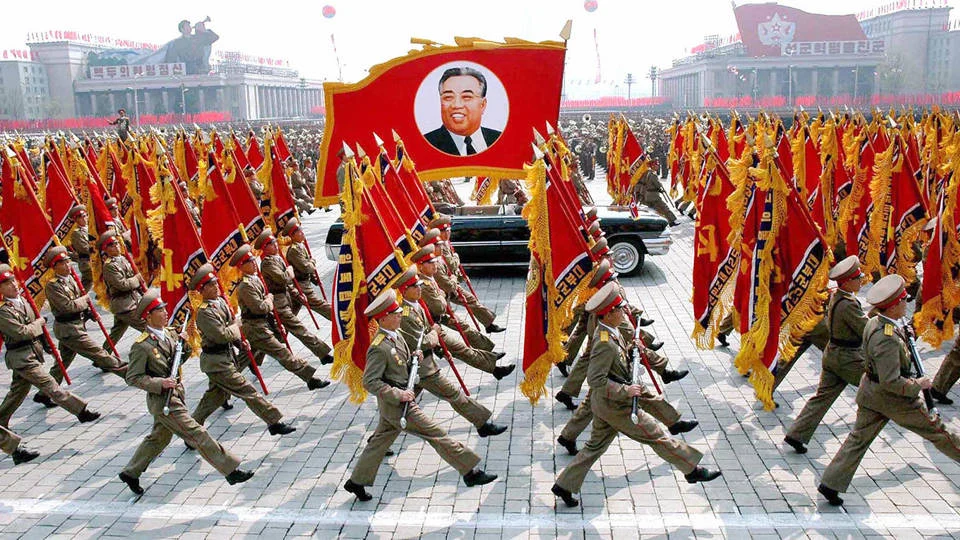
North Korea’s communist regime has long functioned as a faith, repurposing Christian doctrine and imagery to deify its founder, Kim Il-sung, and his descendants. A new book traces how those religious influences transformed the Kim dynasty’s personality cult into a system that has endured across three generations. This analysis delves into the intricate fusion of ideology, propaganda, and quasi-religious fervor that underpins the North Korean state, examining its historical roots, current manifestations, and potential implications for regional stability, particularly in light of recent diplomatic overtures.
The Genesis of a Divine Dynasty: Early Influences and Ideological Synthesis
The seeds of North Korea’s unique ideological landscape were sown in the crucible of Japanese colonial rule and the subsequent division of the Korean peninsula. Kim Il-sung, the nation’s founder, emerged as a charismatic leader with a vision of national salvation. While officially espousing Marxist-Leninist principles, his regime strategically incorporated elements that resonated deeply with Korean cultural and historical sensibilities, including Confucianism and, ironically, Christian symbolism.
Early Christian missionaries had a significant presence in Korea during the late 19th and early 20th centuries. While their primary goal was evangelization, their activities inadvertently contributed to a societal awareness of certain Christian tenets and imagery. Kim Il-sung and his inner circle, astute in their understanding of mass psychology and cultural underpinnings, began to adapt and repurpose these familiar concepts to serve their political agenda.
The concept of a divine savior, a central tenet in Christianity, was readily transferable to the deification of Kim Il-sung. He was presented not merely as a political leader but as a paternal figure, a benevolent god-king who had liberated the Korean people from oppression and would guide them to a utopian future. This narrative was meticulously crafted through omnipresent propaganda, educational curricula, and public rituals designed to instill an almost unquestioning reverence.
From Personality Cult to Enduring System: The Role of "Juche" and Religious Tropes
The philosophical underpinnings of North Korea’s ideology, most notably the concept of "Juche" (self-reliance), were developed and propagated to further solidify the Kim dynasty’s authority. While Juche is ostensibly a political and economic doctrine emphasizing self-sufficiency, its implementation has taken on a distinctly quasi-religious character.
Key elements of this religious metamorphosis include:
- Theology of the Leader: Kim Il-sung was posthumously declared "Eternal President," a title that evokes a sense of perpetual divine presence. His teachings are treated as infallible scripture, and his biography reads as a hagiography, replete with miraculous events and unwavering moral rectitude.
- Sacred Texts and Rituals: The writings and speeches of Kim Il-sung and his successors are considered sacred texts, studied intensely and recited in unison. Public gatherings often resemble religious services, with fervent pronouncements of loyalty and devotion. The veneration of portraits and statues of the leaders mirrors the veneration of religious icons.
- Symbolism and Imagery: The regime has liberally borrowed and adapted Christian symbolism. The concept of resurrection, for instance, is subtly evoked in narratives of Kim Il-sung’s enduring legacy. The idea of a chosen people, guided by a divine leader, resonates with the sense of exceptionalism often projected by North Korea. While the regime actively suppresses organized Christianity within its borders, it has effectively co-opted its symbolic language to bolster its own mythos.
- Intergenerational Succession: The hereditary transfer of power from Kim Il-sung to his son Kim Jong-il, and subsequently to his grandson Kim Jong-un, has been framed not as dynastic succession but as the continuation of a divinely ordained lineage. This has created a unique form of political religiosity, where loyalty to the leader is paramount and inextricably linked to national identity.
A new book, detailed in the provided content, specifically examines how these religious influences have been instrumental in transforming the Kim dynasty’s personality cult into a robust and enduring system. By understanding the psychological and cultural mechanisms at play, the book offers critical insights into the longevity of this unique political structure.
Geopolitical Repercussions: Trump’s Diplomacy and Regional Instability
The provided snippet of news from August 21, 2026, highlights a critical juncture in North Korea’s relationship with the United States and its impact on regional dynamics. US President Donald Trump’s efforts to re-engage with North Korean dictator Kim Jong-un, marked by the curtailment of joint military exercises with South Korea, have generated significant concern.
This strategic shift by the Trump administration has been interpreted in several ways:
- Strain on US-South Korea Relations: The decision to scale back joint military drills, a cornerstone of the US-South Korea alliance for decades, has inevitably caused friction. South Korea relies on these exercises for deterrence and interoperability with its most crucial security partner. The perceived unilateralism of this decision has led to anxieties within Seoul about the reliability of US security commitments.
- Perception of US Unpredictability: Across Asia, the Trump administration’s foreign policy has often been characterized by unpredictability. This latest move, while potentially aimed at de-escalating tensions with North Korea, risks reinforcing the perception that the US is an unreliable ally, potentially undermining regional alliances built on mutual trust and predictable security guarantees.
- Empowering Kim Jong-un: The curtailment of military exercises is likely to be viewed by Kim Jong-un as a significant concession and a sign of US willingness to negotiate on his terms. This could embolden his pursuit of greater strategic independence, not only from the US but also from China.
China’s Strategic Calculus: A Delicate Balancing Act
Even Chinese President Xi Jinping, a key regional player, is likely to view these developments with apprehension. While China seeks stability on its doorstep, a perceived weakening of US influence and a more assertive North Korea could present new challenges.
Kim Jong-un’s interpretation of Trump’s move as empowering his quest for independence from China suggests a deepening of his strategic autonomy. This could manifest in several ways:
- Reduced Chinese Leverage: As North Korea becomes less reliant on Chinese military support due to diminished US-South Korea drills, Beijing’s ability to influence Pyongyang’s behavior may diminish.
- Increased Regional Tensions: A more emboldened North Korea, less constrained by US military presence, could pursue more aggressive policies, potentially leading to increased tensions on the Korean peninsula and in the broader East Asian region.
- Shifting Alliances: The evolving geopolitical landscape might prompt other regional actors to reassess their alliances and security strategies, potentially leading to new alignments and increased regional competition.
Background Context: A History of Diplomacy and Provocation
The period leading up to August 2026 has been marked by a complex interplay of diplomatic engagement and North Korean provocations. Following a period of heightened tensions and nuclear brinkmanship in previous years, President Trump initiated a series of high-profile summits with Kim Jong-un, aiming for denuclearization.
- June 2018, Singapore Summit: The first summit between Trump and Kim resulted in a vague agreement on denuclearization, but concrete steps proved elusive.
- February 2019, Hanoi Summit: A second summit in Hanoi collapsed without an agreement, highlighting the deep divisions over the sequencing and scope of denuclearization and sanctions relief.
- Subsequent Engagements: Despite the Hanoi setback, intermittent diplomatic channels remained open, often punctuated by North Korean missile tests and other provocations, leading to a cycle of engagement and de-escalation.
The decision to curtail joint military exercises in August 2026 can be seen as a continuation of Trump’s unconventional diplomatic approach, seeking to break deadlocks through novel gestures. However, critics argue that such moves, without commensurate steps from North Korea, risk undermining deterrence and emboldening the regime.
Supporting Data and Analysis: The "Juche" System’s Resilience
The enduring nature of the Kim dynasty’s personality cult is a subject of considerable academic and intelligence analysis. Data points that underscore its resilience include:
- Longevity of the Regime: The Kim dynasty has ruled North Korea for over 70 years, a remarkable feat for a communist regime in a post-Cold War world. This longevity is directly attributable to the effectiveness of its ideological control and the pervasive nature of its personality cult.
- Economic Sanctions and State Control: Despite extensive international sanctions aimed at crippling its economy and forcing denuclearization, the North Korean state has largely maintained its grip on power. This suggests a high degree of internal cohesion, albeit enforced through severe repression. The regime’s ability to weather economic storms is a testament to its centralized control and its capacity to mobilize its population through ideological fervor.
- Information Control: North Korea operates one of the most tightly controlled information environments in the world. Access to external media is severely restricted, and the state-controlled media disseminates a constant stream of propaganda reinforcing the divine status of the leadership and the existential threat posed by external enemies.
- Public Rituals and Displays of Loyalty: The omnipresent public displays of loyalty, from mass rallies to mandatory study sessions of the leaders’ works, serve to constantly reinforce the cult of personality and suppress any potential dissent. These rituals are not merely performative; they are integral to the maintenance of social order and ideological conformity.
Official Responses and Expert Opinions
While specific official statements from South Korea and China regarding the August 2026 military exercise curtailment are not detailed in the provided snippet, their likely reactions can be inferred from historical patterns and strategic interests.
- South Korea: Seoul would likely express concerns about the impact on readiness and the alliance’s credibility, while simultaneously emphasizing the continued commitment to its own defense and the alliance with the US. Diplomatic reassurances would be sought from Washington.
- China: Beijing would likely issue statements calling for de-escalation and the resumption of dialogue, while potentially expressing quiet unease about the shifting balance of power and the potential for increased North Korean assertiveness. China’s primary interest remains regional stability, which can be jeopardized by a more unpredictable North Korea.
Experts on North Korea have offered varied perspectives on Trump’s diplomatic gambits. Some argue that unconventional approaches are necessary to break through the regime’s entrenched positions. Others contend that such concessions without concrete denuclearization steps risk legitimizing Kim Jong-un’s regime and undermining long-standing deterrence strategies. The book mentioned in the article likely provides a nuanced perspective on these dynamics, linking the regime’s ideological resilience to its continued international maneuvering.
Broader Impact and Implications: The Future of the Korean Peninsula
The intertwined nature of North Korea’s "faith-based" regime and the current geopolitical landscape presents a complex set of implications for the future of the Korean Peninsula and Northeast Asia.
- Continued Nuclear Ambitions: The perceived success of Kim Jong-un in extracting concessions without significant denuclearization progress could further entrench his nuclear weapons program. The regime views its nuclear arsenal as the ultimate guarantor of its survival, a belief deeply intertwined with its ideological narrative of self-reliance and defiance against perceived external threats.
- Risk of Miscalculation: A reduction in joint military exercises, coupled with an emboldened North Korea, increases the potential for miscalculation and unintended escalation. The delicate balance of deterrence could be disrupted, leading to heightened tensions and a greater risk of conflict.
- The Role of Ideology in Diplomacy: Understanding the quasi-religious underpinnings of the North Korean regime is crucial for effective diplomacy. Negotiations that fail to account for the deep-seated ideological convictions and the symbolic importance of leadership deification are likely to be met with limited success.
- The Long-Term Challenge of Denuclearization: The enduring nature of the Kim dynasty’s personality cult and its ideological insulation present a formidable challenge to any long-term strategy for denuclearization. Until the fundamental nature of the regime’s self-perception and its security calculus are addressed, the path to a denuclearized Korean Peninsula will remain fraught with difficulty.
In conclusion, the analysis of North Korea’s "faith-based" regime, as explored in the referenced book and illuminated by current events, reveals a deeply entrenched system where religious influences have been masterfully woven into the fabric of political power. The deification of the Kim dynasty, far from being a mere propaganda tool, has become the bedrock of national identity and the engine of state resilience. As geopolitical dynamics continue to shift, understanding these deeply ingrained ideological and religious currents is not merely an academic exercise but a critical necessity for navigating the complex and often volatile future of the Korean Peninsula.
