

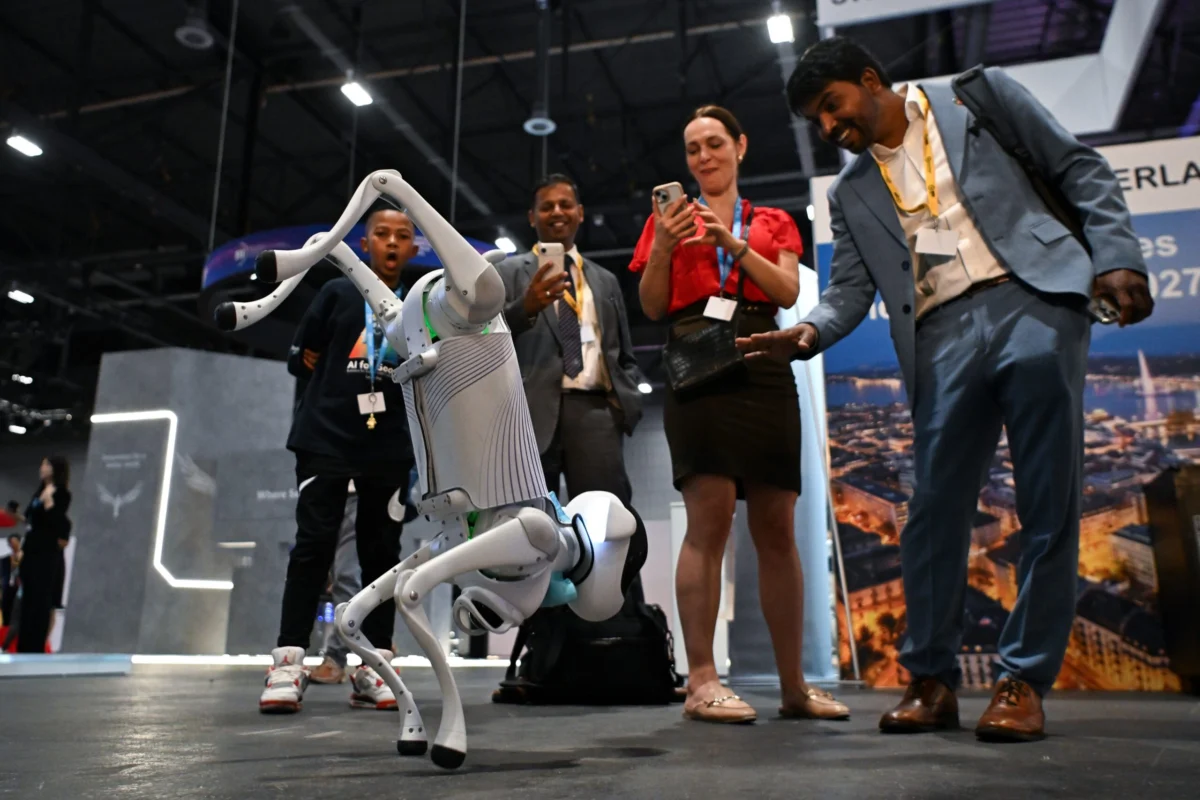
Against the backdrop of Geneva’s sprawling airport district, the 106,000-square-meter convention center transformed into a bustling microcosm of the global technological zeitgeist. Inside, the atmosphere was a sensory overload of high-tech optimism and humanitarian urgency: live onstage coding sessions, AI refresher courses, and an obstacle course of gizmos. Attendees navigated the halls wearing glowing green silent-disco-style headphones, which broadcast UN panel discussions directly into their ears, while others sought a moment of respite in the "Networking Zone." There, participants gathered on a rotating seating contraption known as UFOTECH—a device that resembled a Chinese restaurant’s lazy Susan more than a traditional piece of office furniture.
This was the scene at the 10th annual AI for Good Summit, an event organized by the United Nations’ International Telecommunication Union (ITU). The summit serves as a primary global platform where representatives from the private and public sectors attempt to solve a singular, daunting puzzle: how to harness artificial intelligence for the benefit of humanity rather than its detriment. While the halls of Washington D.C. are currently filled with Silicon Valley executives testifying about the existential risks of superintelligence, and the White House implements stringent export controls on advanced semiconductors, the Geneva summit remains tethered to a more idealistic, albeit increasingly contested, vision of the future.
The Mandate of the ITU and the Vision of "Good"
The International Telecommunication Union, as the UN’s specialized agency for information and communication technologies, has spent a decade positioning itself as the bridge between rapid innovation and global equity. Doreen Bogdan-Martin, the Secretary-General of the ITU, opened the summit with a keynote that underscored the organization’s foundational belief. She stated that artificial intelligence, if deployed with responsibility and foresight, could be the catalyst for solving the most intractable problems facing the species, from eradicating hunger and curing chronic diseases to mitigating the catastrophic effects of a warming planet.
However, Bogdan-Martin also acknowledged that the utopian promise of AI is currently undergoing its most rigorous test. The challenges are no longer theoretical; they are manifesting in real-time as the technology is deployed across diverse and often unequal landscapes. The central question permeating the conference was not whether AI is "good" in the abstract, but what "good" looks like when filtered through the lenses of different cultures, economies, and political systems.
The Growing Divide: Infrastructure and the Compute Economy
A significant portion of the summit’s discourse focused on the "politics of infrastructure." In the current global economy, access to AI is not merely a matter of downloading software; it is a matter of "compute"—the massive processing power required to train and run large-scale models. This has created a new form of digital divide, where a "compute economy" is emerging that threatens to leave poorer nations dependent on a handful of corporate entities and foreign superpowers.
Syed Munir Khasru, chairman of the Institute for Policy, Advocacy, and Governance, argued during a session on hardware that compute should no longer be viewed as a private commodity but as essential development infrastructure. He noted that if the goal is truly "AI for all," then the international community must treat processing power with the same level of urgency as it treats access to water or electricity.
The data supporting this concern is stark. Currently, the vast majority of the world’s high-end AI chips and data centers are concentrated within the United States and China. This geographic centralization has led to a linguistic and cultural bias in AI development. Most large language models (LLMs) remain structured around English and Western data sets. Speakers at the summit emphasized that if AI is to serve communities in the Global South, there must be a concerted effort to develop smaller, local LLMs that can run on cheaper, more accessible hardware.
The End of the "Age of Innocence"
For many humanitarian advocates attending the summit, the tech industry’s polished, utopian veneer is beginning to crack. Giulio Coppi, a senior humanitarian officer at the campaign group Access Now, delivered a pointed critique of the relationship between the public sector and Big Tech. Speaking on the sidelines, Coppi suggested that the humanitarian world must move out of its "age of innocence."
Coppi’s criticism focused on what he described as a decade of opaque, multimillion-dollar deals funded by public money, where humanitarian organizations have become overly reliant on proprietary technology stacks they do not fully understand or control. "You can’t even explain what’s inside your tech stack, because it has kept changing," he warned, suggesting that the "best friend" relationship between tech giants and NGOs often lacks the necessary transparency and accountability.

This tension between corporate interests and humanitarian needs was further highlighted by a dramatic disruption during a keynote by Amazon Chief Technology Officer Werner Vogels. Pro-Palestine activists stormed the stage, alleging that Amazon’s technology is being utilized in ways that harm Palestinians. Though the protesters were eventually removed, the incident served as a visceral reminder that AI is not a neutral tool; it is an instrument of power that is already being deployed in theaters of conflict.
The Engineering Challenge: Defining "Good" in Code
While policymakers discussed ethics, the engineers present at the summit raised more practical concerns. Vijay Janapa Reddi, an engineering professor at Harvard University, highlighted a fundamental disconnect between high-level policy goals and the realities of software development. He argued that "good" is too vague a standard for an engineer to build against.
"When you’re an engineer, good means nothing," Reddi explained. "I can’t build you something that is good. A plane that flies for five minutes ain’t no good." His point was clear: without verifiable, technical standards and clear metrics for safety and efficacy, "AI for Good" remains a slogan rather than a blueprint.
Gilles Thonet, deputy secretary-general of the International Electrotechnical Commission (IEC), echoed this sentiment, noting that engineers have traditionally viewed human rights as the domain of lawyers and politicians. However, Thonet argued that as AI becomes integrated into every facet of human life, engineers must accept that human rights are now a fundamental part of the technical architecture they design.
From Governance Theater to Technical Enforcement
To bridge the gap between abstract principles and real-world application, several experts called for the creation of "middleware"—a connective layer of technology and policy that translates human rights principles into verifiable technical enforcement. Anja Kaspersen, director of global markets development at IEEE, pointed out that the most consequential decisions regarding AI are often hidden within technical standards and procurement choices rather than being debated in public assemblies.
Jeremy Ng, counsel for AI and the digital economy at the World Bank, added that AI impact assessments must evolve from "governance theater"—a box-ticking exercise for tech giants—into practical tools with actual regulatory teeth. This would require a level of international cooperation that has thus far proven elusive, especially as the U.S. and China continue to engage in a "chip war" that sees export controls used as a primary tool of foreign policy.
A New Framework for Action: The Global Commission
Despite the criticisms of "all talk and no action," the UN utilized the summit to launch a concrete initiative: the formation of a 44-member Global Commission on AI for Good. Co-chaired by Rwandan President Paul Kagame and Salesforce CEO Marc Benioff, the commission is designed to shepherd the transition from discussion to implementation.
Doreen Bogdan-Martin emphasized that no single stakeholder—be it a government, a corporation, or an international body—can shape the future of AI in isolation. The commission aims to create a multi-stakeholder approach that includes voices from the Global South, ensuring that the technology’s development is not dictated solely by the world’s richest markets.
Conclusion: The Race Against the Machine
As the summit concluded, a striking image remained for many attendees. On the convention floor, nestled between displays of Tesla Cybertrucks and UN rescue helicopters, a handful of humanoid robots were seen running between the booths. They moved with a speed and fluidity that fascinated and unsettled the human onlookers.
The robots served as a silent metaphor for the current state of the industry: the technology is sprinting ahead at a pace that far outstrips the global consensus on how to regulate it. While the UN and its partners work to define what "good" means in the context of artificial intelligence, the "damn thing," as Professor Reddi called it, is already landing in practice. The challenge for the next decade will be ensuring that the humanity the summit seeks to protect is not left standing still while the machines—and the corporations that own them—race toward an undefined finish line.
