

The global transition toward renewable energy has reached a critical juncture where the height of wind turbines is no longer just a matter of engineering pride but a fundamental requirement for economic viability. As the industry pushes toward higher hub heights to capture more consistent and powerful wind currents, the logistical hurdles of traditional construction have become increasingly prohibitive. Spain-based Nabrawind has emerged as a pivotal player in addressing these challenges through its proprietary Nabralift system, a self-erecting tower technology that eliminates the need for the massive crawler cranes typically required for ultra-tall installations. This innovation has recently moved from the theoretical and prototype stages into large-scale commercial application, bolstered by a significant acquisition by the Australian green energy giant Fortescue and the attainment of critical international certifications.
The Engineering Breakthrough: The Nabralift Self-Erecting System
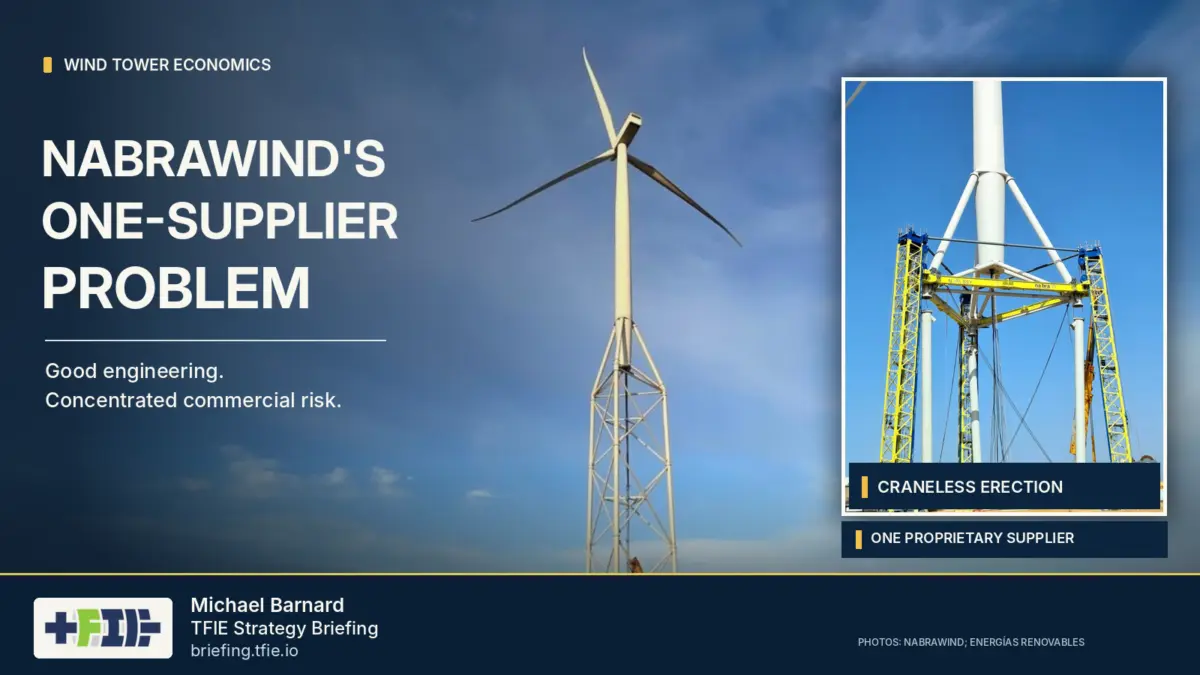
At the heart of Nabrawind’s value proposition is the Nabralift system, a hybrid tower design that combines a traditional tubular upper section with a three-legged steel lattice structure at the base. This design departure from the standard mono-pole configuration allows for a significant reduction in the weight and volume of materials used. More importantly, it facilitates a "jack-up" installation method.
Traditional wind turbine installation requires a crawler crane, some of which are among the largest mobile machines on Earth. These cranes are expensive to mobilize, often costing millions of dollars just to transport to remote sites, and they are highly sensitive to wind speeds. Construction often grinds to a halt if wind speeds exceed 9 to 12 meters per second. Nabrawind’s self-lifting erection system addresses this by using hydraulic equipment integrated into the tower base. The nacelle and the upper tubular sections are assembled at a lower height, and then the entire structure is raised incrementally. As the turbine is lifted, modular steel sections are inserted underneath near ground level.
This methodology allows for installation in wind speeds of up to 15 meters per second, significantly expanding the "weather window" for construction. By performing the majority of the assembly work closer to the ground, the system also enhances safety for technicians and reduces the risk of high-altitude mechanical failures during the lifting phase.
Chronology of Development and Commercialization
The journey of Nabrawind from an innovative startup to a certified industrial provider has been marked by several key milestones. The company first gained international attention with the installation of a 160-meter prototype in Eslava, Spain, in 2018. This project demonstrated that a tower of that height could be erected in less than two weeks, a fraction of the time required for traditional methods at similar heights.
Following the success of the Spanish prototype, Nabrawind expanded its footprint with commercial deployments in Morocco and France. These projects served as "proof of concept" for the international market, showing that the logistics of the modular tower could be managed across borders and varying regulatory environments.
The most significant shift in the company’s trajectory occurred in September 2025, when Fortescue, the global mining and green energy firm led by Andrew Forrest, acquired Nabrawind. This acquisition was a strategic move by Fortescue to secure the technology necessary for its ambitious internal decarbonization goals. Shortly thereafter, in September 2026, the technology reached a new level of maturity when UL Solutions issued a type certification for Envision’s 7.8 MW turbine mounted on Nabrawind’s 188-meter tower. This certification provided the technical assurance required for large-scale commercial deployment and insurance underwriting.

Currently, the technology is being deployed at its largest scale to date at the Nullagine wind project in the Pilbara region of Western Australia. The project features 17 of these 188-meter tower configurations, integrated into a 133 MW wind farm designed to power Fortescue’s extensive mining operations.
Supporting Data: Efficiency and Resource Savings
The engineering advantages of the Nabralift system are supported by substantial data regarding material consumption. In an industry where the cost of raw materials like steel and concrete is a major factor in the Levelized Cost of Energy (LCOE), Nabrawind’s claims are particularly compelling.
According to technical reports from the company, the Nabralift design utilizes approximately 20% less steel than a comparable conventional tubular tower of the same height. Even more striking is the reduction in foundation requirements. Because the three-legged structure distributes loads more efficiently across a wider footprint, the amount of concrete required for the foundation can be reduced by as much as 80% depending on the specific site conditions and soil stability.
These savings have a dual impact. First, they reduce the direct capital expenditure (CAPEX) of the project. Second, they significantly lower the carbon footprint of the wind farm’s construction—a factor of increasing importance as developers look to reduce Scope 3 emissions. In remote locations like the Pilbara, the reduction in concrete is also a major logistical win, as it minimizes the need for water and cement transport in arid, difficult-to-access environments.
The Fortescue Factor and the Nullagine Project
The deployment at the Nullagine wind project represents a unique case study in the commercialization of new energy technology. Because Fortescue owns both the technology provider (Nabrawind) and the end-user (the Nullagine mine), the typical barriers to adopting "first-of-a-kind" technology were largely bypassed.
For Fortescue, the 188-meter towers are essential for the Pilbara’s specific wind profile. In this region, wind speeds are significantly higher and more consistent at nearly 200 meters above ground than they are at the standard 100-to-120-meter heights. By utilizing Nabrawind’s towers, Fortescue can generate more power per turbine, reducing the total number of turbines needed and lowering the overall footprint of the project.
The Nullagine project serves as a "living laboratory." If the 17 turbines are installed on schedule and perform to their rated capacity in the harsh Australian outback, it will provide the most robust evidence yet of the system’s durability and economic performance. However, industry analysts note that this internal success does not automatically guarantee success in the broader third-party market.
Market Challenges and Procurement Risks
Despite the clear engineering benefits, Nabrawind faces significant hurdles in becoming a standard choice for independent power producers (IPPs). The primary concern is "supplier concentration."

In the traditional wind market, tubular towers are a commodity. A developer can source them from dozens of qualified manufacturers globally. If one supplier goes bankrupt or fails to deliver, another can step in. With Nabralift, the technology is proprietary. A developer who chooses this system is tethered to Nabrawind (and by extension, Fortescue) for the core tower components, the specialized lifting equipment, and the long-term maintenance expertise.
For a project to be "bankable," lenders typically require a high degree of certainty regarding the 25-year lifecycle of the asset. This includes:
- Operations and Maintenance (O&M): If a component deep within the three-legged structure fails in year 15, are there third-party contractors capable of fixing it?
- Supply Chain Stability: Does the supplier have the financial health to honor warranties for two decades?
- Interchangeability: Can the turbine be replaced with a different model in the future if the original manufacturer exits the market?
For Nabrawind to capture a larger share of the global market, it may need to move toward a licensing model, where established tower manufacturers are trained and authorized to produce the Nabralift design. This would alleviate fears of a "monopoly" on parts and service.
Broader Impact and Industry Implications
The success of 188-meter towers is a precursor to an even more ambitious goal: the 300-meter wind tower. As the industry looks toward the next decade, reaching heights of 300 meters would allow wind farms to access "jet stream" style winds that are currently untapped by land-based turbines. At such heights, the traditional mono-pole tower becomes physically and economically impossible due to the massive base diameter required for stability.
Nabrawind’s modular, self-erecting approach is currently one of the few viable pathways to reaching those heights. By proving the technology at 188 meters, the company is laying the groundwork for the next generation of ultra-tall wind energy.
Furthermore, the Nabrawind model could change the geography of wind energy. Currently, many regions are deemed "unviable" for wind power because the wind at 100 meters is too weak. However, if 200-meter towers can be installed cheaply and without specialized cranes, thousands of square miles of land could suddenly become prime real estate for renewable energy development.
Conclusion
Nabrawind’s Nabralift system represents a significant shift in how the wind industry approaches the problem of height. By integrating a three-legged structural design with an innovative self-lifting mechanism, the company has addressed the two biggest bottlenecks in the industry: material costs and crane logistics.
The acquisition by Fortescue and the successful certification of the 188-meter tower are major steps forward. However, the true test will be the company’s ability to transition from a proprietary solution for a single industrial giant to a trusted, bankable standard for the global energy market. As the Nullagine project moves toward completion, the wind industry will be watching closely to see if the engineering advantages of the 188-meter tower can overcome the commercial complexities of its unique delivery model. If it succeeds, the horizon of renewable energy may soon sit much higher than ever before.
