

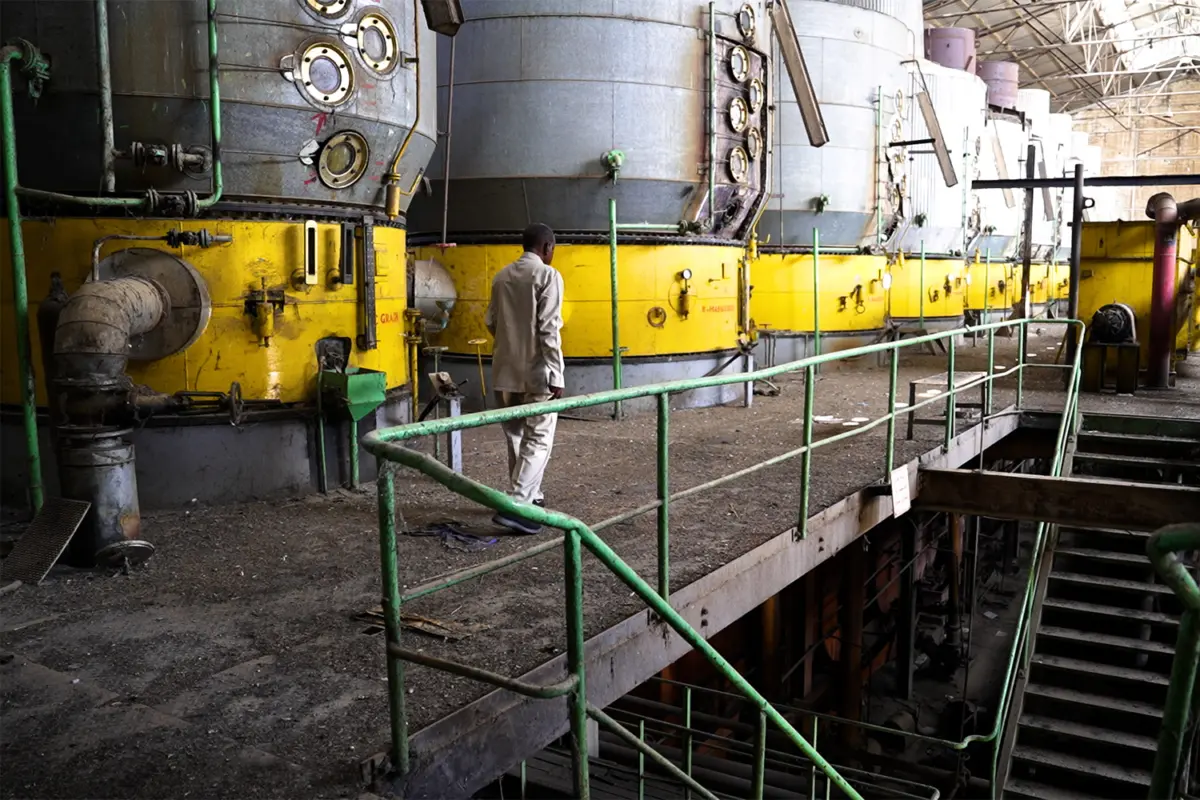
The rhythmic hum of machinery that once defined the industrial districts of Khartoum has been replaced by a haunting silence, occasionally broken by the distant echoes of a conflict that has fundamentally altered the trajectory of the Sudanese nation. For Mansour Gaily, the owner of a prominent sweets factory in the capital, the transition from a thriving entrepreneur to a man surveying the wreckage of his life’s work occurred with terrifying speed. Before April 2023, Gaily’s facility was a cornerstone of the local economy, churning out traditional confectioneries for domestic consumers and providing stable livelihoods for dozens of Sudanese families. Today, he represents the face of a battered industrial class attempting to navigate the precarious path toward economic resurrection in a country still reeling from the scars of civil war.
When the power struggle between the Sudanese Armed Forces (SAF) and the paramilitary Rapid Support Forces (RSF) escalated into full-scale urban warfare in April 2023, the industrial heart of Sudan became a primary battleground. Factories were not merely collateral damage; they became strategic outposts, targets for systematic looting, and casualties of a scorched-earth policy that has decimated the nation’s productive capacity. While the SAF eventually asserted control over the capital by early 2025, the "liberation" of Khartoum did not immediately translate into an economic rebirth. Instead, it revealed a landscape of hollowed-out warehouses and stripped assembly lines.
The Magnitude of Industrial Devastation
The scale of the crisis is quantified in the grim statistics provided by Sudan’s Ministry of Industry. According to official assessments, approximately 1,800 industrial facilities across the country have sustained significant damage during the conflict. Of these, at least 650 factories—representing the backbone of Sudan’s food processing, textile, and consumer goods sectors—have been completely destroyed. The financial toll is equally staggering. Mansour Gaily estimates his personal losses at $1 million, a figure that includes the destruction of specialized machinery, the loss of rare spare parts, and the physical collapse of large sections of his factory infrastructure.
"Our losses are estimated at $1m," Gaily told Al Jazeera in a recent interview. "We lost some machinery, spare parts, and needed to rebuild large parts of the factory." While Gaily has managed to resume some level of production, he is operating at a mere 40 percent of his pre-war capacity. This partial recovery is considered a success story in the current climate, as many of his peers have been unable to reopen at all.
The industrial sector’s collapse is particularly catastrophic because of Khartoum’s historical role as the nation’s economic epicenter. Prior to the war, the capital and its surrounding areas hosted nearly 70 percent of Sudan’s manufacturing activity. The centralization of industry meant that when Khartoum fell into chaos, the entire national supply chain suffered a cardiac arrest. The loss of these facilities has stripped the country of its ability to produce essential goods, forcing a reliance on expensive imports at a time when the Sudanese pound has lost significant value and foreign currency reserves are depleted.
Systematic Looting and the Loss of Capital
For Abdulelah Mohamed, who owned a plastic products and recycling plant in Khartoum, the word "war" does not fully capture the experience of the last three years. He describes a "systematic" campaign of destruction designed to dismantle the country’s industrial potential. "Damaging, destroying and looting the factories was systematic. We lost everything," Mohamed lamented. He emphasizes that the recovery of the sector cannot be achieved through simple repairs; it requires an entirely new national vision for industrialization.

The looting of factories often followed a specific pattern. As fighting moved through industrial zones like Khartoum North (Bahri) and Omdurman, facilities were first stripped of finished inventory, then raw materials, and finally, the heavy machinery itself. In many cases, copper wiring was ripped from walls and engines were dismantled for scrap metal. This loss of "fixed capital" is the greatest hurdle to recovery. Unlike a temporary stoppage in production, the theft of specialized equipment means that factory owners must find massive amounts of hard currency to re-import machinery—a task made nearly impossible by the collapse of the Sudanese banking sector.
The Supply Chain and Infrastructure Bottleneck
The challenges of reopening extend far beyond the walls of the factories themselves. Sara Elfatih Khalil, the Chief Executive of Al Teital Advance Industries, provides a sobering look at the logistical nightmare facing modern Sudanese manufacturers. Her company once employed 300 people in the production of sesame oil, a vital export and domestic staple. Today, her warehouses are empty, and her assembly lines are silent.
"Restoring our confidence as investors requires security and political stability, clear and consistent economic policies, legal protection for investment and property rights, and reliable financing and infrastructure," Khalil stated. She estimates that less than 10 percent of the factories in the sector are currently operational. Those that do manage to run are plagued by intermittent power outages, a lack of clean water, and a transportation network that remains fragmented by checkpoints and damaged roads.
The cost of production has skyrocketed. With local supply chains broken, manufacturers are often forced to import raw materials that were previously sourced from the Sudanese hinterland. For Gaily’s sweets factory, the scarcity of domestic sugar and sesame—ironically two of Sudan’s primary agricultural outputs—means that the "local" product is increasingly made from international ingredients, driving up the price for the end consumer.
Socio-Economic Repercussions: From Workers to Consumers
The industrial paralysis has triggered a massive labor crisis. Thousands of skilled and unskilled workers have been displaced or thrust into poverty. Mohamed Haj, a former employee at a sweets factory in Khartoum North, describes the personal toll of the industrial shutdown. "I lost my job at the beginning of the war, and the factory owner is unable to restore it," Haj said. For workers like Haj, the revival of the industrial sector is not just a matter of macroeconomic policy; it is a matter of survival.
The impact is equally visible at the Bahri Central Market, where shopkeeper Abdelgadir Mohamed struggles to stock his shelves. Sudanese-made goods, once the affordable choice for the masses, have become rarities. "In some cases, the imported products are cheaper for us and for the consumers," the shopkeeper noted, "but many of my customers prefer the Sudanese-made ones."
This preference for local goods is particularly strong for traditional items like tahniya (a sesame-based sweet). However, as consumer Ahmed Mahmoud points out, the volatility of prices is making even basic treats a luxury. "The prices are changing every day," Mahmoud said. "The local products’ prices are high and imported ones are also high." This inflationary pressure, fueled by the lack of local production, is a primary driver of the food insecurity currently stalking the nation.

Government Response and the Path to Reconstruction
In August 2025, the Sudanese Ministry of Industry took a formal step toward addressing the crisis by establishing a specialized committee to assess the condition of industrial facilities in Khartoum State. The government’s proposed recovery plan aims to provide incentives for factory owners to return, including tax breaks and the prioritization of infrastructure repairs in industrial zones.
However, the consensus among economists and business owners is that government promises must be backed by tangible financial support. The Sudanese Chamber of Commerce has been vocal in its demand for "real, practical assistance." Without access to low-interest loans or international development grants, the majority of the 1,800 damaged facilities will likely remain shuttered for the foreseeable future.
There is also a growing debate regarding the geographical future of Sudan’s industry. Economist Mohamed Elnayer argues that the war has exposed the fatal flaw of concentrating the nation’s industrial assets in a single city. He suggests that the reconstruction phase offers a unique, albeit painful, opportunity to decentralize the economy.
"Sudan needs to consider, before reconstruction, whether to simply restore the industrial sector that existed before the conflict, or provide an opportunity to develop a more competitive and productive economy in other Sudanese states," Elnayer explained. By spreading factories across states like Gedaref, White Nile, and Red Sea, Sudan could insulate its economy from future localized conflicts and create a more equitable distribution of wealth.
Chronology of the Industrial Collapse
- April 2023: Conflict erupts in Khartoum between SAF and RSF. Industrial zones in Bahri and Omdurman become front lines.
- May – December 2023: Systematic looting of the "Industrial City" in Khartoum. Major food and pharmaceutical stocks are seized or destroyed.
- 2024: National manufacturing output drops by an estimated 70-80%. Hyperinflation begins to take hold as imports replace local goods.
- Early 2025: SAF claims full control of the capital. Initial assessments reveal that over 600 factories are beyond repair.
- August 2025: The Ministry of Industry forms a committee to facilitate the reopening of factories and assess damages.
- Present: Limited production resumes in a fraction of facilities, with owners operating at reduced capacity and facing extreme capital shortages.
Analysis: The Long Road Ahead
The tragedy of Sudan’s industrial sector is that its destruction was preventable. The targeting of economic infrastructure served as a tool of war, aimed at breaking the resilience of the urban population. Rebuilding this sector will require more than just bricks and mortar; it will require the restoration of a broken social contract and the guarantee of a secure investment climate that has not existed in Sudan for decades.
For entrepreneurs like Mansour Gaily, the motivation to continue is a mix of necessity and patriotism. "We chose to continue because we don’t have any other options," he said. His sentiment echoes across the ruins of Khartoum’s industrial zones. The future of Sudan’s economic recovery hinges on whether the government and the international community can provide the "financial support and coordinated efforts" Gaily calls for. Without a functional manufacturing base, Sudan risks remaining in a cycle of dependency, unable to feed its people or provide the jobs necessary to sustain a fragile peace. The smoking chimneys of Khartoum’s factories were once a sign of a rising nation; their current stillness is a sobering reminder of the high price of conflict.
