

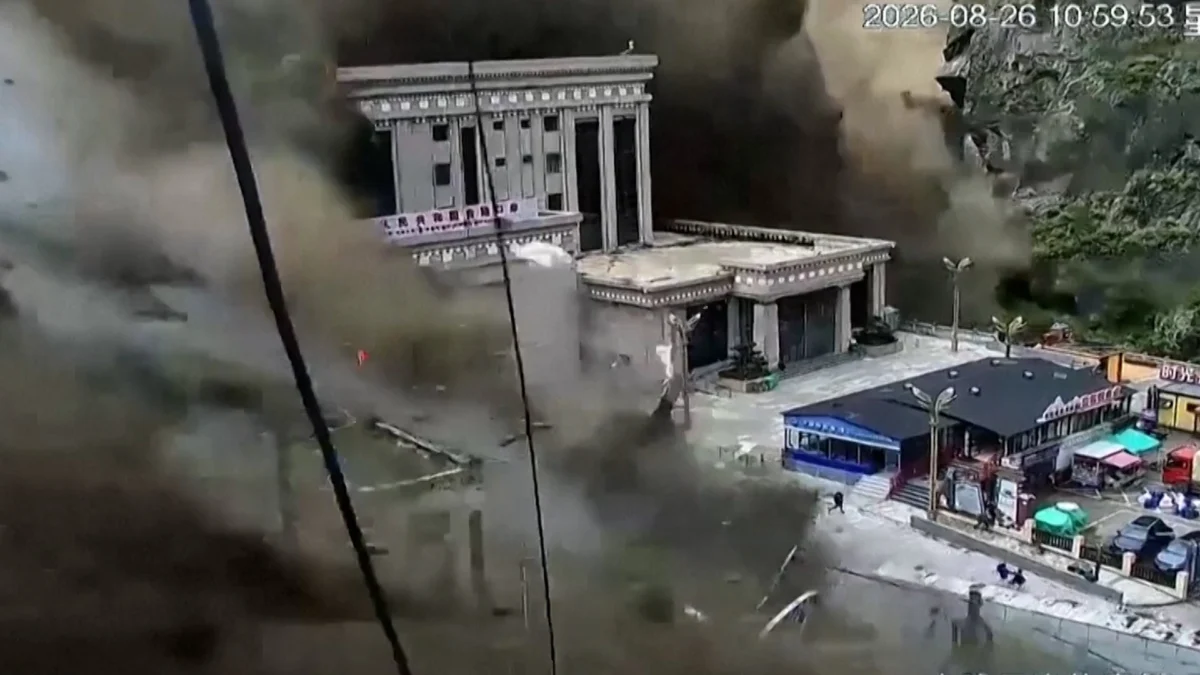
The Himalayan frontier between Nepal and China has been struck by a catastrophic natural disaster that has claimed at least nine lives and left hundreds more missing, following a series of massive mudslides and torrential floods. Captured in chilling CCTV footage that has since circulated globally, the disaster unfolded with terrifying speed at a major border crossing, where civilians were seen fleeing for their lives just seconds before a colossal wall of debris, mud, and water engulfed the landscape. The surge pulverized several buildings, swept away heavy vehicles, and obliterated sections of the highway that serves as a vital economic artery between the two nations.
As of the latest reports from regional authorities on August 26, 2026, rescue operations are struggling against treacherous terrain and continued inclement weather. The incident, which occurred during the peak of an unusually intense monsoon season, highlights the increasing vulnerability of high-altitude infrastructure to extreme weather events. With the death toll expected to rise as search teams reach more remote sections of the affected area, the disaster has triggered a localized humanitarian crisis and a complete suspension of cross-border trade.
The Mechanics of the Disaster: A Convergence of Factors
The disaster began following seventy-two hours of unrelenting rainfall in the central Himalayan range. Meteorological data suggests that the region received over 400mm of rain in a three-day window, a volume that far exceeds the historical average for late August. This saturation caused the fragile mountainous soil—already compromised by previous seismic activity and recent infrastructure development—to lose its structural integrity.
The specific mudslide that devastated the border crossing originated several hundred meters above the valley floor. According to geological assessments, a "glacial lake outburst" or a "landslide dam burst" upstream may have contributed to the suddenness of the flood. When the mountainside finally gave way, it did not just move soil; it carried boulders the size of small houses and uprooted entire swathes of forest, creating a slurry with the density of wet concrete. This mass gained velocity as it descended, funneling through a narrow gorge before exploding onto the border crossing and the adjacent settlements.
Chronology of the Catastrophe
The timeline of the event illustrates the narrow window of survival available to those in the path of the slide.
- August 23 – 24, 2026: Heavy rainfall begins across the Sindhupalchok and Rasuwa districts in Nepal, and the Kyirong and Zhangmu regions in the Tibet Autonomous Region of China. Regional weather bureaus issue "Red Alerts" for flash flooding.
- August 25, 04:00 AM: Small-scale landslides begin blocking secondary roads. Local authorities initiate minor evacuations in low-lying riparian zones.
- August 26, 10:15 AM: A massive geological failure occurs on the upper slopes overlooking the primary border crossing.
- August 26, 10:18 AM: CCTV cameras at the customs and immigration facility capture the final moments of the crossing’s operation. People are seen pointing toward the mountainside before sprinting away from the approaching roar.
- August 26, 10:19 AM: The mudslide strikes. In less than sixty seconds, the main administrative buildings, a parking lot containing dozens of freight trucks, and a temporary housing settlement are buried under ten meters of debris.
- August 26, 12:00 PM: The first emergency response teams from the Nepal Army and the Chinese People’s Armed Police arrive at the peripheries, but are unable to enter the "hot zone" due to unstable ground.
Human Toll and the Search for the Missing
The official death toll stands at nine, but this figure is widely considered a placeholder for a much larger tragedy. The "hundreds missing" reported by local administrators include cross-border traders, seasonal laborers, transport workers, and several families living in the vicinity of the customs post.
The high number of missing persons is attributed to the timing of the slide. Mid-morning is typically the busiest time at the border, with hundreds of people queuing for document processing and goods being loaded and unloaded. Identifying those lost is further complicated by the fact that many were transient workers without permanent residency in the immediate area.
Search and rescue efforts are being conducted by elite mountain rescue units. However, the use of heavy machinery is currently restricted because the mud remains "liquefied," meaning any additional weight could trigger further shifts in the debris field, potentially crushing air pockets where survivors might be trapped.
Economic and Geopolitical Implications
The Nepal-China border crossings, particularly the ones at Tatopani-Zhangmu and Rasuwagadhi-Kyirong, are essential for the landlocked nation of Nepal. They serve as the primary conduits for Chinese electronics, clothing, and construction materials moving south, and for Nepali herbs and handicrafts moving north.
- Trade Disruption: Preliminary estimates suggest that the closure of this crossing will result in a daily trade loss of approximately $3.5 million. With the road infrastructure decimated, it may take months, if not years, to restore full operational capacity.
- Supply Chain Shock: The destruction of dozens of cargo containers will lead to immediate shortages of essential goods in Kathmandu and surrounding districts.
- Infrastructure Fragility: This event has reignited the debate regarding the "Belt and Road" infrastructure projects in the Himalayas. Critics argue that rapid road expansion in these geologically sensitive areas, without sufficient environmental safeguards, exacerbates the risk of such disasters.
Official Responses and International Aid
The government of Nepal has declared the region a "Special Disaster Zone." In a televised address, the Ministry of Home Affairs spokesperson stated, "Our primary focus is the recovery of the missing and the stabilization of the riverbanks to prevent downstream flooding. We are working in close coordination with our Chinese counterparts to manage the crisis at the border."
In Beijing, the Ministry of Foreign Affairs expressed deep condolences and confirmed that Chinese emergency teams are working from the northern side of the border to clear debris and provide medical assistance to survivors. "Nature has dealt a heavy blow to our shared border community. China stands ready to provide all necessary technical and humanitarian support to Nepal during this difficult time," the statement read.
International agencies, including the Red Cross and various UN disaster relief branches, have begun mobilizing supplies. However, the primary challenge remains access. With the main highways severed by multiple smaller landslides, aid can currently only be delivered via helicopter, a method severely hampered by the ongoing monsoon clouds and high winds.
Regional Vulnerability and Climate Context
The disaster of August 2026 is not an isolated incident but part of a broader, more alarming trend. The Himalayas, often referred to as the "Third Pole," are warming at a rate significantly higher than the global average. This warming leads to:
- Increased Glacial Melt: Creating unstable glacial lakes that can burst without warning.
- Erratic Monsoon Patterns: Shifting from steady seasonal rain to "cloudburst" events where a month’s worth of rain falls in a matter of hours.
- Permafrost Degradation: High-altitude soil that was once held together by ice is now thawing, making slopes prone to failure.
Geologists at the International Centre for Integrated Mountain Development (ICIMOD) have previously warned that the combination of steep topography, seismic instability, and extreme weather makes the Nepal-China border one of the most hazardous corridors in the world. This latest mudslide serves as a grim validation of those warnings.
Long-term Recovery and Prevention
As the search for the missing continues, questions are being asked about the future of the border crossing. Engineering experts suggest that "hard" infrastructure like concrete walls may no longer be sufficient. Future reconstruction will likely require "nature-based solutions," such as extensive reforestation of upper slopes and the construction of advanced drainage systems designed to handle "1-in-500-year" flood events, which are becoming increasingly common.
The immediate priority remains the hundreds of families waiting for news of their loved ones. For the survivors, the trauma of the August 26 mudslide will linger long after the mud has dried. The CCTV footage, showing the desperate flight of people against the backdrop of a collapsing mountain, remains a haunting reminder of the sheer power of the natural world and the precariousness of life in the shadows of the world’s highest peaks.
In the coming days, as the rain is forecast to subside, the true scale of the devastation will become clearer. For now, the border remains a scene of silent wreckage, buried under the weight of the Himalayas, as a two-nation rescue effort races against time in a landscape that has been irrevocably altered.
