

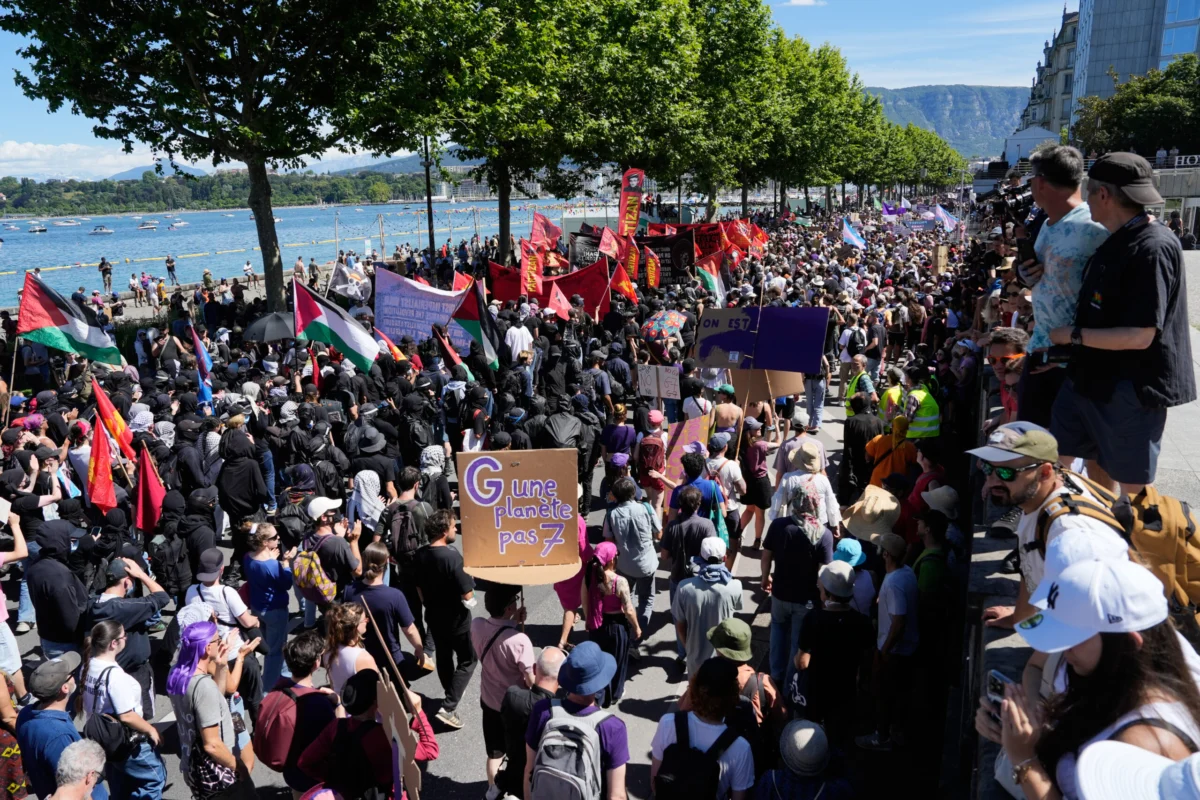
Thousands of activists converged on Geneva, Switzerland, on Sunday, June 14, 2026, to vehemently denounce the policies of the Group of Seven (G7) nations, just hours before the influential bloc’s annual summit was set to commence in nearby Evian-les-Bains, France. The demonstration served as a potent prelude to a gathering that will bring together leaders, including United States President Donald Trump, to address pressing global issues, but which protesters argue is increasingly out of touch with the world’s most critical challenges and its diverse populations.
The Genesis of Dissent: A Coalition Against G7 Policies
The large-scale protest, drawing participants from across Switzerland and neighboring countries, was orchestrated by the "No-G7" coalition, a broad alliance comprising over 60 distinct associations and groups. This diverse front included organizations advocating for Palestinian rights, staunch feminist activists, and passionate environmental campaigners, all united by a shared skepticism and often outright opposition to the G7’s perceived influence and policy directions. The coalition’s spokesperson, Francoise Nyffeler, articulated the profound anxieties driving the protest, stating, "We are very afraid of the policy and the politics of Mr. Trump and also of the other leaders of the G7, because they are fighting, making war all over the place." Nyffeler further emphasized the existential threat perceived by activists: "The planet is in danger, and we are very scared about it and we want to protest and say that the people of the world are against their policies." This sentiment underscores a widespread belief among the protesters that the G7, often viewed as an exclusive club of wealthy nations, prioritizes economic interests and geopolitical dominance over environmental sustainability, human rights, and equitable global development.
Al Jazeera’s Natacha Butler, reporting from the heart of the Geneva demonstration, captured the core message reverberating through the throngs of protesters: a condemnation of the G7 as an entity primarily concerned with "the rich getting richer and the poor getting poorer." Butler highlighted the demonstrators’ conviction that this club of economic powerhouses "doesn’t represent the global population; that their policies and decisions have a negative impact on the world in terms of climate, equal rights and poverty." This perception is not merely anecdotal; it is rooted in observable trends of global wealth disparity, the slow pace of climate action, and persistent geopolitical conflicts, all of which activists link directly or indirectly to the G7’s collective agenda and individual member policies.
Unpacking the G7’s Shifting Relevance and Criticisms
The legitimacy and efficacy of the G7 – comprising Canada, France, Germany, Italy, Japan, the United Kingdom, and the United States – have been subjects of increasing debate in recent decades. Established in the mid-1970s as a forum for the world’s leading industrial democracies to coordinate economic policy in response to the oil crisis and global recession, the G7 (then G6) quickly evolved into a significant platform for discussing broader global issues, including security, development, and climate change. However, its economic footprint and representativeness have steadily diminished. At its peak, the G7 collectively accounted for approximately 70 percent of global gross domestic product (GDP). Today, that figure has shrunk considerably to roughly 40 percent, even while its members still represent only about one-tenth of the global population.
This economic contraction coincides with the dramatic rise of other international groupings. The BRICS bloc – initially Brazil, Russia, India, China, and South Africa – has not only expanded its membership to 11 nations but has also significantly amplified its economic and geopolitical influence. Similarly, the Group of Twenty (G20), which includes the G7 nations alongside major emerging economies like China, India, Brazil, and others, has largely superseded the G7 as the premier forum for international economic cooperation, reflecting a more multipolar global economic landscape. Critics argue that the G7’s continued prominence is an anachronism, a relic of a bygone era that fails to adequately address the complex, interconnected challenges of the 21st century without the full participation of major developing economies.

Specific Policy Grievances Fueling the Protests
This year’s G7 summit, held against a backdrop of global frustration, has amplified existing criticisms, particularly concerning the leadership and policies emanating from Washington. President Trump’s "America First" agenda has frequently clashed with the multilateral spirit traditionally associated with the G7, leading to significant friction on several fronts:
- Trade Tariffs: The imposition of tariffs on goods from key trading partners, including some G7 allies and China, has sparked fears of a global trade war, disrupted supply chains, and introduced considerable uncertainty into the international economic system. Protesters argue these protectionist measures harm developing nations and exacerbate global inequalities.
- US-Iran Tensions: The withdrawal of the United States from the Joint Comprehensive Plan of Action (JCPOA), commonly known as the Iran nuclear deal, and the subsequent re-imposition of crippling sanctions have dramatically escalated tensions in the Middle East. The reference to a "US-Israeli war on Iran" in the protest context highlights deep concerns among activists about potential military escalation and the devastating humanitarian and geopolitical consequences, perceiving Israeli influence on US policy in the region. Many protesters view these policies as destabilizing and contrary to international efforts for peace.
- Climate Crisis: The United States’ withdrawal from the Paris Agreement on climate change has been a consistent point of contention within the G7 and a major rallying cry for environmental activists globally. While other G7 nations have largely reaffirmed their commitments to climate action, the lack of a unified front from the world’s largest historical emitter undermines collective efforts to combat global warming, leading to accusations of inaction and irresponsibility.
- Human Rights and Social Justice: Beyond these prominent issues, the "No-G7" coalition’s diverse composition reflects broader concerns about human rights, gender equality, and social justice. Palestinian rights advocates criticize G7 nations for their perceived inaction or complicity in the ongoing Israeli-Palestinian conflict, particularly regarding Israeli occupation and settlement expansion. Feminist activists decry the slow progress on gender equality globally, linking it to economic policies that disproportionately affect women and to the prevalence of gender-based violence and discrimination.
A Chronicle of Preparation and Protest
The Sunday demonstration in Geneva was the culmination of several days of heightened activity and meticulous planning by activists, met with equally rigorous security preparations by Swiss and French authorities.
Timeline of Pre-Summit Activism:
- Weeks Prior: The "No-G7" coalition engaged in extensive organizing, utilizing social media, community meetings, and traditional outreach to mobilize support for the Geneva protest. Their messaging focused on exposing the perceived failures and injustices perpetuated by G7 policies.
- Friday, June 12, 2026: Initial skirmishes and pre-emptive detentions marked the start of the summit-related unrest. According to Swiss media reports, approximately 20 protesters were detained in the evening, underscoring the authorities’ determination to maintain order. These early detentions often involve individuals suspected of planning disruptive actions or those engaged in unauthorized gatherings.
- Saturday, June 13, 2026: A symbolic and visually striking protest unfolded on Lake Geneva. A flotilla of around 20 boats navigated the waters off the coast of Evian-les-Bains, the summit host town. These vessels displayed an array of anti-G7 and pro-Palestinian banners, sending a clear message directly to the vicinity where world leaders would soon gather. This aquatic protest demonstrated the creativity and determination of activists to make their voices heard despite significant security barriers on land.
- Sunday, June 14, 2026: The main "No-G7" demonstration in Geneva commenced, drawing thousands to the city’s streets. The sheer scale of the turnout, despite the tight security and potential for disruption, underscored the depth of public discontent. Marchers carried placards, chanted slogans, and engaged in peaceful but forceful expressions of their opposition to G7 policies across various themes, from climate change to social inequality and international conflict.
Unprecedented Security Measures and Economic Impact:
The proximity of the summit venue in Evian-les-Bains to Geneva necessitated extensive cross-border security cooperation between Swiss and French authorities. Thousands of police officers were deployed on both sides of the border, creating a formidable security cordon around the summit area and along major transit routes.
- Restricted Zones: Roads leading to Evian and key areas in Geneva were blocked off, and unauthorized gatherings were explicitly banned in designated zones. Airspace restrictions were also imposed over the summit area to prevent aerial intrusions. These measures were designed to create a secure environment for world leaders and delegates, minimizing the risk of direct confrontation with protesters.
- Economic Precautions: The memory of past unrest loomed large over local businesses. The 2003 G8 summit, also held in Evian, had led to significant damage and disruption in Geneva, leaving a costly trail for local enterprises. Learning from this history, scores of businesses and shops in Geneva proactively boarded up their storefronts with wooden panels as a precaution. Authorities also pledged financial support for businesses that might be adversely affected by potential unrest or the economic slowdown caused by security measures. This preemptive action reflects the tangible economic toll that such high-profile international events can impose on host communities. The cost of security operations for G7 summits typically runs into the hundreds of millions of dollars, a significant expenditure often borne by host nations.
Official Responses and the G7’s Stated Agenda
While G7 officials and leaders rarely directly engage with protest movements during summits, their public statements and the summit’s official agenda implicitly address some of the concerns raised by activists. The G7 typically frames its annual meetings as essential forums for addressing global challenges, fostering economic stability, and promoting shared values.
- Summit Agenda: For the Evian summit, the G7 leaders were expected to focus on a range of critical issues, including strengthening the global economy, addressing climate change and biodiversity loss, digital transformation, and geopolitical stability. Official statements often emphasize the G7’s commitment to multilateralism and its role in coordinating efforts to tackle complex cross-border problems.
- Host Nation Stance: Swiss and French authorities, while ensuring freedom of assembly as a democratic right, reiterated their primary responsibility to maintain public order and ensure the safety of both citizens and summit participants. Their deployment of extensive security forces was presented as a necessary measure to prevent violence and protect property, balancing civil liberties with security imperatives. They often appeal for peaceful demonstrations, distinguishing between legitimate protest and destructive acts.
Broader Implications and the Future of Global Governance
The enduring protests against the G7 are more than just episodic events; they represent a recurring challenge to the legitimacy and relevance of traditional global governance structures. The demonstrations in Geneva highlight several profound implications for international relations and the future of multilateralism:
- Legitimacy Crisis for the G7: The shrinking economic share and demographic representation of G7 nations, coupled with persistent critiques of their policies, point to a deepening legitimacy crisis. As emerging economies gain greater influence, the G7’s ability to act as a truly representative or effective global steering committee is increasingly questioned. The protests underscore the popular perception that the G7 is an exclusive club whose decisions disproportionately benefit its members at the expense of broader global equity and environmental health.
- Shifting Global Power Dynamics: The rise of alternative groupings like the G20 and BRICS signals a fundamental shift in global power dynamics. While the G7 retains historical prestige and significant economic clout, its capacity to unilaterally shape global agendas is diminishing. Future global problem-solving will likely require more inclusive forums that genuinely represent the diverse interests and capabilities of a multipolar world.
- The Enduring Power of Protest: Despite massive security operations and official indifference, protest movements continue to play a vital role in international politics. They serve as a critical outlet for public discontent, forcing issues onto the global agenda and holding powerful institutions accountable. The "No-G7" coalition’s ability to mobilize thousands and gain international media attention demonstrates the persistent, albeit often indirect, influence of civil society in shaping public discourse around global governance.
- Challenges for Future Summits: The high cost, security risks, and significant public disruption associated with hosting major international summits pose growing challenges for future hosts. The need to balance security with accessibility, and to manage public dissent while facilitating high-level diplomatic dialogue, will continue to test governments and event organizers. This trend could lead to changes in how and where such summits are held, potentially favoring more isolated or secure locations, or even a greater reliance on virtual diplomacy.
In conclusion, the Geneva protests served as a powerful reminder of the deep divisions and widespread discontent surrounding the current state of global governance. As G7 leaders convened in Evian, they did so under the shadow of thousands of voices demanding greater accountability, inclusivity, and a more equitable and sustainable future. The demonstration not only highlighted specific policy grievances but also underscored the fundamental question of who holds the power to shape the world’s future, and whether traditional institutions like the G7 are still fit for that purpose in an increasingly complex and interconnected world.
