

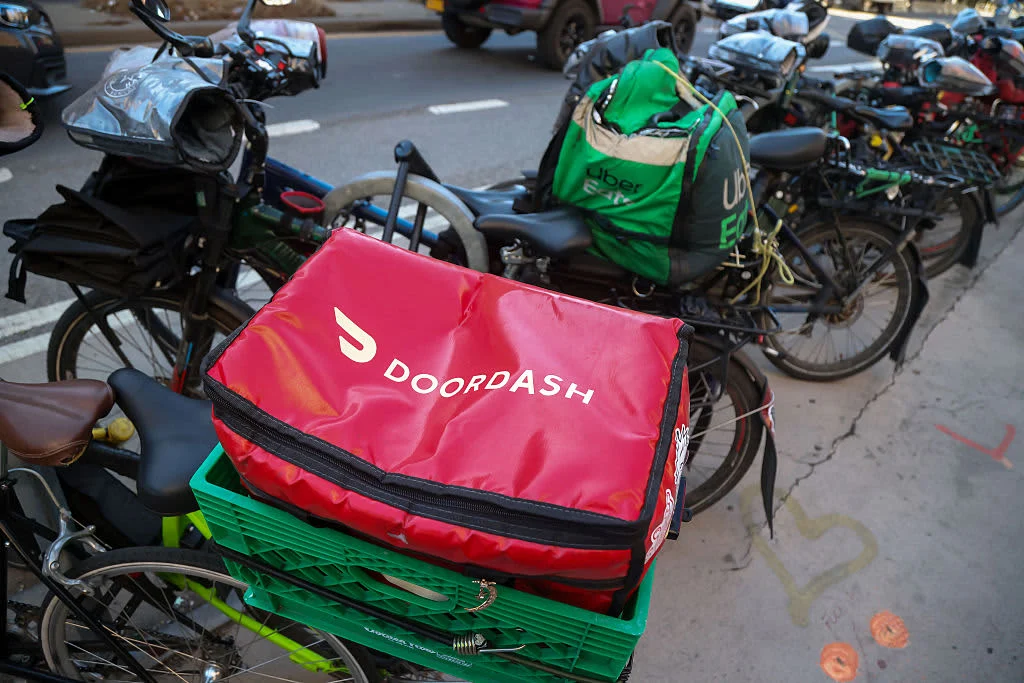
In a significant escalation of the technological rivalry between Washington and Beijing, U.S. lawmakers have formally requested detailed information from the food delivery giant DoorDash regarding its integration of artificial intelligence models developed in China. The inquiry, spearheaded by two influential House committees, underscores a growing bipartisan concern that American corporations may be inadvertently compromising national security by adopting Chinese-engineered software to optimize their operations.
According to documents obtained by CNBC, the House Committee on Homeland Security and the House Select Committee on the Chinese Communist Party (CCP) have launched a joint investigation into the security implications of U.S. companies utilizing Chinese AI models. The committees have specifically targeted DoorDash following public disclosures by the company’s leadership regarding the performance and cost-effectiveness of Chinese-built AI compared to domestic alternatives.
The probe into DoorDash is part of a wider congressional effort to map the extent to which critical U.S. digital infrastructure relies on technology subject to the jurisdiction of the People’s Republic of China (PRC). This investigation has already extended to other high-profile American firms, including the short-term rental platform Airbnb and the AI-powered coding tool Cursor, signaling a new era of regulatory oversight for the domestic tech sector.
The Catalyst: Performance Metrics and Strategic Deployment
The specific focus on DoorDash was triggered by a series of public statements made by the company’s founder and top executives. In a post on the social media platform X, DoorDash founder Andy Fang detailed how the company had begun delegating specific, lower-level AI tasks to Kimi K2.6. Kimi is a sophisticated large language model (LLM) developed by Moonshot AI, a Beijing-based startup that has quickly risen to prominence in the global AI landscape.
Internal assessments from DoorDash’s AI research lab further corroborated this shift. The lab reported that Kimi K2.6, alongside Anthropic’s Fable 5, significantly outperformed other established American models, including Anthropic’s Sonnet 4.6 and Opus 4.8. Crucially, the DoorDash team highlighted that these Chinese models achieved superior results at a "cheaper cost," presenting a compelling economic argument for their adoption.
Lawmakers, however, argue that these short-term economic gains must be weighed against long-term strategic risks. The joint letter sent to DoorDash acknowledges that PRC-developed "open-weight" models offer competitive capabilities and greater customization. However, the chairmen of the committees—led by Representative Andrew Garbarino of the House Committee on Homeland Security—cautioned that these practical considerations do not absolve companies of the need for rigorous, risk-based safeguards.
Understanding the Open-Weight Advantage
To understand the friction between DoorDash and U.S. lawmakers, it is essential to distinguish between the types of AI models currently dominating the market. Most leading American frontier models, such as those produced by OpenAI and Anthropic, are "closed" or proprietary. Users can access them via an API but cannot see the underlying code or host the model on their own private servers.
In contrast, "open-weight" models allow companies to download the model’s parameters, modify them for specific tasks, and self-host them. This provides a level of control and cost-efficiency that is highly attractive to tech-heavy firms like DoorDash. Currently, some of the most capable open-weight models globally are produced by Chinese entities. Moonshot AI’s recent release of the Kimi K3 model earlier this month claimed to have effectively closed the performance gap with the most advanced closed models in the United States, particularly in areas of logical reasoning and coding.
For a company like DoorDash, which manages millions of deliveries, complex logistics, and customer service interactions daily, the ability to use a high-performing, low-cost open-weight model is a significant competitive advantage. However, the House committees are concerned that this creates a "dependency trap," where American innovation becomes tethered to the technological output of a strategic adversary.
A Chronology of Rising Tensions (2024–2026)
The current investigation is the culmination of several years of mounting tension regarding AI supremacy.

- Late 2024: U.S. export controls on high-end semiconductors (such as Nvidia’s H100 chips) were designed to slow China’s AI development. Despite these hurdles, Chinese firms began pivoting toward algorithmic efficiency and open-weight architectures.
- Early 2025: Several U.S. startups, including Lindy and high-profile figures like Coinbase CEO Brian Armstrong, began publicly discussing the use of Chinese models to bypass the high costs and restrictive "safety filters" of U.S. proprietary models.
- July 2025: A major cyber attack on the AI model repository Hugging Face was reportedly thwarted not by American defensive tools, but by a Chinese-developed security system. This event highlighted the sophisticated defensive capabilities of PRC AI, sparking alarm in the Pentagon.
- January 2026: DoorDash executives publicly praise the performance of Moonshot AI’s Kimi series.
- July 2026: The House Committee on Homeland Security and the House Select Committee on the CCP formalize their joint investigation, issuing letters to DoorDash, Airbnb, and Cursor.
National Security and Cybersecurity Implications
The core of the congressional concern lies in the potential for "backdoors" or vulnerabilities within Chinese models that could be exploited by state actors. Representative Andrew Garbarino has been vocal about the CCP’s efforts to close the gap in cybersecurity capabilities.
"The Chinese Communist Party is no longer just nipping at our heels in artificial intelligence; it is racing to close the gap in some of the exact capabilities that will shape the future of cybersecurity," Garbarino stated. He pointed to reports suggesting that Chinese open-weight models have shown an uncanny ability to discover software vulnerabilities and automate cybersecurity tasks, which could theoretically be turned against U.S. infrastructure if those models are embedded in American corporate systems.
Furthermore, the committees are examining whether the data processed by these models—even if self-hosted—could be exfiltrated or if the models contain "poisoned" data sets designed to influence decision-making or degrade performance during a conflict. While there is currently no public evidence that DoorDash’s use of Kimi has led to a data breach, lawmakers argue that the "exposure to risk" is sufficient to warrant federal intervention.
Official Responses and Industry Sentiment
In response to the inquiry, a spokesperson for DoorDash emphasized the company’s commitment to American innovation while defending its right to evaluate the best available tools.
"DoorDash proudly supports American AI leadership and is working to ensure AI benefits Main Street, not just the biggest companies," the spokesperson told CNBC. "We look forward to engaging with the Committees on how we safely and responsibly use AI, including American-developed frontier models and open-weight models."
This sentiment is echoed across much of Silicon Valley. Tech leaders have argued that if U.S. models remain significantly more expensive or more restricted than international alternatives, American companies will be at a global disadvantage. Brian Armstrong of Coinbase and Flo Crivello of Lindy have both suggested that the market will naturally gravitate toward efficiency. The committee’s challenge is to determine if market efficiency is currently at odds with national safety.
A committee aide, speaking on the condition of anonymity, noted that the goal is not necessarily to ban Chinese AI outright—as has been done in some specific government departments—but to ensure a "sufficient open-weight AI strategy" exists domestically. "We want to ensure American companies are not forced to choose between expensive U.S. models and cheap, capable PRC alternatives," the aide said.
Broader Impact and the Path Forward
The outcome of the DoorDash investigation could set a precedent for how the U.S. government regulates the "software supply chain" in the age of AI. If the committees find that the use of Chinese models poses an unacceptable risk, it could lead to new compliance requirements for any U.S. company with more than a certain number of users or of a certain market capitalization.
This investigation also places immense pressure on U.S. AI developers like OpenAI, Anthropic, and Google. To keep American companies within the domestic ecosystem, these providers may need to reconsider their pricing structures or offer more robust open-weight versions of their own models to compete with the likes of Moonshot AI and DeepSeek.
As the AI arms race intensifies, the line between corporate procurement and national defense continues to blur. For DoorDash, a company synonymous with the convenience of the modern American lifestyle, the transition from a delivery platform to a focal point of geopolitical tension illustrates just how deeply AI has permeated the fabric of global commerce. The information and documents DoorDash provides to the committees in the coming weeks will likely play a pivotal role in shaping the next generation of American technology policy.
