

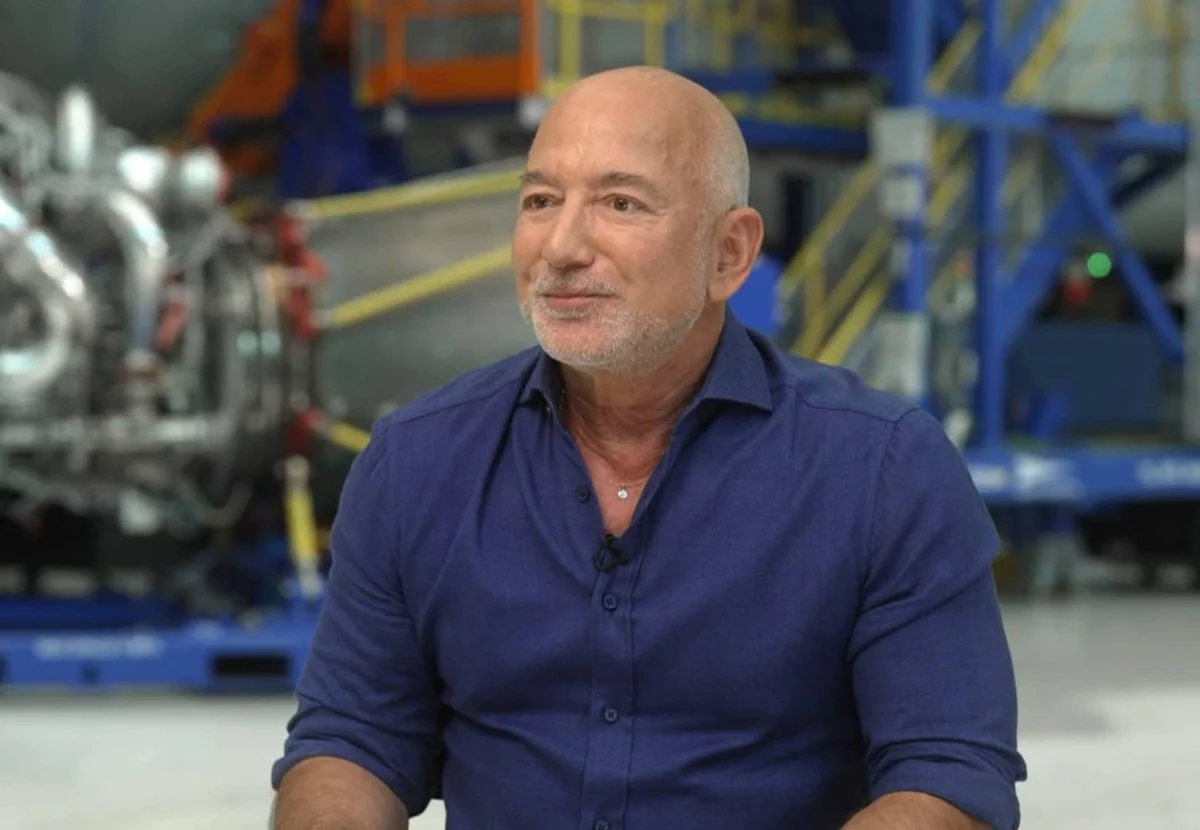
Speaking from Blue Origin’s launch facilities in Merritt Island, Florida, on May 20, 2026, Amazon founder and Blue Origin visionary Jeff Bezos provided a detailed perspective on the future of off-planet computing, characterizing the transition of data centers into Earth’s orbit as a "very realistic" long-term outcome for the technology industry. In an extensive interview with CNBC’s Andrew Ross Sorkin, Bezos addressed the growing intersection of aerospace engineering and cloud computing, while simultaneously urging caution regarding the aggressive timelines currently circulating within the aerospace sector. While several startups and competitors have signaled intentions to establish operational orbital data centers within the next 24 to 36 months, Bezos suggested that such projections likely underestimate the significant economic and thermodynamic hurdles remaining.
"Some of the timelines we hear are very short," Bezos told Sorkin, specifically referencing industry chatter regarding a functional orbital compute infrastructure by 2028 or 2029. "They’re probably not right. The physics of the problem are understood, but the economics and the logistics of scale are still being solved."
The Economic and Technical Barriers to Orbital Compute
The core of Bezos’ argument centered on the fundamental "energy budget" of a data center. On Earth, the primary costs of running massive server farms—such as those operated by Amazon Web Services (AWS), Google Cloud, or Microsoft Azure—are divided between the cost of electricity to power the processors and the cost of cooling them. In space, these challenges are inverted and intensified. While solar energy is abundant and consistent in Low Earth Orbit (LEO), the lack of an atmosphere makes heat dissipation—traditionally handled by air or water cooling—extraordinarily difficult.
Bezos identified two primary levers that must be pulled to make space-based data centers viable: the reduction of semiconductor costs and the continued decline of launch costs. "Chip costs need to come down to make more room for energy in data center budgets," Bezos explained. He noted that for an orbital data center to be competitive with a terrestrial one, the efficiency of the silicon must reach a point where the performance-per-watt justifies the extreme expense of launching the hardware into orbit.
Furthermore, the "mass-to-orbit" ratio remains a critical bottleneck. Even with the advent of reusable heavy-lift rockets like Blue Origin’s New Glenn and SpaceX’s Starship, the cost of replacing hardware in space remains significantly higher than sending a technician into a terrestrial facility to swap a server blade. Bezos suggested that the industry needs a "step-function change" in how we think about hardware longevity and autonomous maintenance in a vacuum.
Project Sunrise and the TeraWave Constellation
The interview comes on the heels of significant regulatory moves by Blue Origin. In March 2026, the company submitted a comprehensive proposal to the Federal Communications Commission (FCC) for an initiative titled "Project Sunrise." This ambitious plan involves the deployment of 51,600 data center satellites into Low Earth Orbit. This figure is staggering, representing a constellation larger than the currently planned Second Generation Starlink fleet.
Project Sunrise is designed to be supported by "TeraWave," a secondary constellation for which Blue Origin has also sought regulatory approval. TeraWave is envisioned as a high-capacity optical and radio-frequency (RF) backhaul network. Its primary function would be to provide the high-speed data links necessary to connect orbital servers to each other and to ground stations on Earth. According to the FCC filings, Blue Origin aims to begin the initial deployment of TeraWave in the fourth quarter of 2027, providing the foundational "interstate highway system" for the data that Project Sunrise will eventually process.
Unlike traditional communication satellites that simply relay signals from point A to point B, the Project Sunrise satellites are intended to house "edge computing" capabilities. This would allow data to be processed in orbit, reducing the latency involved in sending raw data back to Earth and then back to space—a critical factor for future space-based industries, autonomous orbital manufacturing, and deep-space communications.
A Chronology of Blue Origin’s Satellite Ambitions
To understand the scale of Bezos’ current vision, it is necessary to look at the timeline of Blue Origin’s evolution from a secretive rocket engine manufacturer to a potential titan of orbital infrastructure:
- September 2000: Jeff Bezos founds Blue Origin with the long-term goal of enabling a future where millions of people live and work in space.
- 2015–2020: Blue Origin focuses heavily on the New Shepard suborbital vehicle and the development of the BE-4 engine. During this period, Bezos begins articulating the need to move "heavy industry" off-planet to protect Earth’s environment.
- 2023–2024: Amazon, Bezos’ former company, begins launching prototype satellites for Project Kuiper, a direct competitor to SpaceX’s Starlink. While separate from Blue Origin, the projects share a symbiotic interest in LEO infrastructure.
- January 2026: Blue Origin officially files for the TeraWave constellation, signaling a shift toward providing high-bandwidth orbital networking.
- March 2026: The Project Sunrise filing reveals the scale of Bezos’ data center ambitions, requesting permission for over 50,000 satellites.
- May 20, 2026: Bezos uses the CNBC platform to temper expectations, moving the public discourse from "if" it will happen to "when" and "at what cost."
Strategic Implications and Industry Reactions
The move toward orbital data centers is not merely a vanity project for billionaires; it is a response to the growing environmental and logistical constraints on Earth. Terrestrial data centers currently consume an estimated 1.5% to 2% of global electricity, a number expected to rise sharply with the proliferation of generative AI. By moving compute power to space, companies could theoretically tap into 24/7 solar power without the need for vast tracts of land or the massive water consumption required for cooling.
Industry analysts have reacted to Bezos’ comments with a mixture of skepticism and validation. "Bezos is being the ‘adult in the room’ regarding the timeline," said Marcus Thorne, a senior aerospace analyst at Global Orbit Insights. "The technical reality of managing 51,000 satellites, all of which are generating immense heat from high-performance computing, is a thermal management nightmare. However, the fact that he is filing for these numbers suggests Blue Origin is betting the entire farm on the idea that the ‘Gravity Economy’ will be centered around data."
Competitors in the space-to-cloud sector, including Microsoft’s Azure Space and various startups like LEOCloud and Axiom Space, have not yet officially commented on the Project Sunrise filings. However, sources within the industry suggest that the sheer volume of satellites requested by Blue Origin has sparked a "land grab" mentality for orbital slots and frequency spectrums at the FCC.
The AI Factor: Why Space Compute Matters Now
The timing of Project Sunrise is inextricably linked to the explosion of Artificial Intelligence. AI models require massive computational clusters, which generate enormous amounts of heat. In a terrestrial environment, this heat is a liability. In the vacuum of space, while heat is harder to get rid of, the potential for massive, unobstructed solar arrays provides a power source that is virtually "free" once the infrastructure is in place.
Furthermore, as humanity moves toward more permanent lunar bases and potential Mars missions, having a "cloud" that exists outside of Earth’s atmosphere becomes a logistical necessity. High-frequency trading, global surveillance, and real-time climate modeling could also benefit from having "nodes" in the sky that process data locally before sending refined insights to the surface.
Future Outlook: The Path to Q4 2027
As Blue Origin prepares for the 2027 TeraWave deployment, the aerospace community will be watching the development of the New Glenn rocket closely. New Glenn’s seven-meter fairing and heavy-lift capacity are essential for the mass-deployment of the Project Sunrise fleet. Without a reliable, high-cadence launch vehicle, the 51,600-satellite goal remains a mathematical abstraction.
Bezos concluded his interview by reiterating his long-held philosophy of "Gradatim Ferociter" (Step by Step, Ferociously). While he acknowledges the "very realistic" nature of space-based data centers, his refusal to endorse a "short" timeline suggests that Blue Origin is bracing for a decade-long engineering marathon rather than a sprint.
For the tech industry, the message is clear: the cloud is no longer just a metaphor for terrestrial server farms—it is moving toward the stars, but the journey will be defined by the harsh realities of physics and the uncompromising bottom line of orbital economics. As the Q4 2027 target for TeraWave approaches, the focus will remain on whether Blue Origin can bridge the gap between Bezos’ cautious rhetoric and the massive scale of his regulatory filings.
