

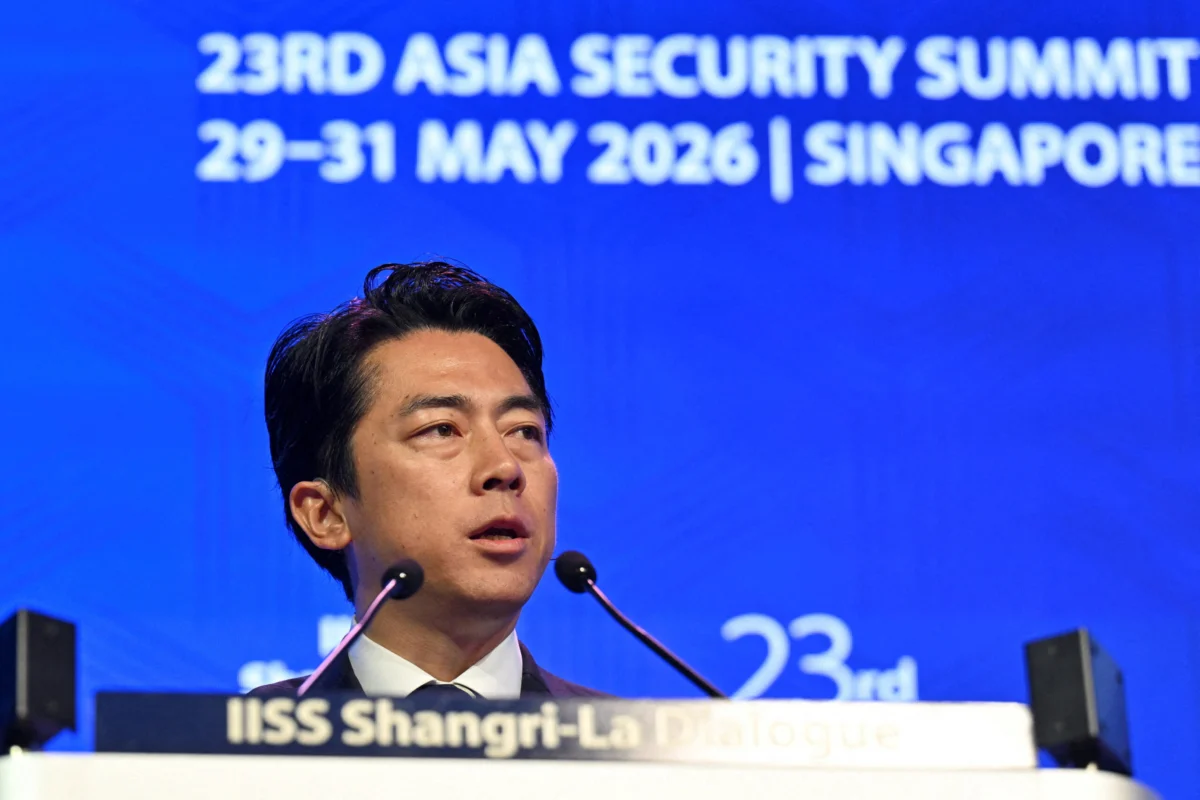
In a high-stakes diplomatic confrontation at the 23rd Shangri-La Dialogue in Singapore, Japanese Defense Minister Shinjiro Koizumi forcefully dismissed allegations that Tokyo is returning to its imperial-era "militarism." Addressing a room of global defense leaders, Koizumi instead pivoted the scrutiny toward Beijing, accusing the People’s Republic of China of a rapid and opaque military expansion that threatens the established international order. The exchange, which took place on May 31, 2026, highlights the deepening rift between the two East Asian powers as Japan undergoes its most significant defense transformation since the end of World War II.
Minister Koizumi’s remarks served as a direct rebuttal to recent rhetoric from the Chinese Ministry of Foreign Affairs, which has increasingly characterized Japan’s defense buildup as a resurgence of "neo-militarism." Koizumi pointed to the vast disparity in strategic capabilities between the two nations to illustrate his point. He noted that while China possesses a massive arsenal of nuclear warheads and long-range strategic bombers, Japan remains a non-nuclear state with no offensive bomber fleet. The Minister argued that the label of "militarism" was being used as a rhetorical tool to distract from China’s own military activities in the South and East China Seas.
The Debate Over "New Militarism" and Strategic Transparency
The friction at the summit reached a peak when Koizumi addressed the lack of transparency regarding China’s defense spending and nuclear modernization. According to recent reports from the Stockholm International Peace Research Institute (SIPRI) and the U.S. Department of Defense, China’s official defense budget has seen consistent annual increases of approximately 7%, though external analysts suggest the actual spending is significantly higher when accounting for research, development, and paramilitary forces.
"China continues to increase its defense spending at a high level without adequate explanation," Koizumi stated. "Think about it. There’s a country that has a huge arsenal of nuclear weapons and strategic bombers. Japan has neither of such weapons, and yet Japan is labeled ‘new militarism’?"
He further asserted that Japan’s post-war record "speaks for itself," emphasizing Tokyo’s 80-year adherence to the United Nations Charter and international law. Since 1945, Japan has maintained a strictly defensive posture under its "Peace Constitution," though the current administration under Prime Minister Sanae Takaichi has moved to reinterpret these constraints in light of what it calls a "severely deteriorating" regional security environment.
The Chinese delegation was quick to counter. Major General Meng Xiangqing, a prominent voice for the People’s Liberation Army (PLA) at the forum, questioned Japan’s moral authority to lead on regional security. Meng referenced Japan’s historical actions during the early 20th century, stating, "I deeply doubt whether a country that has not thoroughly eradicated the toxic legacy of militarism is qualified to talk extensively about defense cooperation… especially with the Asian countries it once invaded."
A Timeline of Japan’s Shifting Defense Policy
The current tension is the culmination of a decade-long shift in Japanese security policy, accelerated by the 2022 National Security Strategy and the subsequent leadership of Prime Minister Sanae Takaichi. To understand the gravity of Koizumi’s statements, it is necessary to examine the milestones that have led to this moment:
- December 2022: The Japanese government approves three key defense documents, including the National Security Strategy, which labels China as the "greatest strategic challenge." Japan commits to doubling its defense spending to 2% of GDP by 2027.
- November 2025: Prime Minister Sanae Takaichi issues a landmark warning that a Chinese invasion of Taiwan would constitute a "survival-threatening situation" for Japan, implying that the Japan Self-Defense Forces (JSDF) could be deployed in a collective self-defense capacity.
- April 2026: The Takaichi cabinet officially scraps the decades-old ban on the export of lethal weapons. This move allows Japan to co-develop and export advanced fighter jets and missile systems with allies like the United Kingdom and Italy.
- May 2026: Japan announces the successful deployment of long-range "counterstrike" missiles, capable of reaching targets on the Asian mainland, a capability previously avoided to maintain a purely defensive image.
This timeline demonstrates that while Japan rejects the "militarism" label, it is undeniably moving toward a more "normal" military status, capable of projecting power to deter regional threats.
The Taiwan Factor and Deteriorating Bilateral Ties
The issue of Taiwan remains the primary flashpoint in Japan-China relations. Under the leadership of Prime Minister Takaichi, Tokyo has moved away from the strategic ambiguity favored by previous administrations. The Takaichi administration’s stance is predicated on the geographic reality that the southernmost islands of Japan are less than 150 kilometers from Taiwan’s coast. Any conflict in the Taiwan Strait would almost certainly involve Japanese territorial waters and airspace.

Koizumi’s predecessor and the current Prime Minister have both argued that "a Taiwan emergency is a Japan emergency." This rhetoric has infuriated Beijing, which views Taiwan as a domestic matter and a "red line" in its foreign policy. The Chinese Ministry of Foreign Affairs has repeatedly urged Japan to "stop interfering in China’s internal affairs" and warned that Japan is "playing with fire" by aligning so closely with U.S. interests regarding the island.
At the Shangri-La Dialogue, Koizumi lamented that China chose not to send its Defense Minister to the conference, missing an opportunity for direct high-level communication. He emphasized that transparency is born from "discussion and dialogue," yet maintained that Japan’s "door remains open" for engagement to prevent miscalculations.
Strengthening Alliances: The Hegseth-Koizumi Meeting
Beyond the exchange with China, Minister Koizumi used the forum to solidify ties with the United States and other Western allies. He held a bilateral meeting with U.S. Secretary of Defense Pete Hegseth, praising the American commitment to the Indo-Pacific.
The presence of Secretary Hegseth at the summit was particularly significant given the political climate in Washington. With the U.S. administration pushing for European allies to take more responsibility for their own defense, Koizumi sought to ensure that this "burden-sharing" rhetoric did not signal a withdrawal from Asia.
"Division weakens deterrence. Unity strengthens deterrence," Koizumi told the assembly. "If gaps emerge among the United States, Europe, and allies and like-minded countries, forces which take it as an opportunity will surely come in."
This call for unity is a clear reference to the "no-limits" partnership between China and Russia, as well as the growing security ties between North Korea and Moscow. Japan is increasingly positioning itself as the bridge between Euro-Atlantic and Indo-Pacific security, arguing that the security of the two regions is "inseparable."
Implications for Regional Stability
The enrichment of Japan’s defense capabilities and its vocal stance at the Shangri-La Dialogue carry several long-term implications for the Indo-Pacific region:
- Accelerated Arms Race: Japan’s move toward "counterstrike capabilities" and the lifting of arms export bans will likely prompt China to further increase its own regional deployments. This creates a "security dilemma" where each side’s defensive measures are viewed as offensive threats by the other.
- Multilateral Defense Architecture: Koizumi’s emphasis on "unity" underscores the growth of "minilateral" groupings such as the Quad (U.S., Japan, Australia, India) and AUKUS. Japan is increasingly seeking to integrate its defense industry with these frameworks.
- Economic De-risking: The military tensions are mirrored in the economic sphere. As Japan strengthens its military stance, it is also leading efforts to "de-risk" supply chains from China, particularly in critical technologies like semiconductors and rare earth minerals.
- Domestic Political Shift: Within Japan, the Takaichi government’s policies reflect a shift in public opinion. While pacifism remains a core value for many, the threat of a nuclear-armed North Korea and an assertive China has made the "proactive contribution to peace" through military strength more palatable to the Japanese electorate.
Conclusion
The 23rd Shangri-La Dialogue has underscored that the era of "strategic patience" in East Asia has ended. Defense Minister Shinjiro Koizumi’s refusal to accept China’s "militarism" narrative marks a confident, albeit controversial, new chapter in Japanese diplomacy. By challenging Beijing on transparency while simultaneously deepening ties with the U.S. and Europe, Japan is signaling that it will no longer remain a "silent partner" in regional security.
As the summit concluded, the message from Tokyo was clear: Japan will continue to modernize its forces and strengthen its alliances, viewing "unity" as the only viable path to deterring a major conflict. However, with China equally committed to its own military "rejuvenation," the path to regional stability remains fraught with the risk of miscalculation, requiring the very "dialogue" that Koizumi claims is currently lacking.
