

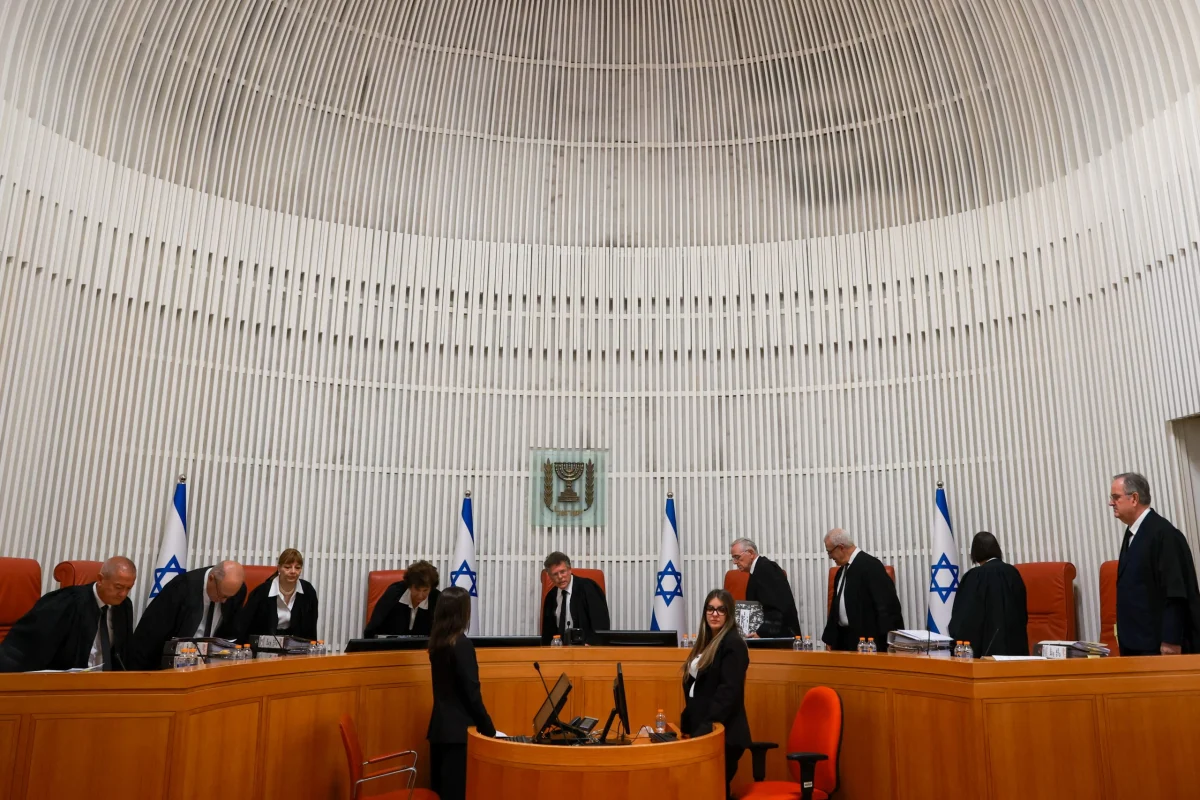
Israel’s highest judicial body, the Supreme Court, delivered a landmark decision on Friday, October 4, 2026, overturning a controversial ban imposed by the Central Elections Committee on two prominent Arab-majority political lists, Ra’am and the Joint List, from contesting the upcoming parliamentary elections scheduled for October 27. In a unanimous ruling, the nine Supreme Court justices determined that the committee’s decision failed to meet the stringent legal requirements necessary for excluding political parties from the democratic process. This pivotal judgment ensures the continued participation of Palestinian citizens of Israel, who constitute approximately 20 percent of the nation’s population, in the electoral race, following widespread accusations of political targeting and double standards against the elections committee.
Further solidifying its role as a guardian of democratic norms, the Supreme Court also voted 7-2 to reinstate Ofer Cassif, a sitting Jewish member of the Knesset representing the Hadash party, which is part of the Joint List alliance. Cassif, known for his outspoken criticism of Israel’s policies toward Palestinians, had similarly been disqualified by the Central Elections Committee. However, the court’s intervention was not absolute. Sami Abu Shehadeh, the leader of the Balad party, another faction within the Joint List, was compelled to withdraw his candidacy under direct judicial pressure, effectively circumventing a formal disqualification but marking a significant concession.
Background to the Disqualifications: A Flurry of Controversial Bans
The saga began in September 2026 when the Central Elections Committee, a body comprising representatives from various Knesset factions, voted to disqualify both the Joint List and Ra’am as collective parties. Simultaneously, it moved to ban individual candidates: Ofer Cassif and Sami Abu Shehadeh. The committee’s decisions, often driven by political motivations rather than strict legal interpretation, ignited a firestorm of criticism from human rights organizations, legal experts, and opposition parties, who decried the bans as an assault on democratic representation and freedom of speech.
The accusations leveled against the disqualified entities and individuals were varied but typically revolved around allegations of "denial of Israel’s existence as a Jewish and democratic state," "incitement to racism," or "support for armed struggle against the state." Specifically, Ofer Cassif faced disqualification attempts based on his alleged support for "armed struggle against the state of Israel," a claim he vehemently denies, attributing it to his strong criticisms of government policies. The two dissenting Supreme Court justices in Cassif’s case echoed this sentiment, arguing that his statements indeed constituted grounds for exclusion.
Sami Abu Shehadeh, on the other hand, became a particular target of the far-right, led by National Security Minister Itamar Ben-Gvir, a key ally of Prime Minister Benjamin Netanyahu. The push to bar Abu Shehadeh intensified over an article he penned following the Hamas attacks on October 7, 2023. In the piece, Abu Shehadeh described the attack as "an important historical event," a characterization that his opponents seized upon as evidence of support for terrorism, despite his explicit denials of such backing. These politically charged accusations underscore the highly polarized environment in which Israeli elections are contested, particularly concerning issues related to Palestinian rights and the Israeli-Palestinian conflict.
The Supreme Court’s Unanimous Verdict for the Arab Lists
The Supreme Court’s decision to reinstate Ra’am and the Joint List was delivered unanimously, highlighting a clear judicial consensus on the lack of sufficient legal grounds for their exclusion. This unanimous ruling is particularly significant, as it signals a strong judicial assertion against what many perceive as politically motivated attempts to sideline minority representation. Under Israeli law, specifically the Basic Law: The Knesset, the bar for disqualifying a party or candidate is exceptionally high, requiring unequivocal and compelling evidence that the entity or individual fundamentally rejects Israel’s existence as a Jewish and democratic state or incites racism. The court, in its consistent jurisprudence, has maintained that mere political dissent, even if controversial, does not meet this threshold.
Historically, the Supreme Court has almost invariably overruled the Central Elections Committee when it attempts to ban parties or candidates, especially those representing Arab constituencies. This consistent judicial oversight serves as a critical check on the committee’s powers, often preventing what could be perceived as the tyranny of the majority or politically expedient disenfranchisement. The court’s role is to ensure that the foundational principles of democracy, including the right to vote and to be elected, are upheld, even for minority voices that may hold views unpopular with the mainstream.
The Forced Withdrawal of Sami Abu Shehadeh: A Troubling Precedent?
While the Supreme Court’s decisions regarding the two Arab lists and Ofer Cassif were celebrated by many as a victory for democracy, the case of Sami Abu Shehadeh presented a more nuanced and, for some, troubling outcome. During a hearing on Thursday, October 3, Supreme Court President Yitzhak Amit reportedly informed Abu Shehadeh that a majority of the nine justices favored his disqualification. He was given an ultimatum: withdraw his candidacy by Friday, October 4, or face an official court-ordered ban.
Under immense pressure and facing the near certainty of judicial exclusion, Abu Shehadeh reluctantly withdrew from the election. The Israeli Public Broadcasting Corporation reported the details of this judicial coercion. Balad, in a subsequent statement, articulated its concerns, suggesting that a court-ordered removal, as opposed to a voluntary withdrawal, would have established a "grave precedent for the country’s political and parliamentary life." Such a precedent, they argued, could pave the way for easier removal of Arab candidates in future elections, potentially eroding the already narrow margins of democratic participation for Palestinian citizens of Israel.
Abu Shehadeh’s withdrawal, though technically voluntary, underscores the precarious position of Arab political leaders who articulate narratives challenging the dominant Israeli discourse. His comments regarding the October 7, 2023, attacks, interpreted by his detractors as legitimizing terrorism, became the primary weapon used by figures like Itamar Ben-Gvir to push for his removal. Abu Shehadeh, speaking to Al Jazeera, expressed profound disappointment, stating he "didn’t have any other choices" and that the events constituted a "historical catastrophe for democracy, or the very narrow margins of democracy in the State of Israel." He emphasized that his disqualification stemmed from holding "a different narrative on how to read history, the present, and the future."
Accusations of Double Standards and Political Motivations

The Central Elections Committee’s September vote, which initially sought to ban the Arab lists and individual candidates, drew immediate and sharp accusations of double standards. Critics highlighted the apparent disparity in how Palestinian-led parties and left-leaning Jewish candidates were scrutinized compared to far-right ministers. Some prominent figures within the current government, including those aligned with Prime Minister Netanyahu, have faced international sanctions or have a history of inflammatory rhetoric, yet their eligibility to run was not challenged with the same vigor or legal intensity by the committee.
This perceived asymmetry fuels cynicism among Palestinian citizens of Israel regarding the fairness and impartiality of Israeli democratic institutions. The argument is that the rules are applied selectively, targeting those who challenge the status quo or advocate for Palestinian rights, while overlooking similar or even more extreme rhetoric from the political right, especially when it targets Arabs. Such accusations undermine trust in the electoral process and can lead to increased political alienation among minority groups.
The Landscape of Arab Political Representation in Israel
Palestinian citizens of Israel, who number approximately 2 million and constitute about 20 percent of the population, represent a significant electoral bloc. Their political participation has historically been complex, oscillating between boycotts and active engagement, often marked by a delicate balance between advocating for their rights as a national minority and integrating into the Israeli political system.
The Ra’am party, also known as the United Arab List, made history after the 2021 election by becoming the first independent Arab party to join an Israeli governing coalition. This unprecedented move saw Ra’am become a partner in a disparate coalition that briefly ousted Benjamin Netanyahu from power. Ra’am’s participation signaled a strategic shift for some segments of the Arab community, moving from traditional opposition to seeking influence from within the government, primarily to address socio-economic issues affecting their constituents. In the current election cycle, Ra’am is further diversifying its appeal by fielding a Jewish Zionist candidate for the first time, Yoav Segalovitz, who gained popularity in Arab communities for his work to curb crime as deputy minister for internal security. This move highlights a pragmatic approach to coalition-building and broader appeal.
The Joint List, an alliance primarily comprising Hadash, Ta’al, and Balad, represents a more ideologically diverse and often more confrontational approach to Israeli politics. It typically focuses on national Palestinian rights, opposition to the occupation, and advocating for full equality for Palestinian citizens within Israel. The reinstatement of the Joint List and its key figures, including Ofer Cassif, ensures that these voices, critical of government policy and advocating for a different vision of Israel, will remain on the ballot.
Implications for the October 27 Knesset Election
The Supreme Court’s decisions carry significant implications for the upcoming October 27 Knesset election. The reinstatement of Ra’am and the Joint List means that Arab voters will have a fuller slate of options, potentially boosting turnout. Disqualification often leads to disillusionment and lower participation, as voters feel their choices are being restricted or their voices silenced. By ensuring these parties remain on the ballot, the court has, in part, restored a measure of legitimacy to the electoral process for this community.
However, the forced withdrawal of Sami Abu Shehadeh and the underlying political pressure that led to the initial disqualification attempts could still foster a sense of grievance and alienation. While the court’s reversal prevented a complete democratic breakdown, the episode underscores the persistent challenges faced by Arab parties in navigating Israel’s highly charged political landscape.
For the broader political spectrum, the Supreme Court’s intervention reiterates its crucial role as a bulwark against political extremism and as an upholder of fundamental democratic rights. In an era marked by increasing polarization and attempts to weaken judicial oversight, this decision reaffirms the court’s authority in safeguarding the electoral process. It might also influence future coalition dynamics, as the presence of these Arab parties on the ballot could affect seat distribution and the viability of various government formations.
Broader Legal and Democratic Context
The Israeli Supreme Court’s actions in this case are consistent with its long-standing tradition of protecting minority rights and ensuring broad political participation, even for groups whose ideologies diverge sharply from the political mainstream. This role is particularly vital in a country like Israel, which lacks a formal constitution and relies heavily on its Basic Laws and the Supreme Court’s interpretation of democratic principles.
The tension between the Central Elections Committee, often influenced by political expediency, and the Supreme Court, which adheres to stricter legal interpretations, is a recurring feature of Israeli politics. This dynamic highlights the delicate balance between the legislative/executive branches and the judiciary, a balance that is constantly debated and tested, especially in the current climate where some political factions seek to curtail judicial power.
The events surrounding these disqualifications and reinstatements also underscore the ongoing struggle for freedom of speech and political expression in Israel, particularly for those advocating for Palestinian rights. While the court’s decision largely protected these freedoms, the pressure exerted on Abu Shehadeh serves as a stark reminder of the boundaries and sensitivities involved. It raises questions about the true extent of democratic space available for dissenting narratives within the Israeli political system.
In conclusion, the Supreme Court’s comprehensive ruling to reinstate major Arab political lists and a prominent Jewish MK represents a significant moment for Israeli democracy, affirming the judiciary’s commitment to upholding electoral integrity and protecting minority representation. While the forced withdrawal of Sami Abu Shehadeh adds a complex layer to this narrative, the overall outcome ensures that the voices of Palestinian citizens of Israel, in their diverse forms, will be heard in the upcoming Knesset election, thereby reinforcing, albeit with some caveats, the inclusive aspirations of Israel’s democratic framework. The decisions will undoubtedly shape the political discourse leading up to October 27 and influence the long-term trajectory of Arab political participation in the nation.
