

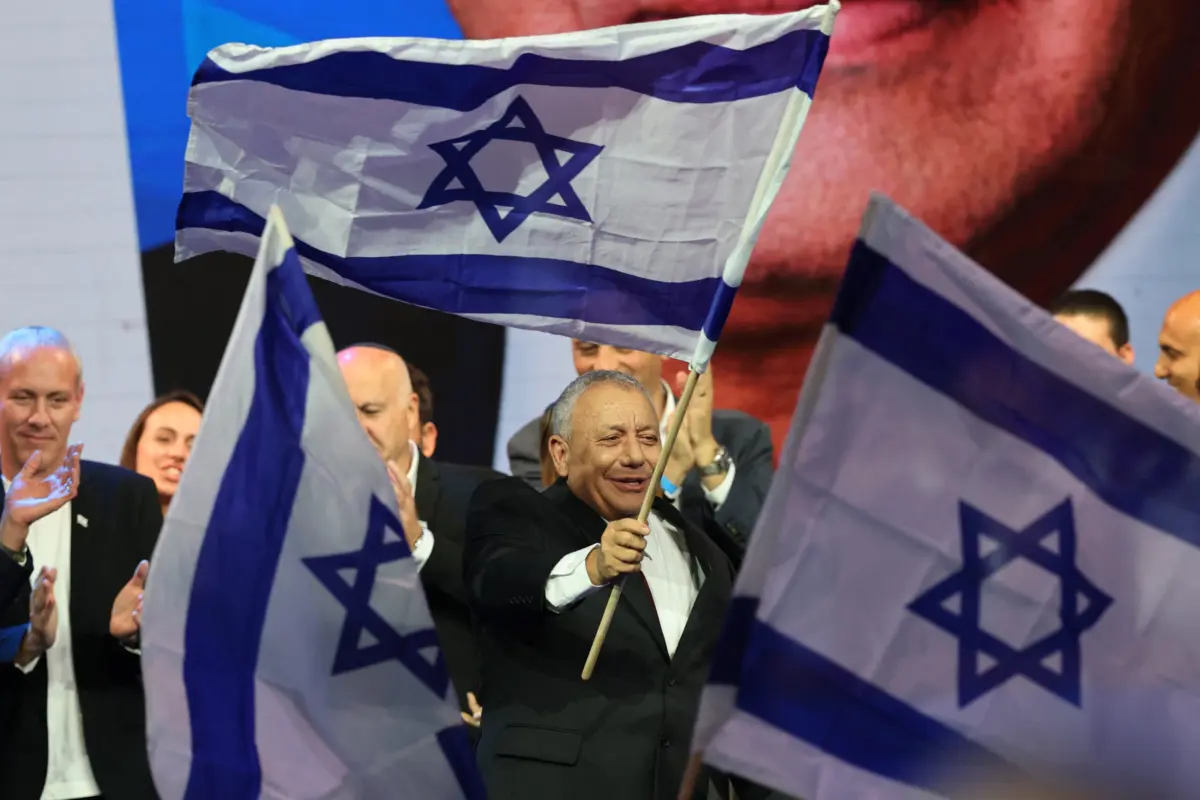
Israel’s fractured political landscape witnessed a significant development this week as key opposition leaders coalesced behind former military chief Gadi Eisenkot, pledging to dismantle Benjamin Netanyahu’s current administration and establish a "national emergency government" with unprecedented urgency. This move comes as the nation grapples with the aftermath of the October 27 election, which once again left no single bloc with a clear path to a governing majority in the 120-seat Knesset, plunging Israel into another round of complex coalition negotiations.
On Tuesday, a pivotal meeting took place in Herzliya, north of Tel Aviv, bringing together the heads of five major opposition parties: Gadi Eisenkot of the Yashar party, former Prime Minister Naftali Bennett, Yisrael Beytenu leader Avigdor Liberman, Yair Golan of the Democrats, and Yair Lapid, who helms the Yesh Atid party. This marked their first joint gathering since the recent general election, signaling a concerted effort to overcome ideological differences in pursuit of a common goal: the swift removal of Netanyahu from power. The leaders issued a joint statement affirming their collective recommendation of Eisenkot to President Isaac Herzog and announced that negotiating teams would immediately commence drafting policy guidelines and coalition agreements. Their declared objective is to replace the "Oct. 7 government" – a direct reference to the current administration’s perceived failings following the Hamas-led attacks – with a robust "national emergency government."
The Shifting Sands of Post-Election Israel
The October 27 election results underscored the deep political polarization within Israel. Netanyahu’s right-wing and religious bloc secured 53 seats, while the diverse opposition garnered 48. Crucially, Arab-led parties, primarily the Joint List with 11 seats and Ra’am with eight, collectively hold 19 seats. With a majority requiring 61 seats, these 19 seats are indispensable for either bloc to form a stable government, positioning Arab parties as potential kingmakers in an otherwise deadlocked parliament.
The opposition’s agreement to back Eisenkot, a figure with a distinguished military background and seen by some as a centrist unifying force, injects a new dynamic into the coalition talks. Eisenkot, a former Chief of Staff of the Israel Defense Forces, carries significant public recognition and a reputation for pragmatism, which his supporters believe could bridge the divides within the opposition. His Yashar party, meaning "straight" or "honest," positions itself as a principled alternative to the existing political establishment.
However, the path to forming a government remains fraught with challenges, particularly concerning the contentious issue of allying with Arab-led parties. The joint statement from the opposition leaders outlined four core principles set forth by Eisenkot: all parties in government must recognize Israel as a Jewish state and unequivocally label Hamas a terrorist group. These conditions, while aimed at solidifying a unified national stance, are precisely the points of contention that could exclude some Arab-led parties, whose platforms often emphasize the rights of Palestinian citizens within Israel and critique Israeli policies regarding Gaza and the West Bank.
Presidential Consultations and the Race Against Time

The agreement among opposition leaders comes just a day before President Isaac Herzog is slated to begin formal consultations with all elected parties on Wednesday and Thursday. During these consultations, party representatives will inform the President of their preferred candidate to form the next government. The candidate who secures the most recommendations is typically given the first mandate, usually for 28 days, with a potential 14-day extension. If Eisenkot can indeed secure the backing of Arab lawmakers, he would likely receive the most recommendations, putting him in a strong position to be tasked with forming the next government.
The urgency expressed by opposition leaders, particularly Naftali Bennett, who stated, "We don’t have time – we must act with great urgency," reflects the broader national mood of instability and the desire for decisive leadership, especially in the wake of the ongoing conflict in Gaza and heightened regional tensions. Israel has been through an unprecedented cycle of elections in recent years, with four general elections between April 2019 and March 2021, each failing to produce a stable, long-term government. The October 27 election marked yet another chapter in this saga of political fragmentation.
The Arab Parties: A Decisive but Contentious Force
The role of Arab-led parties is arguably the most sensitive and critical factor in the current coalition calculus. Yousef Jabareen, head of the largest Arab-led party in the incoming parliament, the Joint List, has publicly urged the opposition to "accept political reality" and join forces to remove Netanyahu. Jabareen’s statement underscores the deep-seated desire among many Arab-Israeli politicians to see an end to the current right-wing government, which they perceive as particularly hostile to their community’s interests.
Among the opposition leaders, Yair Golan of the Democrats stands out as the only one openly advocating for an alliance with Arab-led parties, condemning their exclusion as "racist." Prior to the Herzliya meeting, Golan met with leaders of Arab-led parties, promising to address critical issues facing Palestinian citizens of Israel, such as the alarming rates of crime within their communities. Following these discussions, both sides emphasized their "shared interest in using the parliamentary majority to bring down the Netanyahu-Ben-Gvir-Smotrich government and replace it," according to a joint statement. This highlights a potential ideological alignment on the objective of removing the current government, despite significant differences on other policy matters.
Conversely, Avigdor Liberman, leader of the Yisrael Beytenu party, has firmly opposed including Arab-led parties in any coalition, though he, like many others, also wishes to avoid another election. Liberman’s stance reflects a significant segment of Israeli society that views Arab parties with suspicion, often questioning their loyalty to the state. This deep division within the opposition regarding Arab participation poses a formidable hurdle to forming a stable majority.
The marginalization of Israel’s minority Arab population in national politics is a long-standing issue, exacerbated significantly since the October 7 Hamas-led attacks and Israel’s subsequent military operations in Gaza. Arab citizens, who constitute about 20 percent of Israel’s population, are descendants of Palestinians who remained within the borders of the newly established Israeli state in 1948, following what they refer to as the Nakba, or catastrophe. Their political representation has historically been viewed with skepticism by mainstream Israeli parties, a sentiment that has intensified amid the ongoing conflict. Recent months have seen several Palestinian politicians, both former and current members of the Knesset, briefly arrested for comments or actions deemed critical of Israel’s actions in Gaza or its occupation of the West Bank, illustrating the shrinking space for dissent.
Netanyahu’s Defensive Stance and International Scrutiny

Meanwhile, Benjamin Netanyahu, Israel’s longest-serving prime minister, remains defiant. On Monday, he called for a "broad national government" under his leadership, emphasizing that his Likud party, with 27 seats, remains the largest single party in the Knesset. However, no opposition leader has expressed any openness to joining a Netanyahu-led coalition, indicating the depth of the political chasm separating him from his rivals. Netanyahu, for his part, has consistently ruled out any coalition with Arab-majority lists, accusing them of "supporting terrorism and denying the existence of the Jewish state," allegations vehemently rejected by Arab political leaders.
Netanyahu’s political survival is further complicated by his ongoing legal battles and increasing international scrutiny. The 76-year-old prime minister is currently on trial for corruption charges, including bribery, fraud, and breach of trust. These charges, which he denies, have cast a long shadow over his leadership and are a frequent point of attack for his political opponents. Furthermore, he is now wanted by the International Criminal Court (ICC) for alleged war crimes and crimes against humanity committed in Gaza. This unprecedented development places immense pressure on Netanyahu and Israel’s international standing, especially as the humanitarian crisis in Gaza continues to deepen. More than 74,000 Palestinians have been killed in the enclave since Israel began its war in October 2023, according to figures from the Palestinian health ministry, figures that have drawn widespread international condemnation and calls for accountability.
Implications and Future Outlook
The current political maneuvering carries profound implications for Israel’s domestic stability, its handling of the ongoing conflict in Gaza, and its regional and international relations. A successful formation of a government by the opposition, particularly one that includes Arab parties, would represent a significant paradigm shift in Israeli politics. It could potentially lead to a recalibration of domestic policies, a different approach to the Gaza conflict, and a renewed focus on issues such as the rights of Palestinian citizens within Israel.
However, the challenges are immense. Even if Eisenkot receives the mandate from President Herzog, the process of forming a stable coalition from such diverse parties – ranging from centrist-liberal (Yesh Atid, Democrats) to right-wing secular (Yisrael Beytenu) and religious-nationalist (Bennett’s Yamina faction, though he ran independently) – will require extraordinary political skill and compromise. The ideological chasm over the role of Arab parties is not easily bridged. Should the opposition fail to form a government, the mandate could then revert to Netanyahu, who would face similar, if not greater, difficulties in assembling a majority. The ultimate failure of either bloc to form a government would likely trigger yet another general election, prolonging the political instability at a time of national crisis.
The current situation highlights the deep fragmentation of Israeli society and politics, a trend that has accelerated in recent years. The absence of a clear majority, the significant influence of smaller, often ideologically rigid parties, and the ever-present specter of another election underscore the fragility of Israel’s parliamentary democracy. As President Herzog embarks on his consultations, the nation watches anxiously, aware that the decisions made in the coming days will shape Israel’s trajectory in a period of unprecedented domestic and regional upheaval. The path forward demands not just political acumen, but a willingness to transcend long-standing divisions, a challenge that has repeatedly eluded Israeli leaders in recent memory.
