

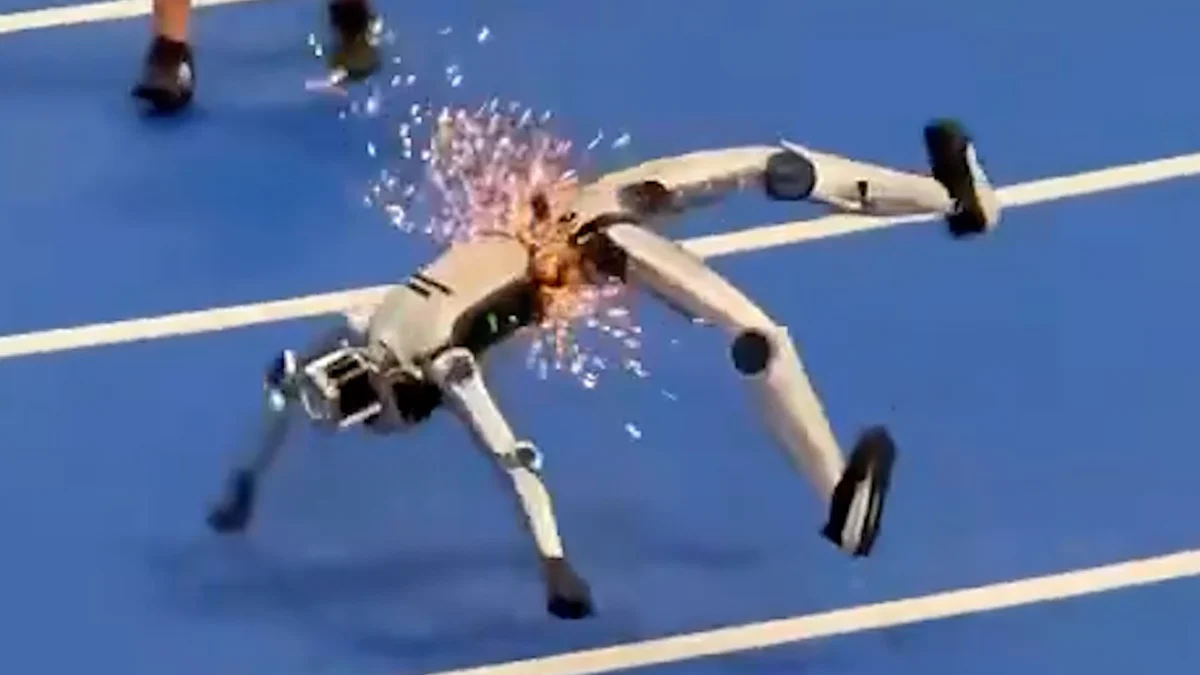
A state-of-the-art humanoid robot suffered a dramatic malfunction and crashed during an ambitious 100-meter sprint test, an incident that underscores both the significant advancements and the persistent challenges within China’s burgeoning robotics industry. The event, which occurred at an undisclosed testing facility in China, was part of a high-profile demonstration aimed at showcasing the nation’s progress in developing robots capable of advanced human-like locomotion and agility. The incident, details of which emerged on August 21, 2026, has prompted discussions among experts regarding the intricate complexities of replicating human biomechanics and the iterative nature of technological innovation.
The Ambitious Attempt and Unforeseen Setback
The humanoid robot, reportedly a product of several years of intensive research and development by a consortium of leading Chinese universities and technology firms, was attempting to complete a full 100-meter sprint on a specially designed track. The objective was to demonstrate its capability for high-speed bipedal locomotion, a critical benchmark in the field of advanced robotics. For context, achieving stable, high-speed running for a bipedal robot is exponentially more difficult than walking or even jogging, requiring sophisticated balance algorithms, precise motor control, robust hardware, and instantaneous sensory feedback processing.
Eyewitness accounts and preliminary reports suggest the robot began its sprint with promising initial acceleration, demonstrating impressive stride and stability. However, approximately midway through the course, observers noted an unexpected deviation in its gait. The robot appeared to lose its balance rapidly, exhibiting a series of uncontrolled movements before toppling forward onto the track. While the full extent of the damage to the prototype remains unclear, the incident brought the demonstration to an abrupt halt and necessitated immediate intervention from engineering teams. No human injuries were reported, as safety protocols were strictly in place for such high-risk testing environments.
China’s Robotics Ambitions: A National Priority
This incident occurs against the backdrop of China’s aggressive and well-funded national strategy to become a global leader in artificial intelligence and robotics. The nation has consistently emphasized robotics as a strategic emerging industry, crucial for its economic transformation and technological sovereignty. Initiatives such as "Made in China 2025," though evolving, have historically highlighted the importance of indigenous innovation in high-tech sectors, including advanced robotics, intelligent manufacturing, and autonomous systems.
According to data from the International Federation of Robotics (IFR), China has been the world’s largest market for industrial robots for several years, with installations continuously increasing. While industrial robots primarily focus on factory automation, the nation’s ambitions extend far beyond, into service robotics, medical robotics, and critically, humanoid robotics. Government investment in robotics research and development has been substantial, with significant funding channeled into key laboratories, national projects, and partnerships between academia and industry. Analysts project China’s robotics market to continue its robust growth, potentially reaching over $100 billion by the end of the decade, a significant portion of which is earmarked for R&D in advanced humanoid capabilities.
The Engineering Marvel and Its Inherited Challenges
Humanoid robots represent the pinnacle of robotic engineering, aiming to mimic the form and function of the human body. This involves not only complex mechanical design for joints and limbs but also sophisticated software for perception, cognition, and motor control. For a robot to sprint like a human, it must continuously manage its center of mass, absorb and generate ground reaction forces, adapt to minor surface irregularities, and execute a dynamic, coordinated movement sequence across its entire body. Each of these aspects presents a formidable engineering challenge.
The 100-meter sprint, a benchmark of athletic prowess for humans, is an even greater challenge for machines. It requires sustained high power output, rapid information processing, and exceptional dynamic stability. Unlike walking, which involves maintaining continuous contact with the ground, running involves phases where both feet are airborne, demanding precise control over momentum and balance during transient states. Robotics engineers worldwide are striving to achieve this level of agility, with leading research groups often sharing their incremental progress, including both successes and failures, as part of the collaborative scientific process.
Expert Reactions and Inferred Statements
While specific statements from the involved research institute were not immediately available, industry experts and officials familiar with China’s robotics landscape offered insights into the implications of such an event.
Dr. Lin Wei, a prominent robotics professor at a leading Chinese university, not directly involved in this project, remarked, "This incident, while a setback, is an inevitable part of pushing the boundaries of what’s possible. Every crash, every failure, provides invaluable data that engineers use to refine algorithms, strengthen materials, and improve designs. The fact that a Chinese team is attempting such an ambitious feat as a 100-meter sprint with a humanoid robot itself speaks volumes about their confidence and the level of technological advancement they have achieved."
An anonymous source close to the project, speaking on background due to ongoing internal reviews, indicated, "The team is, of course, disappointed but remains undeterred. The robot performed exceptionally well in preliminary tests at lower speeds. This high-speed trial was designed to identify failure points under extreme conditions. The data collected from this incident, particularly concerning balance control and motor synchronization at peak velocities, will be instrumental in the next iteration of the design. We view this not as a failure, but as a crucial learning phase."
Government officials, while not directly commenting on this specific incident, have consistently reiterated China’s long-term commitment to robotics. A recent statement from the Ministry of Industry and Information Technology (MIIT) emphasized that "innovation inherently involves risk, and progress is often forged through overcoming challenges. China’s strategic investment in core technologies, including advanced robotics, will continue unabated, recognizing that breakthroughs require persistent effort and a willingness to learn from every experiment."
Global Context: The Race for Humanoid Agility
The pursuit of dynamic bipedal locomotion is a global endeavor. Companies like Boston Dynamics have captivated the world with their Atlas robot’s acrobatic feats, demonstrating parkour, backflips, and sophisticated manipulation. However, even these highly advanced robots operate in controlled environments and are still far from achieving the sustained high-speed running capabilities of humans over varied terrain. Other nations, including Japan, South Korea, and the United States, have also invested heavily in humanoid robotics, with applications ranging from disaster response to elder care.
The competition is fierce, and each nation is vying for a lead in this transformative technology. While some focus on robust industrial applications, others prioritize extreme agility and human-like interaction. China’s attempt at a 100-meter sprint signifies its intent to compete at the very forefront of dynamic locomotion, aiming not just for functional robots but for machines that can operate with an unprecedented level of athleticism and autonomy.
Lessons Learned and Forward Trajectory
The crash of the humanoid robot serves as a stark reminder of the immense complexity inherent in advanced robotics. It highlights that the journey from controlled laboratory demonstrations to real-world, robust performance is fraught with technical hurdles. Key areas for further development identified by such incidents typically include:
- Advanced Control Algorithms: Refining real-time balance and gait control to handle unexpected disturbances and maintain stability at high speeds.
- Hardware Robustness: Designing lighter, stronger, and more resilient mechanical components and actuators that can withstand high stresses and impacts.
- Sensor Fusion and Perception: Improving the robot’s ability to perceive its environment accurately and quickly, allowing for adaptive responses.
- Power Management: Ensuring sufficient and consistent power delivery to motors during high-demand activities like sprinting.
- Data-Driven Iteration: Leveraging detailed telemetry from failures to inform subsequent design cycles, a process crucial for rapid technological evolution.
Broader Implications and the Future of Humanoid Robotics
Despite the immediate setback, this incident is unlikely to derail China’s broader ambitions in robotics. On the contrary, such public demonstrations, even those ending in mishaps, can fuel further investment and innovation by showcasing the frontier of current capabilities. The long-term implications of achieving truly agile humanoids are vast, spanning multiple sectors:
- Manufacturing and Logistics: Humanoid robots could perform complex tasks in unstructured environments, collaborating more naturally with human workers.
- Service Industries: From hospitality to healthcare, agile humanoids could provide assistance in diverse settings, adapting to human-centric spaces.
- Exploration and Disaster Response: Robots capable of navigating challenging terrains and performing delicate tasks could be deployed in hazardous environments, reducing risks to humans.
- Defense and Security: The development of highly agile robots could have significant implications for reconnaissance, surveillance, and operational support.
The path to fully autonomous, highly agile humanoid robots capable of consistently performing human-level feats remains long and arduous. However, each attempt, even those that end in a fall, contributes valuable knowledge to the global scientific community. The incident involving the Chinese humanoid robot underscores the iterative, challenging, yet ultimately promising journey towards a future where intelligent machines play an increasingly integrated role in human society, pushing the boundaries of what is mechanically and computationally possible.
