

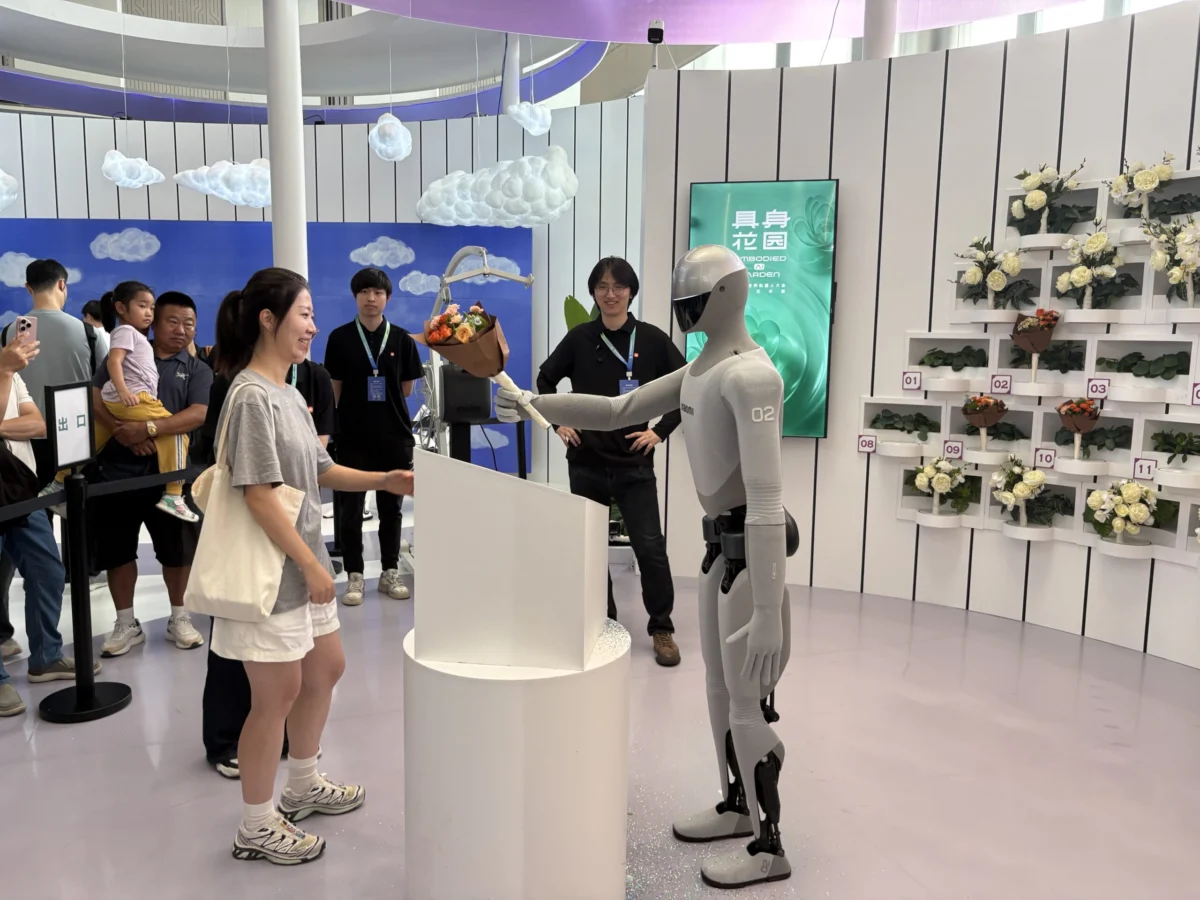
The global humanoid robotics sector is navigating a complex landscape marked by both exhilarating technological breakthroughs and persistent developmental challenges, further complicated by escalating geopolitical tensions. At the prestigious World Humanoid Conference held in Beijing in August 2026, industry leaders convened to showcase advancements, debate future trajectories, and acknowledge the formidable hurdles still impeding widespread adoption. Chinese consumer electronics giant Xiaomi was among the high-profile participants, demonstrating its latest humanoid robot, underscoring the nation’s ambitious push into advanced robotics. Yet, beneath the veneer of innovation, a consensus emerged: the technology, while promising, is not yet ready for prime time, facing significant bottlenecks in efficiency and learning capabilities.
The World Humanoid Conference: A Global Stage for Innovation
The World Humanoid Conference, an annual event that has steadily grown in prominence, serves as a critical platform for researchers, developers, manufacturers, and investors in the burgeoning humanoid robotics field. Hosted in Beijing, a city at the forefront of China’s strategic investment in artificial intelligence and automation, the 2026 iteration attracted a diverse array of global talent. Its agenda typically spans cutting-edge research presentations, product demonstrations, policy discussions, and investor forums, aiming to accelerate the development and commercialization of humanoid robots. For China, hosting such an event reinforces its commitment to becoming a global leader in high-tech industries, a key pillar of its national strategic plans. This year’s conference, however, was particularly charged, with industry leaders openly addressing the chasm between aspirational visions and current practical realities, set against a backdrop of increasing international regulatory friction.
Technical Bottlenecks: The Efficiency and Learning Conundrum
A central theme echoing through the conference halls was the fundamental challenge of making humanoid robots as efficient and adaptable as their human counterparts. Wang Xingxing, founder of Unitree, a prominent Chinese robotics firm, articulated this dilemma directly to attendees. "Robots are not yet as efficient as humans, and take time to learn new skills, creating a bottleneck for the industry," Wang stated. His remarks came just one day after Unitree experienced a staggering 460% surge on its IPO day, followed by an 18.7% decline on Thursday, a volatility that starkly illustrates the market’s fluctuating confidence in the sector’s immediate commercial viability.
The "efficiency bottleneck" is multi-faceted. It encompasses limitations in dexterous manipulation, where robots struggle with tasks requiring fine motor skills, adaptability to novel objects, or handling deformable materials with the same finesse as humans. Furthermore, navigation in unstructured or dynamic environments remains a significant challenge, requiring advanced perception, planning, and real-time adaptation capabilities that are computationally intensive and prone to error. The process of "learning new skills" for robots, often reliant on sophisticated AI models and extensive training data, is another major hurdle. Unlike humans who can generalize from limited experiences, robots typically require vast datasets or iterative trial-and-error in simulated or real-world environments, a process that is both time-consuming and expensive. This slow learning curve directly impacts deployment costs and the speed at which new applications can be developed, hindering their integration into dynamic workplaces.
Wan Bin, Chief Operating Officer of Keenon, a startup specializing in service robots, further elaborated on the engineering demands. He noted that achieving 50% or even 80% task completion reliably is relatively achievable for robots. However, scaling that to a 99.9% completion rate – the standard often required for real-world commercial deployment where errors can be costly or dangerous – "really tests engineering and training capabilities." This minute difference represents an enormous leap in development effort, requiring robust error recovery systems, sophisticated sensor fusion, and highly refined control algorithms.
Geopolitical Headwinds: The FCC’s Restrictive Stance
Adding another layer of complexity to the global robotics landscape are the intensifying geopolitical tensions, particularly between the United States and China. In July 2026, the U.S. Federal Communications Commission (FCC) announced a significant policy shift, adding foreign-made advanced robotic devices, including humanoids, to a restricted list impacting imports to the U.S. While the official statement did not explicitly name a country, the move was widely interpreted within the industry as targeting Chinese technology, reflecting broader concerns over national security, data privacy, and intellectual property in the U.S.-China tech rivalry. The FCC clarified that retailers could still import models previously approved, but the directive signals a tightening of regulations that could reshape global supply chains for advanced robotics.
The implications of such restrictions are a subject of intense debate. Jeff Burnstein, president of the Association for Advancing Automation (A3), offered a pragmatic perspective. He told CNBC that the immediate impact on the U.S. market for humanoids isn’t substantial, primarily because "there aren’t that many humanoids being used in the U.S." This indicates that while the regulatory move is significant politically, its practical effect on current market dynamics for humanoids is limited due to the nascent stage of the technology’s widespread adoption. However, Burnstein highlighted that "where the impact might be in the U.S. is on autonomous mobile robots, which are used in factories that much more than humanoids are." This underscores a critical distinction in the robotics market: highly functional, purpose-built industrial robots and AMRs are already integrated into supply chains, making them more susceptible to trade restrictions, whereas general-purpose humanoids are still largely in R&D or pilot phases.
The FCC’s action is part of a broader trend of technological decoupling, where nations seek to secure their supply chains and protect sensitive technologies from perceived foreign threats. For the humanoid robotics industry, this could lead to a bifurcation of markets, potentially slowing global standardization efforts and increasing development costs as companies adapt to different regulatory environments. It also poses a challenge for international collaboration, which has historically been a driver of innovation in complex technological fields.
Market Pragmatism: Solutions Over Form Factor
Despite the futuristic allure of humanoids, the current market demand, particularly from businesses looking to enhance efficiency, is strikingly pragmatic. Jeff Burnstein emphasized this point, stating, "What I hear from customers in the U.S. [is that] ‘we want solutions. We have a problem. We need a solution. We don’t care if it’s a humanoid. We don’t care if it’s a traditional robot, a collaborative robot. We don’t even care if it’s a robot. We need a solution.’" This sentiment highlights a critical challenge for humanoid developers: proving their technology offers tangible, cost-effective solutions that outperform existing automation methods or human labor.
The onus, therefore, falls squarely on "humanoid players to show we have a solution," Burnstein added, stressing the need for robots to be "affordable, safe and ready to use." This means moving beyond impressive demonstrations to robust, reliable, and commercially viable products. The current state of technology means that companies deploying robots for efficiency gains are often not even considering humanoids, opting instead for established, specialized robotic systems that have proven their return on investment. The global market for industrial robots, for instance, has been steadily growing, with thousands of units deployed annually in manufacturing and logistics, solving specific problems with high precision and repeatability. In contrast, the market for general-purpose humanoids remains largely speculative, awaiting breakthroughs that can bridge the gap between human-like capabilities and practical utility.
Pioneering Practical Applications: Keenon’s Hybrid Strategy
Amidst these challenges, some companies are adopting innovative strategies to carve out early niches for humanoid robots. Keenon, the service robot startup, exemplifies this pragmatic approach. COO Wan Bin detailed Keenon’s strategy of developing humanoids for specific tasks, often in conjunction with simpler, dedicated delivery robots. For example, in hotels, Keenon’s humanoids are being deployed to handle laundry services, performing tasks that might be too complex or varied for traditional industrial robots but are routine enough to be automated. This hybrid model leverages the strengths of different robot types: simpler robots for repetitive, structured tasks, and more advanced humanoids for tasks requiring greater dexterity, perception, or interaction with human environments.
Keenon’s business partners, which include major brands like Buffalo Wild Wings and Hilton, attest to the growing demand for automation in service industries. The company’s impressive shipment figures further validate its strategy: Keenon has shipped more than 100,000 robots to date and expects that number to exceed 150,000 units by the end of next year. While these figures likely encompass a range of service robots, including their simpler delivery models, they indicate a successful path for deploying automation where specific pain points can be addressed. Their approach to humanoid integration, focusing on narrow, high-value applications, offers a potential blueprint for early commercialization while the broader challenges of general-purpose humanoids are being tackled.
The Global Race and Future Outlook
The discussions at the World Humanoid Conference underscored a fierce global competition in robotics, with nations like China, the U.S., Japan, and European countries investing heavily in R&D. Companies like Tesla with its Optimus bot, Figure AI, Agility Robotics (Digit), and Boston Dynamics (Atlas) are all pushing the boundaries of humanoid capabilities, showcasing impressive feats of mobility and manipulation. China, in particular, has outlined ambitious plans to dominate the robotics sector, with significant government funding and policy support aimed at fostering domestic innovation and market leadership.
Looking ahead, the path to widespread humanoid adoption is multifaceted. It will require not only significant technological advancements in AI, sensor fusion, battery technology, and materials science but also a keen understanding of economic viability and societal acceptance. Reducing manufacturing costs, ensuring robust safety standards, and simplifying the integration of robots into existing workflows are paramount. The long-term vision of humanoids assisting across industries, from manufacturing and logistics to healthcare and domestic services, remains compelling. However, the immediate future demands a focus on solving specific, high-value problems with reliable, affordable, and safe robotic solutions. As the industry grapples with these technical and geopolitical complexities, the journey from impressive demonstrations to ubiquitous deployment promises to be one of sustained innovation and strategic navigation.
