

The United States housing market is exhibiting a remarkable resilience, with homebuyers seemingly adapting to an elevated interest rate environment, pushing overall mortgage application volume up by 1.7% last week compared with the preceding week. This uptick, reported by the Mortgage Bankers Association’s (MBA) seasonally adjusted index, occurred even as the average contract interest rate for 30-year fixed-rate mortgages reached its highest point in over a month, signaling a potential shift in buyer psychology and market expectations. The data comes amidst a complex backdrop of persistent inflation and evolving geopolitical tensions, particularly concerning the war with Iran, which has demonstrably influenced economic sentiment and borrowing costs.
The latest figures, current as of Saturday, May 9, 2026, reveal that the average contract interest rate for 30-year fixed-rate mortgages with conforming loan balances—those at or below $832,750—edged up to 6.46% from 6.45%. This marginal increase, though seemingly small, marks a significant psychological threshold, representing the highest rate observed in more than four weeks. Concurrently, points for these loans, including the origination fee for a 20% down payment, saw a slight decrease to 0.63 from 0.66, suggesting lenders might be adjusting other fees to mitigate the impact of rising rates. Despite these higher borrowing costs, applications for a mortgage to purchase a home recorded a robust 4% increase for the week and stood an impressive 7% higher than the corresponding week one year ago, underscoring a persistent underlying demand.
A Market Adapting to the "New Normal"
The current housing market dynamics reflect a broader acceptance among prospective buyers that the era of ultra-low mortgage rates, a hallmark of the post-2008 financial crisis recovery and the early pandemic period, is firmly in the past. For much of the 2010s and into the early 2020s, rates frequently hovered below 4%, sometimes even dipping under 3%, creating an unprecedented environment for homeownership and refinancing. However, a combination of factors, including aggressive monetary policy tightening by the Federal Reserve to combat persistent inflation, supply chain disruptions, and more recently, geopolitical instability, has driven borrowing costs significantly higher.
The "new normal" is characterized by rates consistently above 6%, a level that would have been considered prohibitive just a few years prior. Yet, the recent surge in purchase applications indicates that many buyers, after a period of adjustment and perhaps sidelined anticipation of rate decreases, are re-engaging with the market. This renewed vigor suggests that factors beyond immediate interest rate fluctuations, such as accumulated savings, lifestyle changes, and the fundamental desire for homeownership, are now taking precedence for a significant segment of the population.
Joel Kan, an MBA economist, captured this sentiment succinctly, stating in a release, "Potential homebuyers shrugged off the current economic and mortgage rate uncertainties and returned to the market." This observation points to a psychological shift, where buyers, having absorbed the reality of higher rates, are now prioritizing their housing needs over waiting for potentially elusive lower rates, especially given the ongoing inflationary environment which erodes purchasing power over time.
Chronology of Market Dynamics and Influencing Factors
The current rebound in buyer demand follows a period of significant volatility and uncertainty that marked the beginning of the spring housing market. This crucial selling season, typically characterized by increased activity, initially stalled. The slowdown coincided directly with the start of the war with Iran, a major geopolitical event that sent ripples through global financial markets and amplified existing economic anxieties. The conflict, escalating in early spring, introduced a new layer of uncertainty, impacting everything from oil prices to investor confidence, and consequently, bond yields—the primary determinant of mortgage rates.
Prior to the conflict, the market was already grappling with the Federal Reserve’s sustained efforts to curb inflation, which had seen the benchmark federal funds rate climb steadily over the preceding two years. These rate hikes were a direct response to a "hotter-than-expected" monthly report on consumer prices, indicating that inflationary pressures were more entrenched than initially projected. Such reports often lead to market expectations of continued Fed tightening, pushing bond yields and mortgage rates higher.
However, in the last few weeks leading up to this report, a notable shift began to emerge. Lawrence Yun, chief economist for the National Association of Realtors (NAR), observed a "surge in buyer demand" during a conference call discussing April home sales. This resurgence, coming on the heels of the initial market stall, suggests a period of adaptation, where buyers, having initially paused, re-evaluated their positions and decided to proceed with their purchase plans. This could be attributed to several factors: pent-up demand from buyers who delayed purchases earlier in the year, a realization that rates might not significantly decline in the near future, or a fear of missing out (FOMO) as home prices, despite higher rates, have largely remained firm or continued to appreciate in many desirable areas.
Supporting Data and Market Specifics
The detailed breakdown of mortgage applications provides a granular view of the market’s current state. The 1.7% increase in total mortgage application volume represents a significant inflow of activity, translating to hundreds of thousands of potential transactions across the country. The dominance of purchase applications, which rose by 4% weekly and 7% annually, highlights that the primary driver of this market activity is new home acquisitions rather than refinancing existing loans.
The average contract interest rate of 6.46% for 30-year fixed-rate mortgages with conforming loan balances represents a slight but impactful increase from the previous week’s 6.45%. For a loan of $400,000, even a marginal increase of 0.01% can translate to hundreds of dollars more in interest paid over the life of the loan. The associated points decreasing to 0.63 from 0.66, including origination fees for loans with a 20% down payment, indicates a slight reduction in upfront costs, which might be a strategic move by lenders to make mortgages marginally more attractive despite the higher headline rate.
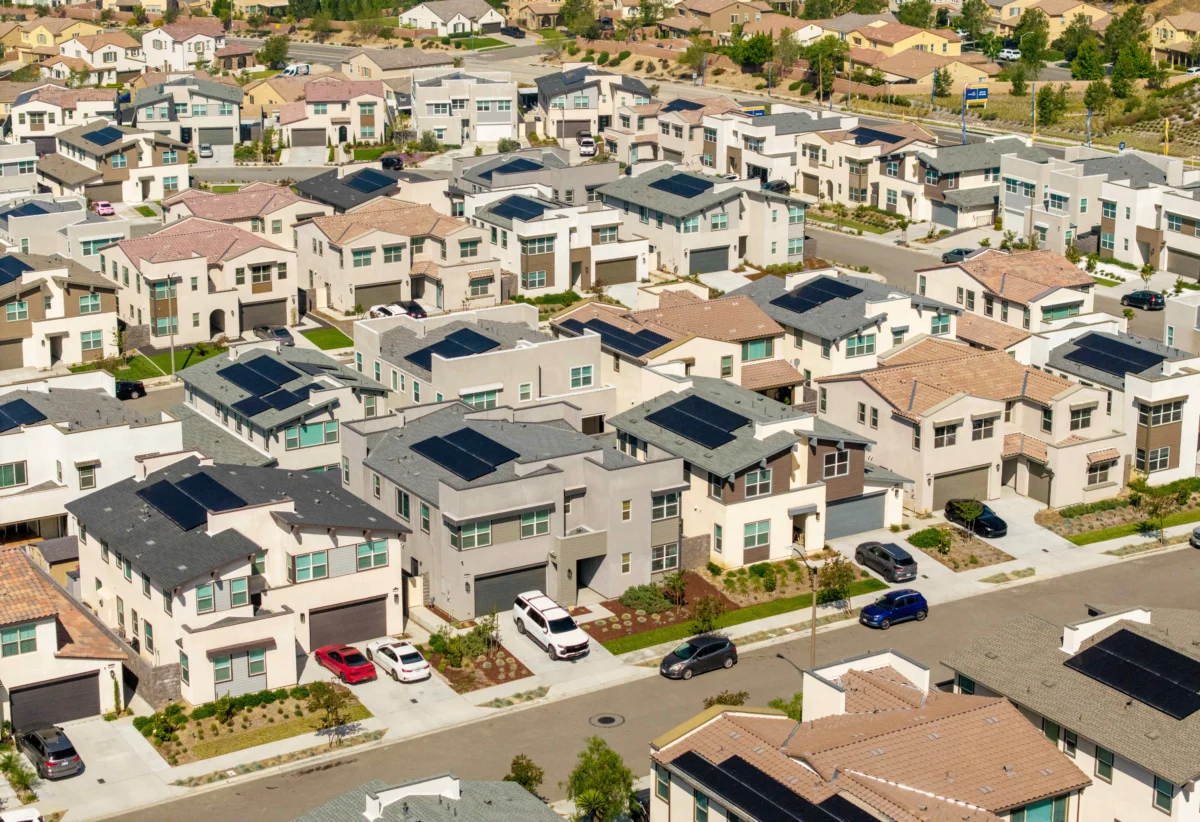
Further supporting data from regional markets, such as Fontana, California—the setting for the accompanying image of new homes—often reflects these broader national trends but with localized intensity. California’s housing market, characterized by persistent demand and limited inventory, typically sees strong competition. Even with higher rates, a new development in a growth area like Fontana is likely to attract significant interest, as the fundamental drivers of population growth and economic opportunity continue to underpin housing demand. While specific local data for Fontana on this exact date is not provided, the visual context suggests a vibrant construction sector attempting to meet demand.
Refinance Market: A Divergent Path
While purchase applications are surging, the refinance segment of the market tells a different story. Applications to refinance a home loan fell 1% for the week, indicating that current rates are largely unattractive for homeowners looking to reduce their monthly payments. Despite this weekly decline, refinance applications were still 28% higher than the same week one year ago, reflecting a baseline of activity that likely includes homeowners who secured much lower rates in the past and are now using their equity for various purposes (e.g., home improvements, debt consolidation) or those who simply missed earlier opportunities.
However, the longer-term trend for refinancing is clear: "Refinance applications declined slightly, led by conventional and VA refinancings, and accounted for a little more than 40 percent of applications last week, the lowest share since July 2025," Kan elaborated. This shrinking share underscores the impact of higher rates. Homeowners who secured mortgages during the low-rate environment of 2020-2022 have little incentive to refinance at current rates. The remaining refinance activity likely comes from a niche segment, such as those with adjustable-rate mortgages resetting to higher payments, or those needing to tap into equity for specific financial needs, rather than seeking lower rates.
Official Responses and Expert Commentary
The statements from Joel Kan of the MBA and Lawrence Yun of the NAR are critical in understanding the professional assessment of the market. Kan’s observation that homebuyers are "shrugging off" uncertainties suggests a pragmatic approach from consumers. This could mean they have come to terms with inflation as a persistent force, making real estate an attractive hedge, or that they are simply unwilling to delay life events any longer. Yun’s report of a "surge" from real estate agents reinforces the on-the-ground reality that buyer traffic has increased noticeably, translating into concrete interest and offers.
Further expert analysis from financial institutions and real estate brokerages often supports these views, providing additional nuance. Economists frequently point to the "lock-in effect," where existing homeowners with low rates are reluctant to sell, thus limiting inventory and paradoxically supporting prices even in a high-rate environment. This creates a challenging market for first-time buyers and those looking to move, often forcing them to accept higher rates or delay their plans. However, the recent data suggests a segment of buyers is now breaking through this "lock-in" barrier, driven by necessity or long-term investment goals.
Broader Impact and Implications
The continued robustness of the housing market, particularly in purchase activity, carries significant implications for the broader economy. Housing is a foundational sector, influencing construction, manufacturing (appliances, furniture), retail spending, and employment. A sustained increase in purchase demand, even at higher rates, can inject confidence into these related industries.
However, the interplay of geopolitical events and inflation remains a critical concern. Mortgage rates moved sharply higher to start the current week, a direct reaction to "less optimistic news on a possible resolution to the Iran war," as well as the aforementioned "hotter-than-expected monthly report on consumer prices." According to a separate survey from Mortgage News Daily, the average rate on the 30-year fixed mortgage has moved 14 basis points higher so far this week, indicating that market volatility linked to global events and domestic economic data is far from over. This immediate response underscores the sensitivity of the financial markets to these external factors. Any further escalation in the conflict or sustained high inflation figures could push rates even higher, testing the limits of buyer resilience.
For homebuyers, the implication is clear: the cost of borrowing is likely to remain elevated, and potentially increase further, in the near term. This necessitates careful budgeting, strong financial planning, and potentially adjusting expectations regarding the size or location of their desired home. For sellers, increased buyer demand, particularly in regions with limited inventory, could translate into quicker sales and potentially fewer concessions.
From a macroeconomic perspective, the Federal Reserve will be closely monitoring these trends. While a robust housing market can indicate economic strength, unchecked inflation remains the primary concern. If housing demand contributes to inflationary pressures (e.g., through rising rents or construction costs), the Fed may feel compelled to maintain its restrictive monetary policy for longer, or even consider further rate hikes, creating a feedback loop that could eventually dampen housing activity.
The housing market’s current trajectory highlights a complex dance between persistent demand, adaptive consumer behavior, and powerful external forces. As the "new normal" solidifies, homebuyers and industry stakeholders alike will need to remain agile, informed, and prepared for continued adjustments in a landscape shaped by both domestic economic realities and global geopolitical shifts.
For those navigating these complex market conditions, understanding the latest trends and expert analysis is paramount. Resources like CNBC’s Property Play with Diana Olick offer weekly insights into new and evolving opportunities for real estate investors, delivered directly to your inbox. Subscribing to such specialized newsletters can provide crucial guidance in an ever-changing market.
