

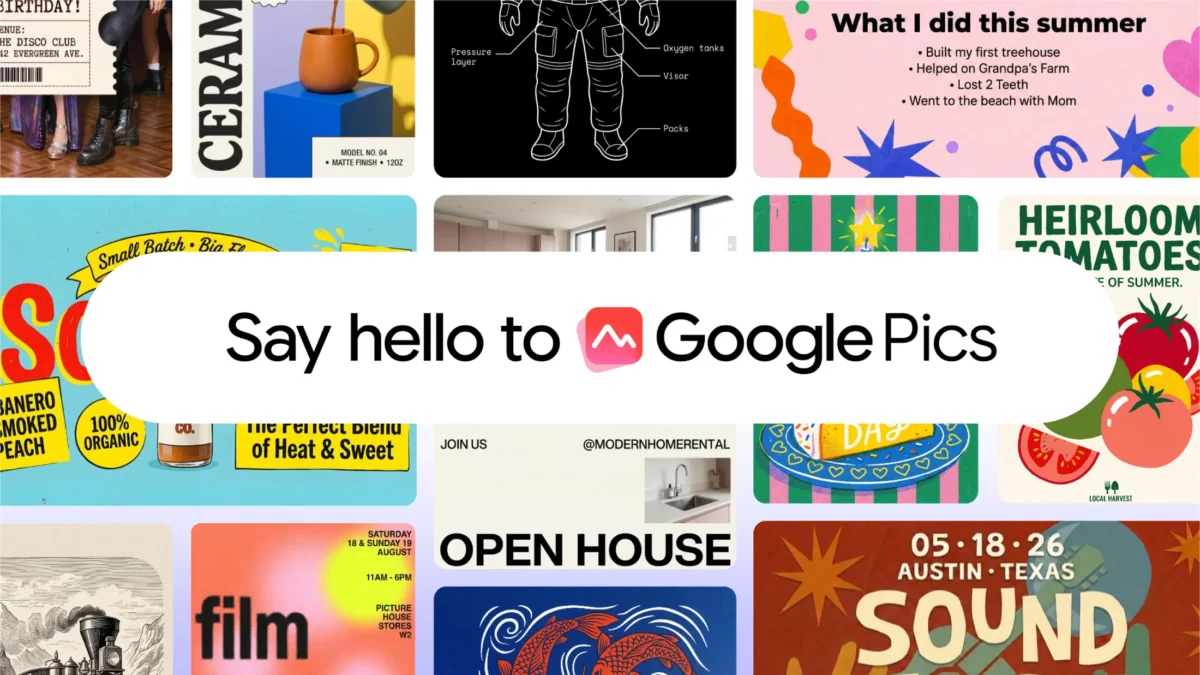
Google has officially announced its entry into the competitive creative design market with the introduction of Google Pics, a sophisticated image-creation and editing tool designed to reside within the Google Workspace ecosystem. This strategic move positions the technology giant as a direct competitor to established design platforms like Canva and Adobe Express, signaling a significant shift in how corporate and creative assets are generated within professional environments. The new tool is powered by Google’s proprietary Nano Banana image-generation model, a specialized architecture optimized for efficiency and high-fidelity visual output. According to the company’s rollout schedule, Google Pics will become available over the coming weeks to a broad spectrum of Workspace customers, as well as individual subscribers of the Google AI Pro and Ultra tiers.
The launch marks a pivotal moment in the evolution of Google Workspace, transforming it from a suite of productivity and communication tools into a comprehensive creative hub. By embedding generative AI directly into the workflow of documents and presentations, Google aims to eliminate the friction associated with switching between different applications to find or create visual content. The initial phase of the rollout begins today with integration into Google Docs and Google Slides, with plans to expand the service to Google Drive in the near future. This phased approach allows Google to monitor user interaction and refine the interface before a total ecosystem-wide deployment.
Technical Architecture and the Nano Banana Model
At the core of Google Pics is the Nano Banana model. While Google has historically utilized its Gemini and Imagen models for broad AI tasks, Nano Banana appears to be a more streamlined, task-specific iteration designed for the rapid generation of workplace-appropriate visuals. This model is engineered to balance computational efficiency with the nuanced requirements of professional design, such as maintaining brand consistency and adhering to specific aspect ratios required for social media and corporate presentations.
The choice of the "Nano" prefix suggests that the model is designed to run efficiently across various hardware configurations, potentially allowing for faster rendering times within the browser-based Workspace environment. Industry analysts suggest that by developing a model specifically for design tasks, Google can offer a more tailored experience than general-purpose image generators. This specialization is crucial for enterprise customers who require reliable, high-quality outputs that do not necessitate the complex prompt engineering often associated with more experimental AI tools.
Feature Set and Collaborative Capabilities
Google Pics is not merely a static image generator; it is a multi-faceted editing suite. One of its most touted features is the ability to isolate and transform objects within an image. This "object-aware" editing allows users to move elements, resize them, or remove them entirely without compromising the background—a task that previously required professional-grade software like Adobe Photoshop. Furthermore, the tool includes advanced text manipulation features, such as the ability to modify or translate text found within an image. This is particularly relevant for global teams who need to localize marketing materials or internal communications quickly.
Collaboration remains a cornerstone of the Google Workspace philosophy, and Google Pics reflects this. The tool supports real-time collaborative editing, allowing multiple team members to refine a design simultaneously. When a user enters a prompt, the AI generates several variations of the requested image. Team members can then vote on, comment on, or further iterate upon these versions, ensuring that the final product meets the collective requirements of the group. This iterative process is designed to mimic the traditional design review workflow but at a significantly accelerated pace.
A Comparative Analysis: Google Pics vs. Canva and Adobe Express
The entry of Google into this space creates an immediate rivalry with Canva and Adobe. However, the operational philosophy of Google Pics differs fundamentally from its competitors. Canva has built a massive ecosystem based on a marketplace model. In Canva’s environment, professional artists, illustrators, and photographers can upload templates and graphics, earning royalties when users utilize their assets. This creates a symbiotic relationship between the platform and the creative community. In contrast, Google Pics is built entirely on generative AI. The images it produces are synthesized from a model trained on vast datasets of existing artwork, meaning there is no direct royalty pipeline for individual human creators within the app itself.
The distinction between Google Pics and Adobe Express is equally stark. Adobe Express is often viewed as a "bridge" tool for creators who might also use Adobe’s Creative Cloud suite (such as Illustrator or Photoshop). It provides a high degree of manual control, allowing users to build designs from scratch using a combination of stock assets and manual drawing tools. Google Pics, however, is a "prompt-to-create" tool. It is designed for the user who may not have formal design training but needs a professional-looking result quickly. While it offers editing tools, the primary method of creation is through natural language descriptions, shifting the user’s role from a "designer" to a "director."
Market Context and the AI Design Revolution
The launch of Google Pics occurs against a backdrop of explosive growth in the generative AI sector. According to market research data, the global generative AI market is expected to grow at a compound annual growth rate (CAGR) of over 30% through 2030. Within this, the sub-sector of AI-driven design tools is seeing the most rapid adoption among small to medium-sized enterprises (SMEs) and large corporations looking to reduce costs associated with stock photography and basic graphic design.
Google’s decision to bundle this tool into Workspace is a calculated move to increase the "stickiness" of its subscription services. By offering Google Pics to AI Pro and Ultra subscribers, Google is providing a tangible value proposition for its higher-priced tiers. For enterprise customers, the integration simplifies the procurement process; instead of managing separate licenses for Canva or Adobe, companies can consolidate their design needs within the existing Google ecosystem. This consolidation is a significant trend in corporate IT, where "vendor fatigue" has led many organizations to favor all-in-one platform solutions.
Chronology of Development and Rollout
The path to Google Pics has been paved by several years of incremental AI advancements within Google Research.
- 2022: Google introduces Imagen, showing significant progress in photorealistic text-to-image synthesis.
- Early 2023: Integration of AI-assisted features in Slides, such as "Help me visualize," which allowed users to generate simple backgrounds.
- Late 2023: The announcement of the Gemini era, focusing on multimodal AI that can understand and generate text, images, and code.
- Today: The official launch of Google Pics and the Nano Banana model, representing a move from "experimental feature" to a standalone, integrated product.
- Coming Weeks: Rollout to Workspace Business, Enterprise, and Education tiers.
- Future Phase: Integration into Google Drive, allowing for centralized asset management and AI-powered image organization.
Industry Reactions and Ethical Considerations
The reaction from the creative industry has been a mixture of curiosity and concern. Professional organizations representing illustrators and photographers have raised questions regarding the training data used for the Nano Banana model. Since Google Pics generates content based on patterns learned from existing art, the debate over "fair use" and the displacement of human labor remains at the forefront. Unlike the marketplace model of Canva, which provides a financial incentive for human creators, Google’s AI-centric approach is viewed by some as a potential threat to the freelance economy.
Conversely, corporate leaders have welcomed the announcement. Chief Information Officers (CIOs) of major firms have noted that the ability to generate internal-use visuals—such as deck illustrations or employee newsletter headers—without navigating copyright hurdles or stock photo subscriptions is a significant efficiency gain. Google has responded to ethical concerns by stating that the tool is designed to augment human creativity rather than replace it, emphasizing its utility for "everyday design tasks" rather than high-end commercial art.
Broader Implications for the Future of Work
The introduction of Google Pics suggests a future where visual literacy becomes as essential as textual literacy in the workplace. As AI tools lower the barrier to entry for creating high-quality visuals, the expectation for polished, image-rich communication will likely increase. This "democratization of design" means that a project manager or a software engineer can now produce visual content that previously required a dedicated graphic designer.
However, this shift also places a new burden on users to understand the nuances of AI-generated content, including the potential for "hallucinations" (visual artifacts or logical errors in the image) and the importance of ethical prompting. As Google Pics moves into Google Drive, the implications for digital asset management are also profound. AI could theoretically categorize and search for images based on their visual content rather than just their filenames, making the retrieval of assets more intuitive than ever before.
In conclusion, Google Pics represents a major strategic alignment for Google. By leveraging its strengths in AI and its massive Workspace user base, the company is not just adding a feature, but is attempting to redefine the standard workflow for professional design. As the rollout continues, the industry will be watching closely to see how this affects the market shares of Canva and Adobe, and how it transforms the visual landscape of the modern office. For now, Google has made its message clear: the future of design is integrated, collaborative, and, above all, powered by AI.
