

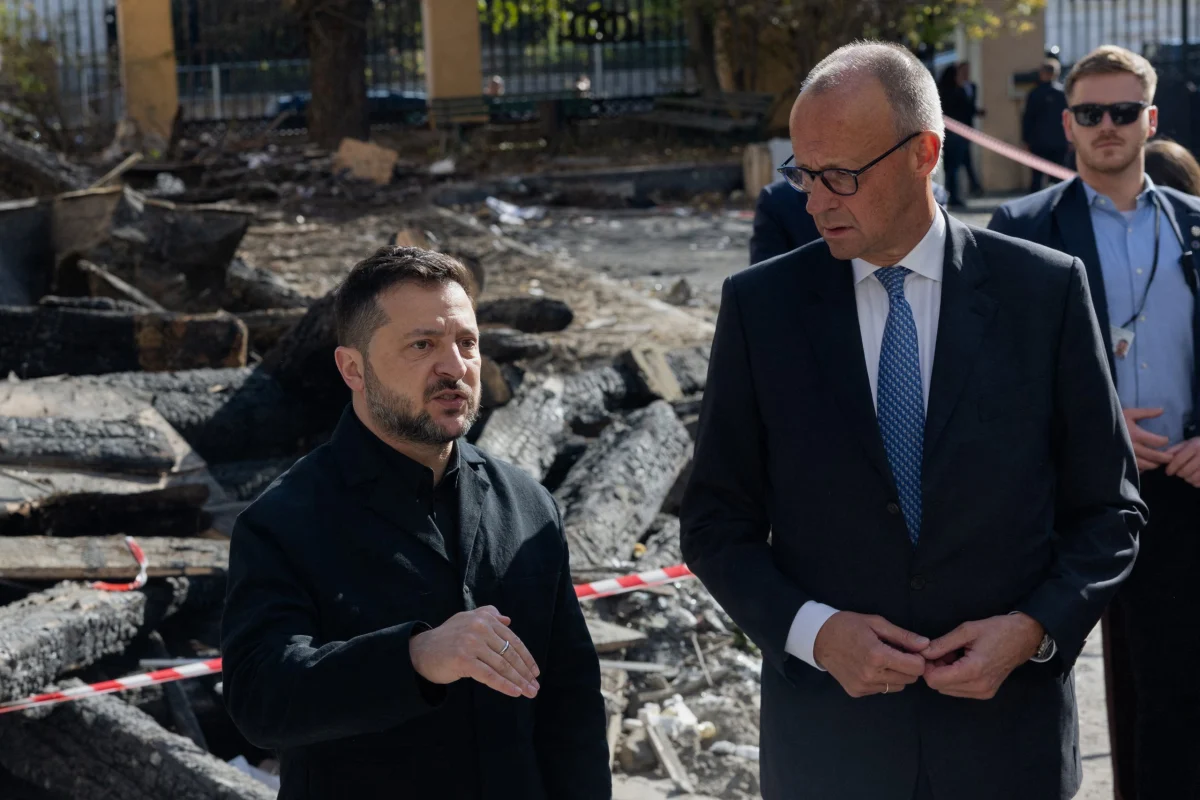
German Chancellor Friedrich Merz arrived in Kyiv on Sunday, October 4, 2026, for an unannounced visit, a powerful demonstration of solidarity that unfolded against a backdrop of air raid sirens and fresh Russian missile strikes targeting the Ukrainian capital. The timing of Merz’s visit, intended to reaffirm Germany’s steadfast support for Ukraine, coincided with a significant Russian assault, including a direct hit on a key bridge in Kyiv, underscoring the relentless aggression faced by the nation. His arrival, shrouded in operational secrecy until his presence in the city, served as a potent symbol of defiance against Russian attempts to destabilize Ukraine and intimidate its international partners.
Context of a Crucial Visit Amid Escalation
Chancellor Merz’s delegation landed in Kyiv at a particularly tense juncture in the protracted conflict. The unannounced nature of the visit itself was a testament to the prevailing security environment, where the threat of Russian aerial attacks is a constant reality. Just hours before his arrival, and indeed during his presence, Kyiv experienced renewed barrages of missiles and drones, disrupting daily life and causing further damage to critical infrastructure. This immediate, palpable danger highlighted the courage required for such high-level diplomatic engagements and amplified the message of unwavering commitment that Merz sought to convey. The visit came barely a day after Russia’s Ministry of Defence issued a stark warning to foreign diplomats and nationals, urging them to leave the capital to avoid potential harm, a clear attempt to deter international engagement with Ukraine. Merz’s decision to proceed despite these threats projected a strong image of Western resolve.
In a statement released upon his arrival, Chancellor Merz articulated the urgency of his presence: "I travelled to Kyiv today because Ukraine needs all our support in the coming weeks." He further emphasized the broader geopolitical stakes, warning, "If Russia is not stopped, its war machine will sooner or later turn against us." This sentiment reflects a growing consensus among European leaders that the conflict in Ukraine is not merely a regional dispute but a direct challenge to the fundamental principles of international law and security architecture in Europe. Germany, once criticized for its perceived reluctance to provide robust military assistance, has since emerged as one of Ukraine’s most significant benefactors, a transformation in foreign policy catalyzed by the full-scale invasion that began in February 2022.
The Unfolding Scene in Kyiv: A City Under Siege
The atmosphere surrounding Merz’s visit was immediately defined by the sounds of conflict. Air raid sirens blared across Kyiv shortly after the Chancellor’s arrival, a chilling soundtrack to high-stakes diplomacy. These warnings were not mere precautions; they were followed by confirmed explosions, signaling active Russian strikes. One of the most significant incidents was the strike on the Northern Bridge, a vital artery spanning the Dnipro River. Kyiv Mayor Vitali Klitschko quickly confirmed the damage via social media, reporting that the attack not only impacted the structural integrity of the bridge but also disrupted road traffic and the supply of hot water to the surrounding residential areas. This marked the second bridge in the capital to be hit over the weekend, indicating a deliberate and intensified targeting strategy by Russia against Kyiv’s logistical and civilian infrastructure.
Chancellor Merz’s itinerary included a poignant meeting with President Volodymyr Zelenskyy at the National Academy of Sciences, a location itself symbolic of the ongoing conflict, having been struck by a Russian drone on September 28. During their discussions, President Zelenskyy painted a stark picture of life under constant threat, telling Merz that Kyiv’s citizens are enduring "terrible nights and days" due to the relentless Russian attacks. This personal testimony from the Ukrainian leader underscored the human cost of the conflict and the immediate necessity of sustained international aid. The decision to meet at a recently targeted civilian institution was a subtle yet powerful defiance, showing that even under threat, the symbols of Ukrainian intellectual life and governance remain operational.
Germany’s Enduring Commitment: Aid, Industry, and Strategic Partnership
Merz’s visit was not merely symbolic; it carried significant material weight in the form of substantial new commitments. He was accompanied by Germany’s economy minister, along with a delegation of high-profile executives from major German companies, including Siemens Energy and Diehl Defence. This composition highlighted a dual focus: immediate military support and long-term strategic industrial cooperation.
Germany has steadily solidified its position as one of Ukraine’s most steadfast supporters. Following the initial invasion in 2022, Berlin underwent a profound shift in its foreign and defense policy, famously termed the "Zeitenwende" (turning point) by Chancellor Merz. This paradigm shift translated into unprecedented levels of military, financial, and humanitarian aid. In April of the preceding year, the two countries had already formalized a significant military pact valued at more than $4 billion, providing Ukraine with crucial weaponry ranging from Leopard main battle tanks to advanced air defense systems like IRIS-T and Patriot missile batteries.

On this visit, Chancellor Merz was poised to announce an additional military aid package worth $1.1 billion. This substantial injection of resources is critical for Ukraine’s defense, especially as the conflict continues its fifth year with no end in sight. Furthermore, an allocation of $394 million was earmarked specifically for repairing damage to Ukraine’s beleaguered energy sector. This particular aid is vital as Ukraine braces for the approaching winter months, historically a period when Russia intensifies its strikes on energy infrastructure to inflict maximum hardship on the civilian population and cripple industrial capacity. The resilience of Ukraine’s energy grid is paramount for both military operations and civilian survival.
Beyond immediate aid, a pivotal aspect of the visit involved discussions to finalize a groundbreaking deal for the joint production of drones and other advanced weaponry. Critically, these collaboratively produced systems are envisioned to possess a range exceeding 600 miles (965.6 km), enabling Ukraine to strike deeper into Russian territory. This initiative represents a strategic pivot, moving beyond mere arms transfers to fostering Ukraine’s indigenous defense industrial base. Such a move would not only reduce Ukraine’s long-term reliance on foreign aid but also strengthen its self-sufficiency and deterrent capabilities against future aggression. For Germany, it signifies a deeper integration of its defense industry with that of Ukraine, reflecting a shared strategic interest in European security. The participation of companies like Diehl Defence, a key player in air defense and precision munitions, underscores the seriousness of these industrial cooperation efforts. Siemens Energy’s presence, meanwhile, hints at potential collaboration in rebuilding and modernizing Ukraine’s energy infrastructure, an equally critical component of long-term recovery and resilience.
Escalation and Russian Strategic Objectives
The context of Merz’s visit is inextricably linked to the ongoing escalation of hostilities. The war, now in its fifth year, has witnessed both sides intensify their use of drone and missile attacks, targeting infrastructure, logistics hubs, and military sites. Russia’s recent surge in aggression is, in part, a retaliatory measure. Just prior to Merz’s arrival, President Zelenskyy had stated in an interview with Reuters that Ukraine was "doubling down" on targeting Russian oil refineries, a strategy aimed at disrupting Moscow’s war economy. This came after a weekend of significant civilian casualties and injuries within Ukraine, prompting Kyiv to escalate its counter-strikes.
Russia’s Ministry of Defence had explicitly promised to intensify its strikes on Ukraine following Zelenskyy’s remarks. The attack on the Northern Bridge and other infrastructure in Kyiv demonstrates Moscow’s commitment to this threat, employing a strategy of attrition and psychological warfare. By striking civilian infrastructure and urban centers, Russia aims to undermine Ukrainian morale, disrupt supply lines, and drain Kyiv’s resources, while simultaneously signaling its unwillingness to yield. The targeting of energy facilities, in particular, is a well-established tactic designed to create humanitarian crises, force mass displacement, and pressure the Ukrainian government. These strikes also serve a dual purpose of demonstrating Russian capabilities and projecting an image of strength to its domestic audience.
Broader Implications and Future Outlook
Chancellor Merz’s visit carries significant geopolitical implications. It sends an unequivocal message of Western resolve to Russia, demonstrating that Moscow’s attempts to intimidate international partners will not deter their support for Ukraine. The presence of a major European leader in Kyiv, defying explicit Russian warnings, underscores the collective commitment to Ukraine’s sovereignty and territorial integrity. This show of unity is crucial for maintaining cohesion within the European Union and NATO, especially as the conflict drags on and fatigue could potentially set in.
The agreement for joint weapons production, particularly long-range systems, marks a significant shift in the strategic landscape. It signifies a long-term investment in Ukraine’s defense capabilities, moving beyond immediate battlefield needs to building a sustainable military-industrial complex. This could have profound effects on Ukraine’s ability to defend itself in the coming years and potentially reshape the balance of power in Eastern Europe. For Germany, this deeper cooperation solidifies its role as a leading European security provider and a key player in shaping the continent’s future defense posture.
Economically, the presence of German business leaders signals confidence in Ukraine’s eventual recovery and a willingness to invest in its future, despite the ongoing conflict. Rebuilding Ukraine’s infrastructure, particularly its energy grid, will require massive international investment and expertise, and Germany appears poised to play a central role. The focus on energy sector repair is not just about immediate relief; it’s about laying the groundwork for a more resilient and modern Ukrainian economy post-conflict.
The humanitarian toll of the war remains immense, as evidenced by President Zelenskyy’s description of "terrible nights and days." The constant threat of strikes, displacement, and the destruction of homes and livelihoods continue to inflict profound suffering on the Ukrainian population. International support, both military and humanitarian, is therefore not just a strategic imperative but a moral one.
As the war enters its fifth year, the visit of Chancellor Merz serves as a powerful reminder of the enduring nature of the conflict and the unwavering, albeit evolving, commitment of Ukraine’s allies. The challenges ahead are formidable, ranging from sustaining military aid and rebuilding a shattered nation to countering Russian aggression and holding perpetrators accountable. However, the defiance demonstrated by both Ukrainian leadership and its international partners, even under the direct threat of war, suggests a continued determination to secure a sovereign and peaceful future for Ukraine. The path ahead remains arduous, but the unity displayed in Kyiv on this critical Sunday in October 2026 offers a beacon of hope amidst the darkness of ongoing conflict.
