

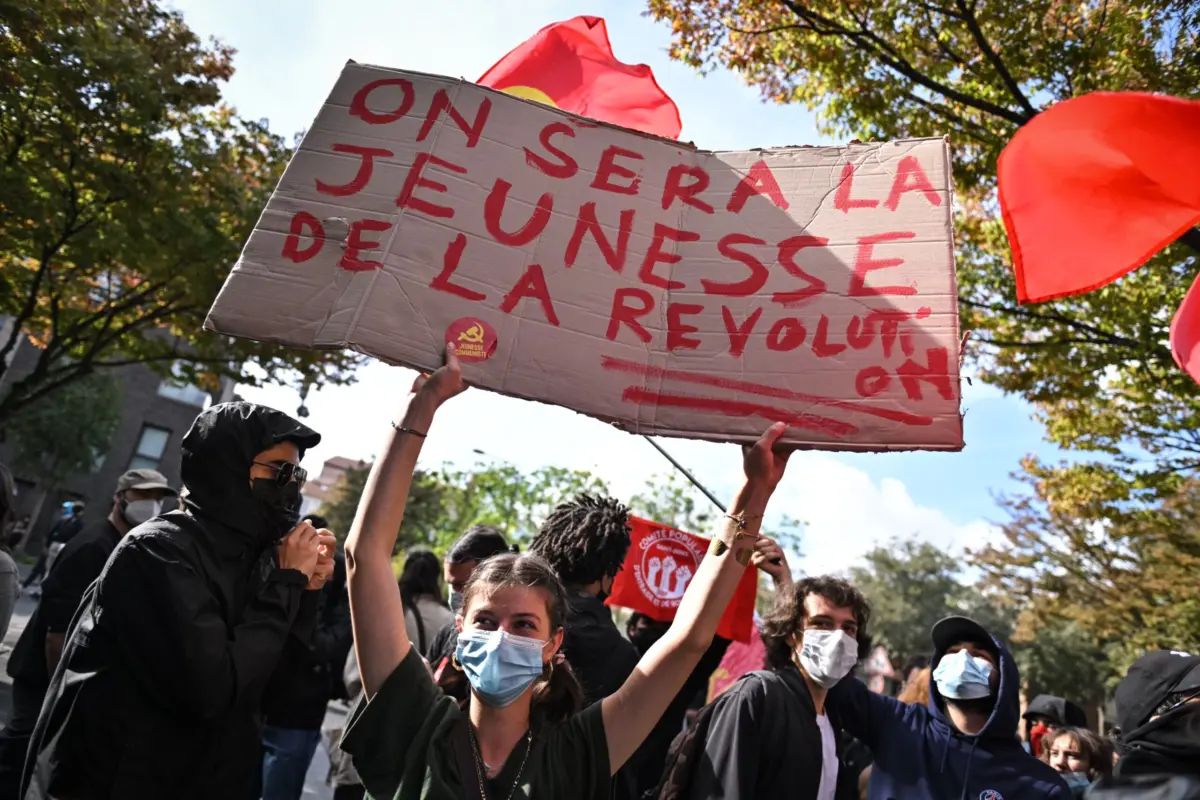
The scale of protests raging across France over the education system, attracting hundreds of thousands of pupils, teachers, and parents, has been described as exceptional by unions and student movement organisers, marking a potential turning point in the nation’s social landscape. Alice Cohen-Morzadec, international spokesperson for France’s Student Union, declared on Tuesday that the movement is "very historic and unprecedented by how big it is," with government sources estimating the number of protesters at 266,000 on that day alone. "Some are saying this is the biggest movement since May 1968," she added, drawing a potent historical parallel that underscores the gravity of the current unrest and its potential for widespread societal impact as France gears up for presidential elections in the coming year, a political landscape increasingly eyed by the far right.
The Unprecedented Scale of Discontent
The initial spark for this wave of protests ignited on September 21 at an underdeveloped high school in a Parisian suburb, a seemingly isolated incident that quickly spiraled into a nationwide phenomenon. Within weeks, the movement swelled, encompassing not only high school students but also university students, teachers, and parents, transforming localised grievances into a collective outcry. The rapid mobilisation and the sheer number of participants have astonished observers, with union figures often exceeding government estimates, pointing to a deep-seated dissatisfaction transcending specific educational concerns.
Organisers highlight the breadth of participation, noting that the protests are not confined to traditional student activist circles but draw from a wide demographic, including younger pupils experiencing their first taste of social action. This broad base suggests that the issues at stake resonate far beyond the immediate academic environment, tapping into a broader sense of disillusionment and anxiety among the youth and their families. The involvement of major educational unions and parent associations further legitimises the movement, lending it significant institutional backing and amplifying its demands on the national stage.
Echoes of History: The Shadow of May 1968
The comparison to May 1968 is not made lightly in France, a nation acutely aware of its revolutionary heritage. The student protests at Paris universities nearly five decades ago were initially driven by opposition to what was perceived as an outdated and overcrowded system, limited opportunities for a burgeoning post-war youth generation, and broader political concerns about authoritarianism under President Charles de Gaulle. That unrest soon spread beyond campuses, expanding into nationwide strikes involving millions of workers that virtually paralysed the country, leading to significant social reforms and a shift in political discourse.
While the current movement shares thematic similarities with 1968 – funding for education, teacher shortages, overcrowded classes, and dilapidated school facilities – historians and student organisers caution against a simplistic equivalence. Robi Morder, a researcher on social movements in France, points out that while the triggers may appear similar, the socio-political context is vastly different. "In 1990 and 1998, governments were led by socialists and leftists. Some of the ministers had been in the youth movement. So when there was an issue, the government knew how to negotiate. In 1990, the president himself received a delegation of students," Morder explained. This historical capacity for dialogue, he suggests, is starkly absent today.
The current protests also recall more recent, albeit smaller, student movements in France, such as those in 1986 against university reforms, 1990 over high school conditions, and 1998 against university selectivity. Each of these moments saw significant student mobilisation, often forcing government concessions, demonstrating a recurring pattern of youth activism as a powerful political force in France. The scale of the current demonstrations, however, places them in a category rarely seen since the transformative period of the late 1960s.
Beyond the Classroom: Deeper Roots of Frustration
While immediate issues like underfunding, lack of teachers, and poor facilities serve as direct grievances, analysts argue these are merely "triggers" for a much deeper malaise. Andrew Smith, a historian of modern France and lecturer in Liberal Arts at Queen Mary University of London, characterizes the underlying sentiment among young people as a "crisis of hope." He elaborates on the multitude of anxieties besieging French youth: "You can see they are bombarded daily with economic problems, political extremes, dangers of warfare in Europe, the threat to their careers from AI, high youth unemployment rates, the climate crisis."
Economically, young French citizens face a challenging landscape. Persistent inflation, which has seen energy and food prices soar in recent years, significantly erodes purchasing power, making it harder to afford housing, education, and daily necessities. Youth unemployment, while fluctuating, often remains higher than the national average, creating a sense of precarity for those entering the job market. The looming threat of Artificial Intelligence replacing certain jobs adds another layer of anxiety about future career prospects, especially for those currently in education.
Politically, the rise of extremist parties, particularly the far-right, creates a volatile and uncertain future. The prospect of significant shifts in national policy and social cohesion fuels apprehension among a generation that often leans towards more progressive and inclusive values. Geopolitical tensions, including the ongoing conflict in Ukraine and other regional instabilities, contribute to a pervasive sense of global insecurity, directly impacting young people who envision their future in an increasingly fragmented world.
Furthermore, the climate crisis is a particularly potent concern for this generation, which will bear the brunt of environmental degradation. Smith highlighted an immediate catalyst for the current protests: "This school year started very differently. The never-ending heatwaves is one thing that really provoked it and made it catch fire. We had classrooms with over 40 people in temperatures exceeding 40 degrees [Celsius; 104 Fahrenheit]. That is untenable." This direct experience of climate change’s impact on their daily lives has transformed abstract environmental concerns into immediate, tangible grievances within the educational setting.
A Crisis of Dialogue: Government’s Stance Under Scrutiny
A significant factor exacerbating the current unrest, according to both historians and student organisers, is a perceived lack of substantive interaction and dialogue between the government and student representatives and unions. Andrew Smith noted the difficulty for the current administration "to meet with interlocutors and try to have dialogue with social partners."
Robi Morder further elaborated on this, contrasting the present government’s approach with past administrations. He suggested that the current political class, largely drawn from a different ideological background and lacking personal experience in youth movements, struggles with the art of social negotiation. "We are not in the same situation because the government is not only from the other side politically, but they also don’t have the experience of the old political class," Morder asserted. "They don’t know how to negotiate a social conflict. The government’s first answer is, ‘It is nothing; we will call the police, and everything will be OK.’"
This perceived dismissiveness and reliance on law enforcement rather than dialogue deeply frustrates student organisers. Chloe Grunenwald, vice president of the Federation of the General Association of Students (FAGE), the largest organisation of its kind in France, representing some 300,000 students, voiced this frustration: "This is too much. Enough is enough. We have been making these demands for years. We need more money for education, we need more teachers, we need better facilities." The feeling that their long-standing concerns are being ignored or met with insufficient engagement fuels the resolve to continue protesting.
The broadening of the coalition, with university unions like FAGE and France’s Student Union (represented by Grunenwald and Cohen-Morzadec, respectively) actively rallying in support of high school pupils, underscores a unified front and a collective belief that the government is not taking their demands seriously. When interviewed by Al Jazeera, several students reiterated their solidarity, indicating that the initial grievances of a suburban high school have blossomed into a nationwide expression of generational discontent.
Student Demands: A Unified Call for Change
Student unions have coalesced around a comprehensive list of 10 demands, publicly outlining their vision for a reformed education system and a more supportive environment for young people. These demands, estimated to cost the government 1 billion euros ($1.1bn), represent a significant investment in the future of France’s youth and are seen as non-negotiable by the protesting groups.
The key demands include:
- Greater Investment in Schools and Universities: A fundamental call for increased public funding to address years of perceived underinvestment, which has led to dilapidated infrastructure and inadequate resources.
- More Staff and Space in Higher Education: To combat overcrowded classrooms and improve the student-to-teacher ratio, ensuring better learning conditions and individualised support.
- Stronger Financial Support for Students: This encompasses various measures aimed at alleviating the financial burden on students, including increased scholarships and grants.
- Improved Housing Support: Addressing the critical issue of affordable student housing, which is a major concern in urban centers.
- Affordable University Meals: Calls for subsidized or lower-cost meals at university cafeterias to ensure food security for all students.
- An End to Higher Fees for International Students: Reversing policies that have increased tuition fees for non-EU students, which critics argue undermines France’s appeal as an international study destination and creates an elitist system.
- An End to All Forms of Repression Linked to the High School and Student Movement: A direct response to allegations of police brutality and perceived heavy-handed tactics used against protesters.
- Improved Mental Health Services for Students: Recognizing the growing mental health crisis among young people, especially in the post-pandemic era.
- Better Integration of Environmental Education: Reflecting the generation’s strong climate concerns, demanding a more robust and practical approach to ecological issues within the curriculum.
- Democratic Reform of Educational Governance: Advocating for greater student and teacher representation in decision-making bodies within the education system.
These demands illustrate a holistic vision for an education system that is not only adequately funded but also equitable, supportive, and responsive to the contemporary challenges faced by young people.
Escalation and Official Response: Navigating Allegations of Brutality
The intensity of the protests has been met with significant police presence, leading to numerous confrontations and allegations of police brutality from protest organisers and unions. Alice Cohen-Morzadec criticised media focus on property damage: "Unfortunately, the media are talking about how bins are being burnt, schools are being blocked, and how it is a form of violence. The real violence is actually coming from the government side." These accusations mirror long-standing complaints about police tactics during social movements in France, which often draw criticism from human rights groups.
In a potential sign of conciliation, Prime Minister Sebastien Lecornu acknowledged the student grievances on Wednesday, stating, "Students must be heard." Concurrently, Interior Minister Laurent Nunez ordered police to suspend the use of stun grenades against protesting high school pupils, a tactic that had drawn particular condemnation for its potential to cause serious injury. This move, while significant, is viewed by many as a tactical concession rather than a fundamental shift in approach.
However, these gestures might not be sufficient to calm the widespread anger. Student organisers remain resolute, viewing the concessions as minimal in the face of their comprehensive demands. The immediate halt of stun grenade use, while welcomed, does not address the broader allegations of disproportionate force or the perceived lack of willingness to engage in genuine dialogue.
Looking Ahead: The Road to October 17 and Beyond
The student movement has strategically aligned itself with broader social and labor actions, indicating a potential for the current unrest to merge with wider societal grievances. Alice Cohen-Morzadec articulated the students’ determination: "We are going to mobilise until we get our demands, especially because we have October 17 and November 20 – as an international date for the youth in all Europe to mobilise for our future, so we want to continue at least until those dates, if not further."
Nationwide strikes and anti-government demonstrations are indeed scheduled for October 17, expected to bring together a large number of unions to air their grievances against soaring energy and food prices, proposed budget cuts, and freezes on public sector salaries. These economic concerns resonate deeply with the student body, many of whom come from families directly impacted by the cost-of-living crisis. The convergence of student and labor movements presents a formidable challenge to the government, potentially creating a unified front of social discontent.
The strikes are backed by the left-wing France Unbowed (LFI) party, led by Jean-Luc Melenchon, and the country’s main labour union, the Confédération Générale du Travail (CGT). This political endorsement, while providing additional leverage, has also drawn criticism. Critics have accused the LFI and Melenchon of inciting violence to score political points against the government, an accusation they and protest organisers vehemently deny. Chloe Grunenwald asserted the independence of the student movement: "Our message has been the same. We are fighting for our rights and our demonstrations are passive. We are not working on behalf of anyone else." This assertion seeks to maintain the movement’s integrity and focus on its core demands, separate from partisan political agendas, even as political actors seek to align with or influence its trajectory.
Broader Implications: A Nation at a Crossroads
The ongoing education protests carry significant broader implications for France, particularly as the nation heads into the 2027 presidential elections. The prolonged unrest could serve as a powerful indicator of widespread public dissatisfaction, influencing voter sentiment and shaping the electoral agenda. The rise of the far-right, already a prominent feature of French politics, could either be fueled by the perceived instability or challenged by a re-energized left-wing opposition capitalizing on social grievances.
The government faces a delicate balancing act. A heavy-handed response risks alienating a generation of voters and further eroding trust in institutions, potentially radicalizing segments of the population. Conversely, appearing too yielding could be perceived as weakness, inviting further demands and potentially emboldening other sectors to strike. The challenge for the administration lies in demonstrating a capacity for genuine dialogue and effective problem-solving, rather than simply managing protests through security measures.
The "crisis of hope" described by historians suggests that the education protests are not merely about classroom conditions but reflect a deeper generational anxiety about the future of French society. How the government responds to these multifaceted concerns – from economic precarity to climate change and political extremism – will define not only the outcome of this specific movement but potentially the trajectory of French politics and social cohesion for years to come. The students, by taking to the streets, have forced a national conversation that extends far beyond school gates, placing the future of France firmly on the public agenda.
