

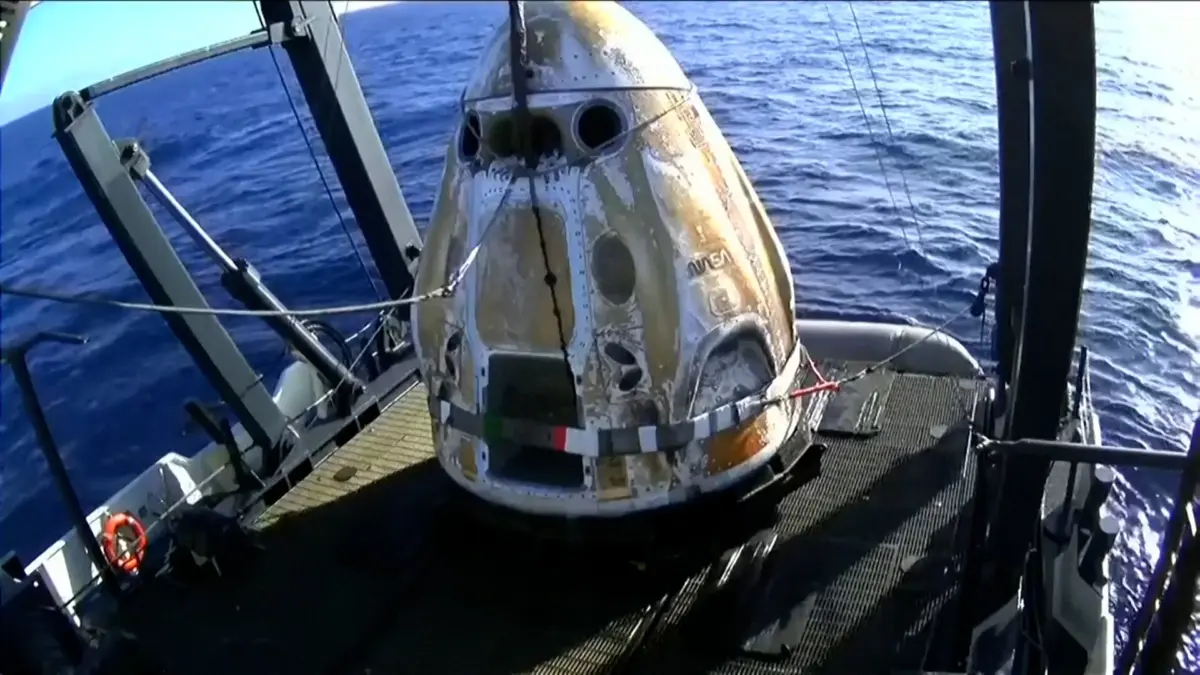
Four international astronauts successfully returned to Earth on Thursday, October 8, 2026, marking the conclusion of an extensive eight-month scientific expedition aboard the International Space Station (ISS). The crew, comprising two NASA astronauts, one European Space Agency (ESA) astronaut, and one Japan Aerospace Exploration Agency (JAXA) astronaut, completed a precision parachute-assisted splashdown in the Pacific Ocean off the coast of California, bringing an end to their critical contributions to orbital research and station maintenance. The flawless re-entry and recovery operation underscored the advanced capabilities of modern commercial crew transportation systems and the robust international collaboration that defines the ISS program.
The Crew and Their Mission: "Vanguard-3" Expedition
The returning quartet, designated as the "Vanguard-3" expedition crew, included Commander Dr. Evelyn Reed (NASA), Pilot Dr. Kenji Tanaka (JAXA), Mission Specialist Dr. Anya Sharma (ESA), and Mission Specialist Dr. Marcus Bell (NASA). Launched aboard a SpaceX Crew Dragon capsule named "Resilience-2" on February 8, 2026, from NASA’s Kennedy Space Center in Florida, their mission was a pivotal component of the ISS’s ongoing scientific agenda, focusing on human health in microgravity, materials science, astrophysics, and Earth observation. Over their 242 days in orbit, the crew circled the Earth approximately 3,872 times, traveling an estimated 160 million kilometers – a distance equivalent to more than one trip to the Sun and back. Their tenure on the orbital outpost saw them become integral to Expedition 70 and later Expedition 71, contributing to a seamless transition of command and continuous scientific output.
The Journey Home: Deorbit and Splashdown
The intricate sequence for returning the crew began hours before splashdown with the meticulous undocking of the Crew Dragon "Resilience-2" from the Harmony module’s forward international docking adapter (IDA) on the ISS. Following a series of carefully executed orbital maneuvers to distance itself from the station, the spacecraft initiated its deorbit burn, a critical firing of its thrusters designed to slow its velocity and begin its descent into Earth’s atmosphere. This burn, lasting approximately 16 minutes, precisely targeted the landing zone in the Pacific.
As "Resilience-2" plunged into the upper atmosphere, its robust heat shield bore the brunt of intense friction, reaching temperatures of up to 1,650 degrees Celsius (3,000 degrees Fahrenheit). The subsequent atmospheric drag significantly slowed the capsule’s descent, preparing it for the crucial parachute deployment sequence. At an altitude of approximately 5,500 meters (18,000 feet), two drogue parachutes unfurled, stabilizing the capsule. Moments later, at around 1,800 meters (6,000 feet), the four main parachutes deployed, slowing the Crew Dragon to a gentle descent velocity of about 7.6 meters per second (17 mph) for its final splashdown. The capsule touched down smoothly at 1:47 PM PDT, approximately 100 kilometers (60 miles) off the coast of San Diego, California.
Within minutes, specialized recovery teams aboard support vessels, including the primary recovery ship "GO Navigator," converged on the capsule. Paramedics and medical personnel were on standby to conduct initial health assessments of the returning astronauts. The crew members were extracted from the capsule, assisted by the recovery team, and transported by helicopter to a nearby medical facility for more comprehensive post-flight examinations and rehabilitation, a standard procedure designed to help them re-adapt to Earth’s gravity after prolonged exposure to microgravity.
A Chronology of Discovery: Eight Months Aboard the ISS
The "Vanguard-3" mission, spanning from February to October 2026, was characterized by an ambitious schedule of scientific inquiry and operational tasks.
- February 8, 2026: Launch of "Resilience-2" carrying Dr. Reed, Dr. Tanaka, Dr. Sharma, and Dr. Bell from Kennedy Space Center’s Launch Complex 39A.
- February 9, 2026: Successful autonomous docking of "Resilience-2" with the ISS, followed by hatch opening and welcoming ceremonies with the incumbent Expedition 70 crew.
- March – April 2026: The crew actively engaged in a series of "Microgravity Crystallization" experiments, growing protein crystals in space to better understand complex biological structures, which has direct implications for drug development on Earth. Dr. Sharma, an expert in materials science, also oversaw the "Advanced Alloy Manufacturing" project, testing new techniques for creating stronger, lighter metallic alloys in the absence of gravitational sedimentation.
- May 2026: Dr. Bell and Dr. Reed conducted two complex spacewalks (Extravehicular Activities or EVAs) totaling over 13 hours. These EVAs were critical for upgrading the station’s external power systems, replacing a faulty battery charge/discharge unit, and installing new external communication antennae, ensuring the continued operational integrity of the orbital outpost.
- June 2026: A significant portion of the month was dedicated to "Veggie-3" experiments, advancing space agriculture by testing new cultivation methods for fresh produce. Dr. Tanaka, with his background in biology, was particularly involved in understanding plant growth dynamics in microgravity and evaluating the nutritional content of space-grown crops, vital for future long-duration missions to the Moon and Mars.
- July 2026: The crew hosted visiting resupply missions, including a Northrop Grumman Cygnus and a SpaceX Cargo Dragon, overseeing the meticulous unpacking and stowing of thousands of pounds of scientific equipment, provisions, and spare parts. This period also saw the activation of new biological research modules focused on understanding immune system responses to long-term spaceflight.
- August 2026: Focus shifted to Earth observation and climate science. Utilizing the station’s external cameras and specialized sensors, the crew captured high-resolution imagery of various geographical regions, monitoring deforestation, glacier melt, and urban expansion, contributing valuable data to international climate research initiatives.
- September 2026: Preparations for their return intensified, alongside continued scientific work. The crew performed detailed inventories, packed critical research samples for return to Earth, and conducted handover briefings with the newly arrived Expedition 71 crew members, ensuring a smooth transition of responsibilities and ongoing experiments.
- October 8, 2026: Undocking from the ISS and subsequent successful splashdown in the Pacific Ocean.
Scientific Harvest: The Research Legacy
The "Vanguard-3" mission generated a wealth of scientific data, contributing to hundreds of ongoing experiments across various disciplines. The crew meticulously performed over 200 distinct scientific investigations, accumulating thousands of hours of research time. The samples brought back to Earth, carefully stored in specialized freezers within the Crew Dragon, include biological specimens, material science samples, and plant growth experiments, which will now undergo extensive analysis by researchers worldwide.
Key scientific contributions are expected in several areas:
- Human Physiology: Data on bone density loss, muscle atrophy, cardiovascular changes, and neurological adaptations in microgravity will further inform countermeasures for long-duration spaceflight, crucial for missions to Mars. The crew participated in daily exercise regimens and detailed physiological monitoring, providing invaluable longitudinal data.
- Materials Science: The creation of advanced alloys and semiconductor crystals in microgravity offers unique properties unattainable on Earth, potentially leading to breakthroughs in electronics, aerospace, and medical technologies.
- Space Biology and Agriculture: Insights into plant growth and microbial behavior in space are fundamental for developing sustainable life support systems for future lunar and Martian outposts.
- Earth Science: Enhanced observation data, particularly from regions affected by climate change and natural disasters, will aid in environmental monitoring and disaster response planning.
These findings are not merely academic; they directly impact the development of safer and more efficient space travel, foster innovations applicable to terrestrial industries, and deepen humanity’s understanding of life beyond Earth.
Official Voices and Anticipation
Following the successful recovery, statements from the involved space agencies reflected a mix of relief, pride, and anticipation.
NASA Administrator, Dr. Seraphina Chen, remarked, "The flawless return of the ‘Vanguard-3’ crew is a testament to the dedication of our international partners, the ingenuity of commercial spaceflight providers like SpaceX, and the unwavering courage of our astronauts. Their eight months on the International Space Station have yielded invaluable scientific insights that will propel us forward in our journey to the Moon and Mars, while also delivering tangible benefits here on Earth."
ESA Director General, Professor Jan Wörner, added, "Dr. Sharma and her colleagues have exemplified the spirit of international collaboration that underpins the ISS. The European experiments conducted during this mission will significantly advance our understanding of life in space and contribute to the next generation of European scientific endeavors."
A JAXA spokesperson highlighted Dr. Tanaka’s contributions, stating, "Dr. Tanaka’s expertise in biological sciences was instrumental in key experiments on space agriculture and human health. His safe return marks another successful chapter in JAXA’s commitment to global space exploration."
Initial communications from the astronauts, though brief due to medical protocols, conveyed profound gratitude and a sense of accomplishment. Dr. Reed was heard expressing relief and excitement to see her family, while Dr. Tanaka reportedly commented on the surprising strength of Earth’s gravity after so long in weightlessness. Full debriefings and public appearances are anticipated after a period of rest and medical evaluation.
Broader Implications for Space Exploration
The "Vanguard-3" mission’s successful conclusion reinforces several critical trends and implications for the future of space exploration.
Firstly, it underscores the continued importance of the International Space Station as a unique microgravity laboratory. Despite ongoing discussions about its eventual decommissioning around 2030, missions like "Vanguard-3" demonstrate its irreplaceable role in conducting long-duration research, testing technologies, and preparing humans for deeper space exploration. The data gathered is directly informing the development of Artemis missions to the Moon and eventual crewed missions to Mars, particularly regarding radiation exposure, psychological resilience, and closed-loop life support systems.
Secondly, the reliability of commercial crew transportation, exemplified by the SpaceX Crew Dragon, is a game-changer. The successful deployment and recovery of "Resilience-2" highlights the maturity and safety of privately developed spacecraft, reducing reliance on government-operated vehicles and fostering a more competitive and innovative space industry. This model is paving the way for future private space stations and commercial space tourism, broadening access to low-Earth orbit.
Thirdly, the international composition of the crew—representing NASA, ESA, and JAXA—reaffirms the strength of global partnerships in space. In an increasingly complex geopolitical landscape, the ISS stands as a beacon of cooperation, allowing nations to pool resources, share expertise, and pursue common scientific goals. This collaborative model will be vital for future ambitious projects, such as lunar gateway stations and Martian expeditions, which will likely require multi-national efforts.
Finally, the mission serves as an enduring source of inspiration. The scientific breakthroughs, technological advancements, and the sheer human endeavor involved in spending eight months orbiting Earth captivate public imagination, encouraging new generations to pursue careers in STEM fields and fostering a broader appreciation for scientific discovery. As humanity looks towards expanding its presence beyond Earth, the lessons learned and the knowledge gained from missions like "Vanguard-3" are foundational to unlocking the next frontiers of space exploration. The safe return of these four individuals marks not just the end of a mission, but a significant step forward in humanity’s ongoing journey into the cosmos.
