

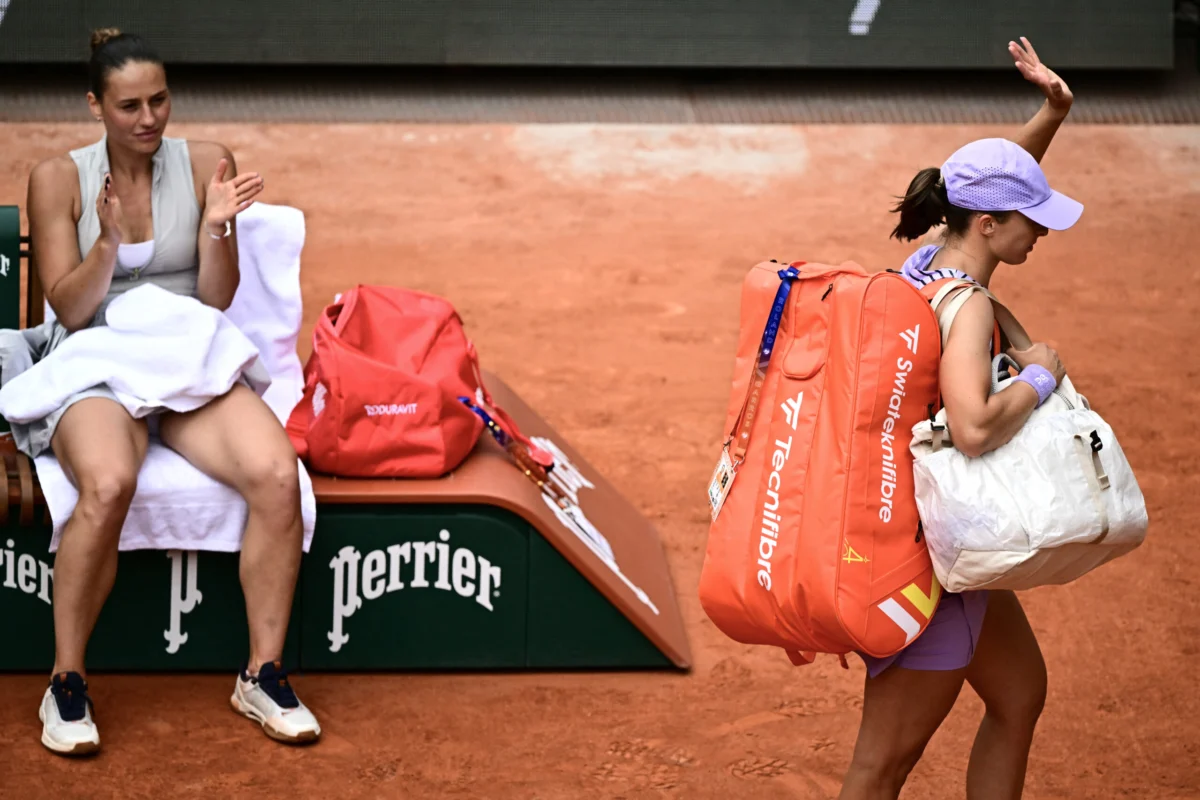
The French Open, renowned for its red clay and gruelling contests, has been rocked by an unprecedented series of upsets in its early stages, culminating in the shocking defeat of four-time champion Iga Swiatek. The Polish third seed, widely considered the "Queen of Clay" and a formidable contender for a fifth Roland Garros title, was ousted in straight sets by Ukraine’s 15th seed Marta Kostyuk in the round of 16. The 7-5, 6-1 defeat on Sunday marked a particularly poignant moment as it occurred on Swiatek’s 25th birthday, turning what should have been a celebration into a day of unexpected exit. This high-profile departure followed a cascade of other top-tier players exiting the tournament, including men’s world number one Jannik Sinner, 24-time Grand Slam winner Novak Djokovic, and defending women’s champion Coco Gauff, transforming the 2026 edition of Roland Garros into a tournament of unforeseen possibilities and emerging narratives.
The Shockwave on Court Philippe-Chatrier: Swiatek’s Unexpected Demise
Iga Swiatek arrived in Paris with an formidable aura, boasting an undefeated 15-0 record on clay this season, including titles in Rouen and Madrid. Her dominance on the surface has been a hallmark of her career, establishing her as the most successful female player at Roland Garros in the modern era, second only to Justine Henin for titles won since the Open Era began. Her quest for a fifth trophy at the clay-court major seemed well on track, making her early exit a seismic event in the women’s singles draw.
The match against Marta Kostyuk, played on the iconic Court Philippe-Chatrier, began with an intensity that belied the eventual scoreline. In the opening set, both players exhibited high-level tennis, exchanging powerful groundstrokes and tactical net play. The early exchanges saw two breaks of serve, indicating a tight contest where neither player was willing to concede ground easily. Kostyuk, however, demonstrated remarkable resilience and a heightened level of play in crucial moments. She held her nerve in the pivotal 11th game, securing a crucial hold, before elevating her game further to claim the first set 7-5 with a decisive backhand crosscourt winner. This set victory was a significant milestone for Kostyuk, as it marked the first time she had ever taken a set off Swiatek in their four career meetings, previous encounters having all gone the Pole’s way in straight sets.
The momentum, once shifted, proved irreversible. Buoyed by her first-set triumph, Kostyuk carried her aggressive yet composed play into the second set. She quickly established a commanding 3-1 lead, capitalizing on a slight dip in Swiatek’s usually unyielding game. While Swiatek fought valiantly, attempting to stem the tide, Kostyuk’s confidence grew with every point. Her serves were potent, her returns incisive, and her movement fluid across the clay. She maintained her focus, denying Swiatek any significant opportunity to mount a comeback. The Ukrainian closed out the set decisively, 6-1, sealing one of the biggest upsets of her career and sending shockwaves through the tennis world.
For Swiatek, the defeat marked a rare moment of vulnerability on her favoured surface. While her birthday often brings good fortune, this occasion proved to be an exception. Her impressive 15-0 clay record for the season was broken, and her quest for a fifth title was prematurely ended. The loss will undoubtedly prompt introspection for the former champion, who has set an incredibly high standard for herself at this tournament.

Kostyuk’s Ascent and Philosophical Victory
Marta Kostyuk’s victory was not merely a physical triumph but also a testament to her evolving mental fortitude and philosophical approach to the game. In her emotional on-court interview immediately after the match, a visibly thrilled Kostyuk confessed, "I’m still in shock." She elaborated on her mindset leading into the match, stating, "I feel like I’ve given myself more space to just create something, to challenge my opponents. I woke up in the morning and all I thought was ‘what an unbelievable day I have to live today… there’s nothing I could do other than this’."
Kostyuk’s candid reflections went deeper than just the match, touching upon her core motivations for playing tennis. "I try not to focus at all on winning and losing, because I’m not playing tennis to win. I’m playing tennis because I love it. I want to connect to people, I want to feel this energy… make people happy and unite people," she explained. This perspective highlights a maturity and self-awareness that often underpins breakout performances on the Grand Slam stage.
Her performance at Roland Garros is a continuation of a promising clay-court season. While the specific tournaments mentioned in the original text (Rouen and Madrid) were previously attributed to Swiatek’s record, it is clear that Kostyuk has been building significant momentum on clay, culminating in this career-defining victory. Her run to the round of 16 and now the quarterfinals at a major is a significant step forward for the Ukrainian, who has steadily climbed the rankings and gained experience on the professional tour. This victory over a dominant clay-court player like Swiatek not only boosts her confidence but also solidifies her position as a legitimate threat in major tournaments. Kostyuk’s next challenge will be against a fellow Ukrainian, the seventh-seeded Elina Svitolina, or the 11th-seeded Swiss Belinda Bencic, in what promises to be another compelling encounter.
A Tournament of Tumult: Major Exits Pave New Paths
The 2026 French Open will be remembered not just for Swiatek’s unexpected exit, but for a remarkable series of early departures by some of the sport’s biggest names. This wave of upsets has dramatically reshaped both the men’s and women’s draws, creating an atmosphere of unpredictability and excitement rarely seen at a Grand Slam.
The men’s singles draw was first to feel the tremors. World number one Jannik Sinner, a rising star and a major contender, was shocked in his third-round match. His exit was followed by the unparalleled upset of Novak Djokovic, the 24-time Grand Slam champion and a multiple French Open winner. Djokovic’s defeat, particularly at an event where he has historically excelled, sent shockwaves through the men’s tour, leaving a vacuum at the top of the draw.
On the women’s side, the defending champion Coco Gauff, who had claimed her maiden Grand Slam title at Roland Garros, also fell prematurely. Her defeat came just a day before Swiatek’s, signalling that the tournament was poised for a shake-up. Gauff’s ouster meant that two of the most dominant forces in women’s tennis over the past year, and the two most recent champions in Paris, were both out before the quarter-finals. The cascade continued with the loss of China’s number one, Wang Xinyu, further thinning the ranks of seeded players.

This succession of high-profile exits has created an unusually open field. For the first time in recent memory, several prominent contenders, including defending champions and world number ones, have exited before the business end of the tournament. This scenario offers a unique opportunity for other players, both established and emerging, to make their mark and potentially claim a coveted Grand Slam title.
The Unforeseen Open Field: New Favourites and Rising Stars
With Swiatek, Gauff, Sinner, and Djokovic out of contention, the landscape of the French Open has dramatically shifted. In the women’s singles, world number one Aryna Sabalenka now stands as the undisputed favourite to claim her first title in Paris. Sabalenka, known for her powerful game and aggressive style, has been a consistent performer at Grand Slams, including multiple major titles. While she has yet to win Roland Garros, her path to the final now appears less fraught with the elimination of her primary rivals. Her ability to navigate the remaining challenges will be a true test of her championship mettle.
Beyond Sabalenka, the open draw presents a golden opportunity for a host of other players. Marta Kostyuk, fresh off her victory over Swiatek, has clearly demonstrated her capability and mental resilience. Her consistent form on clay this season suggests she is not just a one-hit wonder but a serious contender. Other players, perhaps less heralded at the outset, will now see a clearer path to the latter stages, fostering a sense of heightened competition and belief throughout the locker room. The absence of traditional frontrunners often leads to unexpected finalists and champions, making the remainder of the tournament exceptionally compelling for fans and analysts alike.
Veteran’s Valiant Run: Sorana Cirstea Rewrites Her Story
Amidst the drama of top seeds falling, another compelling narrative unfolded on Court Suzanne-Lenglen, featuring the remarkable journey of Romanian veteran Sorana Cirstea. At 36 years old, and with her retirement planned for the end of the season, Cirstea proved that dreams indeed have no expiry date, as she defeated China’s Wang Xinyu 6-3, 7-6(4) to reach her first Roland Garros quarter-final in an astonishing 17 years.
Cirstea’s career has been one of perseverance and dedication. Her previous Grand Slam quarter-final appearances were few and far between, with her last at the French Open dating back to 2009. This gap of 17 years between her first two quarter-finals at a women’s singles major is the longest in the Open Era, a testament to her enduring passion and commitment to the sport. Her victory over Wang Xinyu was hard-fought, showcasing her experience and ability to perform under pressure, particularly in the decisive tie-break of the second set.
In her post-match interview, Cirstea radiated joy and inspiration. "I always thought there is no expiry date for ambition and for dreams. I have so much passion for this sport," she declared. "I absolutely love tennis and to be able to still play at this level – have my family, my team, the closest people watching me – it’s an absolute joy." Her words resonated deeply, particularly in a sport where age is often perceived as a barrier to top-tier performance.

Cirstea directly challenged societal norms, stating, "I think sometimes society puts us in certain groups because of the age. But I think in life, you are free to do whatever you want and I want to play. And here I am, thank you everyone for all the support." Her run is not just a personal triumph but an inspiring message to athletes across all disciplines, demonstrating that dedication and love for the game can defy conventional timelines. As she approaches her final season, Cirstea is crafting a memorable farewell, proving that a career can culminate in unexpected glory.
Historical Echoes and Future Implications
The 2026 French Open is shaping up to be a tournament for the history books, echoing past Grand Slams known for their seismic upsets and the emergence of new champions. The simultaneous exit of multiple top seeds in both the men’s and women’s draws is a rare occurrence, highlighting the increasing depth and competitiveness across professional tennis.
For the women’s tour, Swiatek’s defeat underscores the growing parity and the challenge of maintaining dominance. While Swiatek has been a consistent force, particularly on clay, the field of challengers is stronger than ever. This tournament could signal a shift in the hierarchy, offering a glimpse into potential new rivalries and championship contenders. The implications for the WTA rankings will be significant, with opportunities for players to make substantial gains.
For the tournament itself, the unexpected twists and turns have only amplified interest. Fans are witnessing a true "open" major, where every match carries heightened stakes and the outcome is genuinely uncertain. This unpredictability is a boon for the sport, attracting new audiences and re-engaging existing ones with compelling storylines.
The Road Ahead
As the French Open moves into its decisive stages, the focus will intensify on the remaining players. Aryna Sabalenka’s journey as the new favourite will be under intense scrutiny, while Marta Kostyuk’s challenge to build on her monumental victory will be keenly watched. Sorana Cirstea’s inspiring run will undoubtedly capture the hearts of many, as she aims to extend her dream farewell. With several quarterfinals still to be determined and the semi-finals looming, the clay courts of Roland Garros are set to deliver more thrilling tennis and potentially, the crowning of unexpected champions in this most unpredictable of French Opens. The stage is set for a dramatic conclusion to a tournament that has already defied all expectations.
