

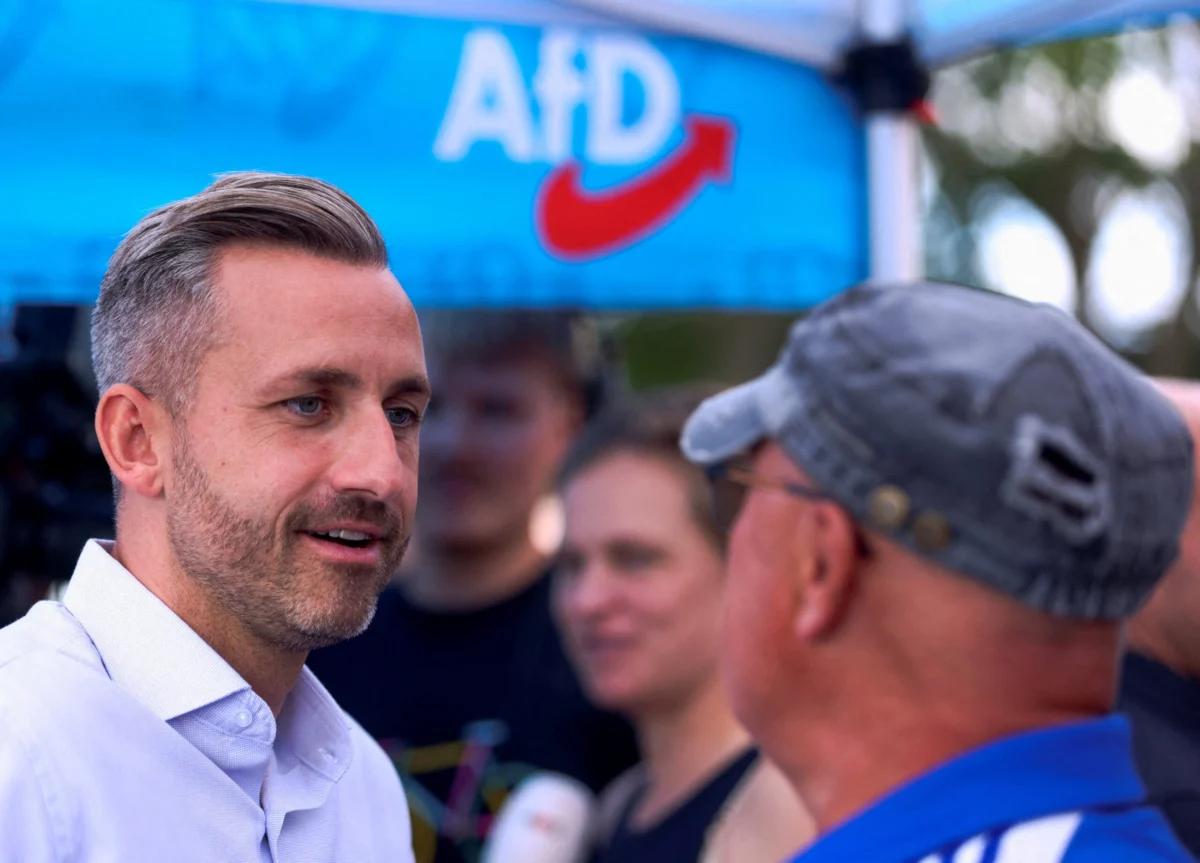
Mario Jung does not fit the conventional profile of a political hardliner or a radical insurgent. A 59-year-old banking clerk residing in Magdeburg, the capital of the eastern German state of Saxony-Anhalt, Jung represents a demographic that was once the bedrock of German stability. For much of his adult life, he cast his ballot for the Christian Democratic Union (CDU), the center-right party that defined the post-war West German "economic miracle" and later steered the nation through reunification. However, Jung’s political allegiance has undergone a fundamental shift, one that mirrors a broader and more turbulent transformation within the German electorate.
Jung attributes his departure from the CDU to the legacy of former Chancellor Angela Merkel, whom he accuses of drifting too far to the left during her sixteen-year tenure. On Sunday, when voters in Saxony-Anhalt head to the polls, Jung intends to cast his vote for the Alternative for Germany (AfD). His motivations are dual-pronged: a deep-seated concern for the national economy and a demand for a restrictive, uncompromising immigration policy. "I am a conservative, and the main reason for me to vote for the AfD is the economy," Jung stated in an interview. He further emphasized his alignment with the party’s stance on migration, asserting that illegal immigrants and those with denied asylum applications must be deported without exception.
The upcoming regional election in Saxony-Anhalt is more than a local contest; it is a high-stakes litmus test for the resilience of Germany’s democratic institutions and the future of its political establishment. For the first time since the end of World War II, a far-right party is in a position to potentially lead a state government. The AfD, led in the state by Ulrich Siegmund, is currently dominating opinion polls, creating a sense of urgency and alarm among mainstream political actors in Berlin.
The Rise of Ulrich Siegmund and the AfD Platform
The face of the AfD’s surge in Saxony-Anhalt is Ulrich Siegmund, a figure who has become a lightning rod for controversy. Once a member of the CDU himself, Siegmund’s transition to the AfD exemplifies the "rightward" migration of voters and politicians who feel the traditional conservative movement has abandoned its core values. His prominence has drawn sharp critiques from the national media; the influential news magazine Der Spiegel recently labeled him "Germany’s most dangerous man," citing his rhetorical style and his role in normalizing extremist discourse.
The AfD’s regional branch in Saxony-Anhalt has been officially classified as "far-right extremist" by Germany’s domestic intelligence agency, the Federal Office for the Protection of the Constitution (BfV). Despite this designation—or perhaps, for some voters, because of it—the party’s popularity remains unshaken. Current polling suggests the AfD could secure more than 40 percent of the vote, a figure that would dwarf its rivals. The CDU, which has historically led the state, trails significantly at approximately 20 percent. Other established parties are struggling to maintain relevance: the Left Party (Die Linke) sits at 12 percent, the Social Democrats (SPD) at 7 percent, and the Greens at a precarious 5 percent.
The party’s election manifesto, titled "The Country First," outlines a radical vision for the state and the nation. Key proposals include:
- The total abolition of the right to asylum.
- The systematic confiscation of cash and assets from asylum seekers to offset state costs.
- The implementation of mass deportations, often referred to by party members as "remigration."
- Criminal penalties, including potential prison sentences, for individuals deemed to have insulted "German identity" or the "historical-cultural entity of Germany."
- The banning of the "Antifa" movement.
- The dismantling of the public broadcasting system (ARD and ZDF).
- A complete reversal of the "Energiewende," Germany’s transition toward renewable energy.
Historical Context: From Euroscepticism to Nationalism
To understand the AfD’s current trajectory, one must look back to its inception in 2013. Originally founded as a "professors’ party" focused on Euroscepticism during the height of the Eurozone debt crisis, the AfD initially sought to challenge the fiscal policies of the European Union. However, the party’s identity underwent a seismic shift in 2015 following Chancellor Merkel’s decision to keep German borders open to approximately one million refugees, primarily from war-torn Syria.
This humanitarian decision became a catalyst for the AfD’s transformation into a populist, anti-immigration movement. Over the last decade, the party has successfully capitalized on cultural anxieties and security concerns. It has frequently politicized high-profile criminal incidents involving asylum seekers, using them as evidence of a "catastrophic migration policy." For instance, a deadly car attack at Berlin’s Pride parade in July was quickly framed by the AfD as a failure of border control, even though investigations later revealed the perpetrator was born in Germany.
The party’s platform has also expanded to include a pro-Russian stance, particularly regarding the war in Ukraine. The AfD has consistently opposed economic sanctions on Moscow, arguing that they harm German industry and energy security. This position resonates strongly in eastern Germany, where historical ties to Russia remain complex and where the economic impact of rising energy costs is felt acutely.
Structural Disparity: The East-West Divide
The AfD’s disproportionate success in the former German Democratic Republic (GDR) states—Saxony-Anhalt, Thuringia, Saxony, and Mecklenburg-Western Pomerania—is the subject of intense sociological study. Analysts point to "structural factors" that have persisted since the reunification of Germany in 1990. While the "Wende" (the turning point) brought political freedom, it also led to the collapse of state-owned industries and a massive exodus of young, skilled workers to the West.
Today, many parts of the East are characterized by depopulated villages, a shortage of medical professionals, and declining public infrastructure. There is a pervasive sense of being "left behind" by a federal government in Berlin that is perceived as prioritizing liberal, urban agendas over the needs of the rural working class.
Thomas Biebricher, a professor at Goethe University Frankfurt, suggests that the AfD’s rise is fueled by a "widespread dissatisfaction with the political situation." He notes that the party has successfully tapped into a "capitalist class" that feels the German state has become over-regulated. "There are influential AfD supporters who believe that taxes should be lowered and that the state should simply intervene less," Biebricher told Al Jazeera. He warned that an AfD victory would not only break a post-1945 political taboo but also "cause considerable damage to Germany’s image" as a stable, investment-friendly democracy.
Data and Analysis: Immigration vs. Economy
While economic grievances are often cited as the primary driver of populism, recent data suggests a more nuanced reality. Martin Schroder, a professor of social sciences at Saarland University, led a decade-long study (2014–2024) to isolate the factors contributing to AfD support. His findings indicate that while economic anxiety is present, it is not the dominant factor.
"Concerns about immigration explain support for the AfD nearly 10 times as much as actual or perceived economic disadvantage," Schroder noted. This suggests that the AfD’s success is rooted more in identity politics and cultural protectionism than in purely material concerns. For voters like Mario Jung, the economy and immigration are inextricably linked; they view the cost of supporting refugees as a drain on resources that should be invested in German citizens and infrastructure.
The Crumbling "Firewall" and National Implications
The traditional response of Germany’s mainstream parties to the AfD has been the "Brandmauer," or firewall—a strict policy of non-cooperation. Friedrich Merz, the current national leader of the CDU, has repeatedly ruled out any coalition or formal cooperation with the AfD at the state or federal level. Merz has also extended this "principle of non-cooperation" to the Left Party, effectively narrowing the CDU’s options for coalition-building.
However, at the local and municipal levels, this firewall is beginning to show cracks. In several smaller councils, CDU members have voted alongside the AfD on specific issues, sparking fierce national debates about the feasibility of isolating a party that represents a third or more of the electorate in some regions.
If the AfD secures 40 percent of the vote in Saxony-Anhalt, the other parties—the CDU, SPD, Greens, and the Left—may be forced into an "all-against-one" coalition to keep the far-right out of power. Such a "Kenya" or "Germany" coalition (named after the colors of the participating parties) often leads to political paralysis, as parties with diametrically opposed views on the environment and social spending struggle to find common ground. This, in turn, can further alienate voters who see the coalition as an undemocratic attempt by the "establishment" to ignore the plurality of the vote.
Looking Ahead: A Season of Elections
The election in Saxony-Anhalt is merely the beginning of a critical month for German politics. On September 20, Mecklenburg-Western Pomerania will also go to the polls, where the AfD is currently polling at 37 percent. On the same day, Berlin—both the federal capital and a city-state—will hold elections. In the capital, the political landscape is more fragmented: the CDU leads with 21 percent, followed closely by the Left Party at 19 percent and the AfD at 18 percent.
The results of these elections will likely dictate the national narrative heading into the next federal election cycle. A victory for the AfD in the East would signal a permanent shift in the German party system, moving away from the "big tent" stability of the past toward a more polarized, European-style multi-party system where the far-right is a permanent and powerful fixture. For the rest of Europe, a Germany preoccupied with internal political upheaval and a surging far-right could mean a less decisive leader in EU policy and a more inward-looking approach to global challenges.
