

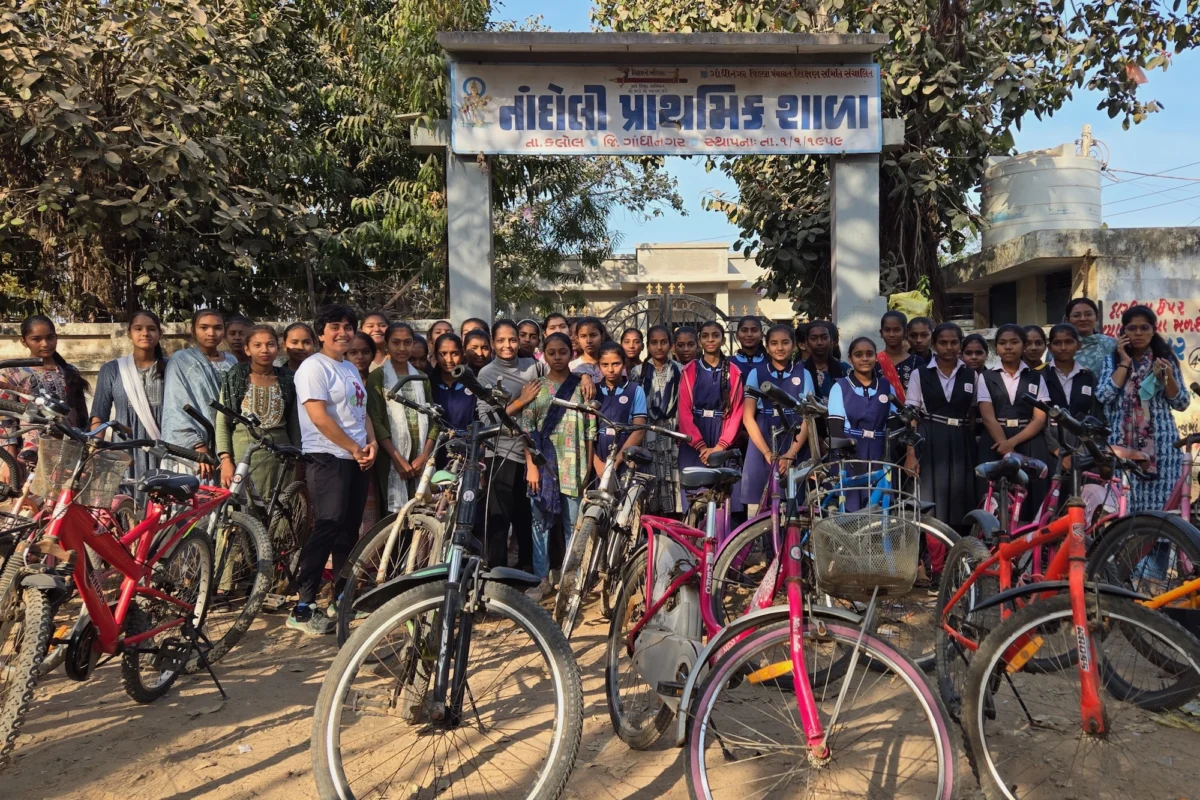
India’s most decorated triathlete, Pragnya Mohan, has launched an ambitious social initiative titled Ek Beti, Ek Cycle (One Daughter, One Cycle) with the goal of ensuring one million rural Indian girls complete their high school education by 2030. By leveraging the simple yet transformative power of the bicycle, the organization addresses the "last mile" connectivity issues that frequently force female students in rural regions to abandon their studies after completing primary school. The initiative, which refurbishes donated bicycles and provides comprehensive maintenance training, seeks to dismantle the physical and social barriers that prevent young women from accessing secondary education, thereby fostering independence and long-term economic empowerment.
The Crisis of Female Education in Rural India
In the vast rural landscapes of India, the transition from elementary to secondary education represents a significant hurdle for female students. Statistics indicate that approximately 58 percent of girls in rural areas do not complete their high school education. While the Indian government’s Right to Education (RTE) Act has successfully increased enrollment at the primary level, the infrastructure for secondary schooling remains geographically sparse. Once a student finishes elementary school in her local village, the nearest high school is often located 8 to 10 kilometers (roughly 5 to 6 miles) away.

For many families living below or near the poverty line, this distance is insurmountable. Public transport is often non-existent in remote regions, and the government does not typically provide school buses for high school students. While families are often willing to let boys navigate long distances independently, traditional gender norms and legitimate safety concerns frequently result in girls being kept at home. Furthermore, the financial burden of private transport—ranging from 1,000 to 1,300 Indian rupees (approximately $12 to $15 USD) per month—is a prohibitive expense for households where the average daily wage may be less than 500 rupees. In this economic context, the education of a daughter is often sacrificed to save costs, leading to a cycle of localized poverty and restricted opportunity.
From Athlete to Advocate: The Genesis of EBEC
Pragnya Mohan’s journey to becoming a social entrepreneur is deeply rooted in her own experiences as an athlete and a student in Ahmedabad, Gujarat. A Chartered Accountant by profession and India’s leading triathlete, Mohan credits her success to the mobility she enjoyed as a youth. Growing up, she relied on a hand-me-down bicycle from her sibling to travel 10 kilometers every morning for swimming practice and to reach her school bus stop. This early access to independent transport allowed her to balance rigorous academic demands with elite athletic training.
Recognizing that her trajectory was an exception rather than the rule for Indian women, Mohan founded Ek Beti, Ek Cycle (EBEC) to institutionalize this advantage for others. The initiative began with a grassroots pilot program in November 2023. Mohan and a small group of volunteers campaigned door-to-door in Ahmedabad, asking residents to donate unused bicycles. The response highlighted a significant disparity: while urban children often outgrow their bicycles or leave them unused, rural girls are desperate for any form of wheeled transport. Today, the program primarily sources donations from students at private urban schools, creating a bridge between India’s growing middle class and its underserved rural populations.

The Operational Model: Refurbishment and "Jugaad"
The EBEC model is built on the principles of the circular economy and community self-reliance. To ensure the donated bikes are safe and durable, the organization has partnered with MYBYK, India’s largest bicycle-sharing platform. MYBYK provides the technical expertise required to refurbish the cycles, often converting them to single-speed configurations to simplify maintenance in areas where complex spare parts are unavailable.
Once refurbished, the bicycles are transported to rural schools. The selection process is handled by local educators who identify girls most at risk of dropping out—specifically those transitioning from Grade 8 to Grade 9. However, receiving a bicycle is not a passive transaction. To earn their bike, students must commit to a multi-day workshop (typically three to five days) conducted by EBEC volunteers.
During these sessions, the girls are taught:

- Cycling Proficiency: Many girls have never been allowed to ride a bike due to cultural taboos.
- Road Safety: Navigating rural roads, which are often shared with heavy agricultural machinery and livestock.
- Mechanical Maintenance: Basic repairs such as fixing a chain, patching a tire, or adjusting brakes.
Mohan notes that the girls often apply "jugaad"—a Hindustani term for innovative, low-cost hacks—to their new vehicles. Students frequently customize their bikes with woven baskets, ropes, and strips of cloth to secure heavy school bags and books, demonstrating an immediate sense of ownership and resourcefulness.
Chronology of Expansion and Geographic Adaptation
Since its inception in late 2023, EBEC has scaled rapidly, reflecting the urgent demand for its services.
- November 2023: Initial pilot launch in Ahmedabad, Gujarat. Door-to-door donation drives established the proof of concept.
- Early 2024: Partnership with MYBYK formalized, allowing for professional-grade refurbishment and the ability to handle larger volumes of donations.
- Mid-2024: The program reached a milestone of 1,200 girls across various districts in Gujarat. Data collection began in collaboration with the School of Public Health at Ahmedabad University to track the physical and academic impact on participants.
- Late 2024: Announcement of expansion into Pune, Maharashtra. This move marks the organization’s first venture outside its home state, necessitating a shift in strategy.
The expansion to Pune has highlighted the need for geographic sensitivity. Unlike the relatively flat plains of Gujarat, Pune’s terrain is hilly. Consequently, the single-speed bikes used in the pilot are less effective. EBEC is now exploring the procurement of multi-gear bicycles and seeking corporate sponsorships to supplement their fleet of refurbished units. This adaptation underscores Mohan’s philosophy that mobility challenges are not "one-size-fits-all" and must be met with localized solutions.

Impact Analysis: Beyond the Classroom
The impact of providing a bicycle extends far beyond the simple act of attending school. According to feedback forms collected from teachers three months after distribution, there is a marked improvement in several key metrics:
- Attendance Consistency: Girls with bicycles are less likely to miss school due to weather or the unavailability of a male family member to escort them.
- Physical Health: Daily cycling has led to increased stamina and a higher rate of participation in school sports teams, challenging the traditional view of rural girls as physically frail.
- Confidence and Agency: Educators report that students who cycle to school exhibit greater confidence in the classroom. The "spatial freedom" of being able to move between villages independently translates into a greater sense of self-worth and autonomy.
One notable case study involved a student who requested to keep her bicycle after graduating high school so she could attend university. Her family had initially opposed higher education due to the even greater distance to the nearest college, but the presence of the bicycle removed the primary logistical barrier, allowing her to become the first woman in her family to pursue a degree.
Broader Socio-Economic Implications
The mission of Ek Beti, Ek Cycle aligns with broader national and international development goals. According to the World Bank, every additional year of secondary education can increase a girl’s future earning potential by up to 20 percent. By keeping one million girls in school, EBEC is effectively contributing to India’s long-term GDP by preparing a more skilled female workforce.

Furthermore, the program addresses the gender gap in mobility. In many parts of rural India, the road is considered a male space. By flooding these roads with female cyclists, EBEC is performing a quiet social revolution, normalizing the presence of women in public spaces and reclaiming the right to movement.
Future Outlook: The Road to One Million
As EBEC celebrates its two-year mark, Pragnya Mohan is shifting her focus toward systemic change. While the donation model is effective for local clusters, reaching one million girls requires institutional support. The organization is currently in discussions with state government education departments to integrate the EBEC model into existing welfare schemes.
"The goal is to build a self-sustaining ecosystem," Mohan explains. By training older students to lead workshops for younger ones, the program becomes less dependent on outside volunteers. The vision for 2030 is not just to hand out a million bikes, but to create a culture where a girl’s education is never cut short by something as fixable as a 10-kilometer road. For Mohan and the thousands of girls now pedaling toward their futures, the bicycle is more than a tool—it is a vehicle for a new era of Indian history.
