

The global business landscape is currently navigating a period of profound transition, driven by an escalating climate crisis and a growing demand from the next generation of leaders for academic programs that prioritize planetary health alongside profit. For nearly two decades, research has consistently indicated that young professionals are increasingly fearful of environmental degradation and disillusioned by what they perceive as inadequate government responses. In response to this demand, Corporate Knights has released its 17th annual Better World MBA ranking for 2026, identifying the institutions most effectively preparing students to navigate and mitigate these systemic challenges.
This year’s ranking comes at a critical juncture for higher education. As institutions grapple with the rapid rise of artificial intelligence and shifting geopolitical priorities, some business schools have seen a "slippage" in their sustainability focus. Corporate Knights, however, has refined its methodology to identify schools that are not merely treating sustainability as a marketing trend but are genuinely embedding it into the core of their curricula and producing graduates who achieve measurable impact in the professional world.
A New Benchmark for Educational Impact
The 2026 methodology marks a significant evolution from previous years, reflecting a broader trend in the education sector toward accountability and outcomes-based assessment. Corporate Knights has introduced two primary adjustments to its scoring system to better serve prospective students seeking high-impact careers. First, the organization has increased the weight of graduate-impact metrics. This change rewards institutions that can demonstrate their alumni are securing roles within "impact organizations" or positions where they have significant influence over clean, sustainable decision-making.
Second, the 2026 ranking introduces bonus marks for schools that implement rigorous, standardized testing of sustainability knowledge. By rewarding institutions that use tools such as TASK™ (The Assessment of Sustainability Knowledge) by Sulitest, the ranking encourages schools to move beyond passive lecturing. Schools can earn up to a 10% bonus if they mandate these assessments at both the entry and exit points of the program, ensuring that students have actually mastered the complexities of sustainable development.
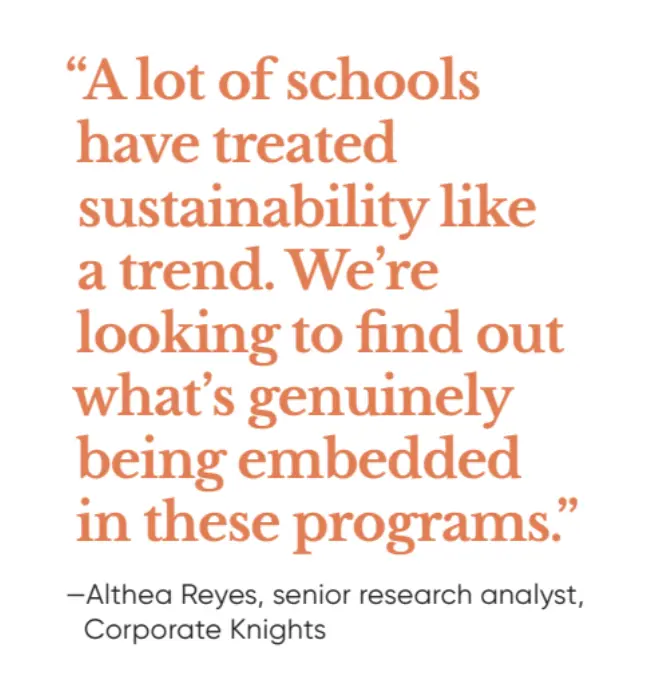
Althea Reyes, senior research analyst at Corporate Knights, noted that the ranking must evolve alongside the practices of the schools it monitors. She observed that while many schools are distracted by the latest technological headwinds, the goal remains to find those programs that remain steadfast in their commitment to sustainable business education regardless of external trends.
Global Leaders in Sustainable Business Education
The 2026 rankings saw a shift at the top of the leaderboard, with Maastricht University’s School of Business and Economics in the Netherlands claiming the number one spot. Ascending from third place in 2025, Maastricht’s victory coincides with its 50th anniversary. The university’s flagship part-time MBA program is designed for experienced professionals, with an average student tenure of 15 years.
According to Dean Mariëlle Heijltjes, Maastricht’s success is rooted in a holistic approach. Sustainability is not a siloed elective but is woven into the fabric of the entire curriculum, beginning with foundational courses like "Sustainability Science, Policy, and Society." The program’s objective is to ensure that sustainability becomes a core component of the student’s professional identity and long-term career goals.
Securing the second position is the University of Cape Town (UCT) Graduate School of Business in South Africa, which rose significantly from seventh place in 2025. UCT’s curriculum is built on the philosophy that sustainability is a strategic imperative rather than a compliance exercise. The school emphasizes the "triple bottom line," teaching students to evaluate business decisions based on their impact on communities and the environment as much as their financial returns. This high ranking highlights the growing influence of African institutions in the global sustainability dialogue.
Rounding out the top tier is a tie for third place between the University of Vermont’s Grossman School of Business in the United States and Griffith Business School in Australia. Griffith, which held the top spot in 2025, remains a global leader in "values-led" education. The university has integrated sustainability into its 2025–2030 strategic plan, with a commitment to achieving net-zero emissions by 2029.
The Canadian Stronghold and the "Realist Idealist"
Canada continues to be a powerhouse in sustainable business education, with several institutions placing in the top 40. Leading the Canadian cohort is the University of Victoria’s Peter B. Gustavson School of Business, which climbed to sixth place globally. The school’s MBA in Sustainable Innovation is specifically designed for mid-career professionals looking to pivot or enhance their impact within their current industries.

Cheryl Mitchell, the program’s academic director, describes her students as "realist idealists." These individuals come from diverse backgrounds—including the Alberta oil patch, government agencies, and non-profit sectors—all sharing the belief that organizations can be leveraged to build better communities. The program utilizes unconventional teaching methods, including play-based spaces, mentorship, and collaborative problem-solving with First Nations communities, to address what Mitchell calls "wicked problems."
The impact of the Gustavson program is evidenced by its alumni. Graduates have moved into high-level sustainability roles at major consulting firms, launched their own sustainability consultancies, and spearheaded green transitions within the mining and financial sectors.
Other Canadian schools also maintained strong positions. York University’s Schulich School of Business ranked 17th, followed closely by Toronto Metropolitan University (19th), HEC Montréal (20th), and the University of British Columbia’s Sauder School of Business (23rd). The University of Guelph and McGill University also secured spots within the top 40, underscoring the consistent quality of ESG (Environmental, Social, and Governance) education in the country.
Addressing the "Sustainability Slippage" and AI Distraction
A recurring theme in this year’s analysis is the concern that the rapid emergence of artificial intelligence (AI) is siphoning attention and resources away from climate-focused education. Corporate Knights researchers noted that some institutions have begun to treat sustainability as a passing trend rather than a fundamental shift in business logic.
The 2026 ranking aims to counter this trend by focusing on "core" MBA programs rather than specialized climate degrees. The rationale is that if sustainability is to become the standard for global business, it must be embedded in the general management training that the majority of MBA students receive. The data suggests that while AI is a transformative tool, it should be used to enhance sustainability efforts—such as optimizing energy grids or tracking supply chain emissions—rather than replacing them as the primary focus of corporate responsibility.
Undergraduate Excellence: The BCom Rankings
In addition to the MBA rankings, Corporate Knights evaluated Canadian Bachelor of Commerce (BCom) programs. The University of British Columbia’s Sauder School of Business took the top spot, followed by the University of Manitoba’s Asper School of Business and the University of Saskatchewan’s Edwards School of Business.
These undergraduate rankings are particularly important as they represent the foundational training of the next generation of entry-level business professionals. By integrating sustainability early in the academic journey, these schools are ensuring that the business leaders of the 2030s and 2040s enter the workforce with an inherent understanding of environmental and social externalities.
Methodology and the Path to Accountability
The 2026 ranking examined 173 business schools globally. To be eligible, schools must be accredited by major bodies (such as AACSB, AMBA, or EQUIS) or be PRME (Principles for Responsible Management Education) Champions. The scoring is heavily weighted toward curriculum (80%), which includes an analysis of core courses to determine the percentage of time dedicated to sustainability topics. The remaining 20% is determined by alumni impact.
The inclusion of the TASK™ bonus is perhaps the most significant step toward objective accountability in recent years. By providing a standardized metric for sustainability literacy, Corporate Knights is pushing the academic community toward a "common language" of impact.
Conclusion: The Future of Corporate Leadership
The results of the 2026 Better World MBA ranking suggest a bifurcation in the world of business education. On one side are institutions that view sustainability as a peripheral concern or a marketing requirement; on the other are the leaders—like Maastricht, UCT, and UVic—that view the climate crisis as the defining challenge of modern management.
As Althea Reyes noted, these rankings provide a glimpse into the "companies of the near future." The students graduating from these top-ranked programs are not just learning how to manage balance sheets; they are learning how to manage a world in flux. In a global economy increasingly defined by resource scarcity, regulatory shifts toward carbon pricing, and a heightened focus on social equity, the education provided by these institutions is becoming the new gold standard for corporate leadership. For the young people "desperately fearful" of the future, these schools offer more than just a degree; they offer a roadmap for meaningful action.
