

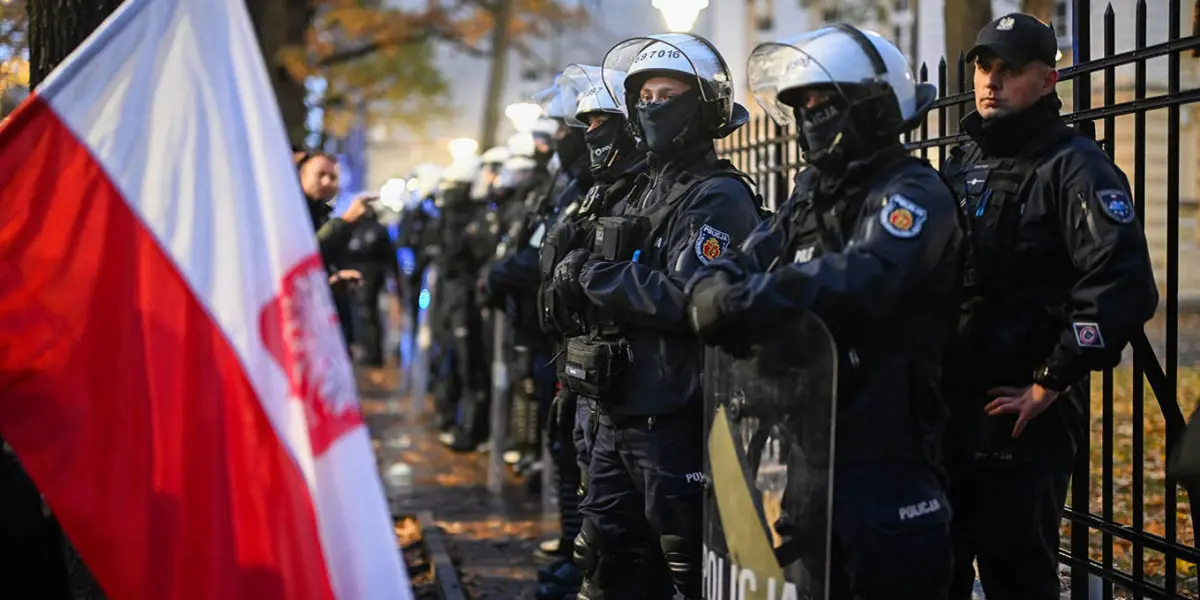
The removal of Bogdan Święczkowski as president of the Constitutional Tribunal has triggered a physical confrontation at the court and a political standoff between Donald Tusk’s government and the far-right Law and Justice (PiS) party. But Święczkowski was not so much removed as barred, because he held the position illegally.
WARSAW – Poland’s Constitutional Tribunal has become the epicenter of a dramatic political and legal showdown, as Prime Minister Donald Tusk’s government grapples with the fallout from the contested presidency of the court. The tumultuous events, which have included physical confrontations and a deep political standoff with the opposition Law and Justice (PiS) party, raise fundamental questions about the rule of law and the legitimacy of institutional actions taken to restore democratic norms. At the heart of the controversy lies the assertion by the Tusk government and the judges elected by its liberal parliamentary majority that Bogdan Święczkowski’s tenure as president was unlawful, necessitating his exclusion from the role. This situation prompts a critical examination not of whether democrats must break the law to mend institutions undermined by populist authoritarians, but rather of the legal framework and historical context that led to this impasse.
The Escalation of Conflict at the Constitutional Tribunal
The immediate catalyst for the current crisis was the attempt by the Tusk government to assert control over the Constitutional Tribunal, an institution that has been a focal point of political contention since the PiS party came to power in 2015. The government’s move to question and ultimately prevent Bogdan Święczkowski from acting as president has led to scenes described as chaotic and physically tense within the court premises. This incident is not an isolated event but rather a culmination of years of political maneuvering and legal challenges that have eroded public trust in Poland’s highest judicial body.
Sources within the Tribunal have reported that Święczkowski was effectively barred from entering the premises in his capacity as president on November 1, 2026. This action, taken by individuals aligned with the new government’s agenda, was reportedly met with resistance, leading to the physical confrontations. The exact nature and severity of these altercations remain subjects of ongoing reports, but the symbolism of such events within a judicial institution is stark.
Historical Context: A Contested Legacy
To understand the current crisis, it is crucial to revisit the tumultuous period that preceded it. Following the 2015 parliamentary elections, the PiS party, under the leadership of Jarosław Kaczyński, embarked on a series of reforms that significantly altered Poland’s judicial system. These reforms, which included changes to the Constitutional Tribunal, were widely criticized by the European Union and international legal bodies as undermining the independence of the judiciary and the separation of powers.
The PiS government appointed judges to the Tribunal under controversial circumstances, often bypassing established procedures and leading to accusations of politicization. Bogdan Święczkowski, a former prosecutor general and a figure closely associated with PiS, was appointed as president of the Tribunal in December 2021. His appointment, like those of other judges during the PiS era, faced legal challenges and was contested by opposition parties and civil society organizations.
The liberal coalition government, which came to power in December 2023 after winning the general election, pledged to reverse what they termed the "democratic backsliding" of the previous eight years. A key promise was the restoration of the rule of law and the independence of state institutions, including the judiciary and the Constitutional Tribunal. The current actions against Święczkowski are seen by the government as a necessary step in this restoration process, aiming to rectify what they perceive as unlawful appointments and decisions made under the previous administration.
Legal Arguments and Counter-Arguments
The Tusk government’s position hinges on the argument that Święczkowski’s appointment and, by extension, his presidency of the Constitutional Tribunal, were based on flawed legal premises. They contend that the PiS government manipulated the legal framework to ensure its influence over the court, rendering the appointments and subsequent decisions illegitimate. This perspective often invokes international legal standards and the opinions of European bodies, such as the European Commission and the Court of Justice of the European Union (CJEU), which have repeatedly raised concerns about the rule of law in Poland.
Conversely, the PiS party and its supporters maintain that the actions of the Tusk government are themselves unlawful and constitute a politically motivated attack on the judiciary. They argue that the judges appointed during the PiS era were duly elected and that any attempt to remove them or question their authority is a violation of constitutional order. This narrative often frames the government’s actions as an attempt to seize power through extralegal means, disregarding the legal pronouncements of the Tribunal itself.
The legal debate is complex, involving interpretations of Polish constitutional law, previous court rulings, and the applicability of EU law. The validity of appointments made under contested circumstances, the powers of the parliament to revisit judicial appointments, and the ultimate authority of the Constitutional Tribunal itself are all at stake.
Supporting Data and International Scrutiny
The situation in Poland has drawn significant attention from international bodies. For years, the European Union has been engaged in a protracted dispute with the previous PiS government over the rule of law, including the independence of the judiciary. The European Commission has initiated infringement procedures and has held back billions of euros in EU funds due to these concerns.
A report by the European Commission in July 2023, for instance, highlighted ongoing systemic challenges to the rule of law in Poland, specifically mentioning concerns about the independence of the judiciary. While the report predates the current government, the underlying issues it identified remain relevant to the ongoing dispute over the Constitutional Tribunal.
Furthermore, the Venice Commission, an advisory body of the Council of Europe on constitutional matters, has repeatedly issued opinions critical of the PiS government’s judicial reforms, emphasizing the need to ensure the independence and impartiality of constitutional courts. These international assessments provide a backdrop against which the current events are being viewed globally.
Official Responses and Political Reactions
The Tusk government has defended its actions as necessary to uphold democratic principles and the rule of law. A spokesperson for the Prime Minister’s office stated that the government is committed to restoring the full functionality of state institutions in accordance with the constitution and the law. They emphasized that the actions taken regarding the Constitutional Tribunal are aimed at correcting past transgressions and ensuring that the court operates independently and impartially.
In contrast, the Law and Justice party has vehemently condemned the government’s moves. PiS leaders have accused Tusk of staging a "coup" and undermining the constitutional order. They have vowed to resist what they describe as an illegitimate attempt to dismantle institutions established by the previous government. Public statements from PiS officials have often invoked patriotic and nationalistic sentiments, portraying the government’s actions as a betrayal of Polish sovereignty.
Civil society organizations and legal experts in Poland are divided, reflecting the deep polarization of the country. Some welcome the government’s efforts to reform the judiciary, seeing it as a long-overdue correction. Others express caution, warning that the methods employed could further undermine legal certainty and create a precedent for future political interventions in the judiciary.
Broader Impact and Implications
The ongoing crisis at the Constitutional Tribunal has profound implications for Poland and the European Union. Domestically, it signifies a critical juncture in the country’s democratic trajectory. The Tusk government faces the challenge of navigating a highly polarized political landscape while attempting to implement significant institutional reforms. The success or failure of these efforts will shape Poland’s commitment to democratic values and the rule of law for years to come.
Internationally, the events underscore the persistent challenges to democratic norms within some EU member states. The dispute over the Constitutional Tribunal could reignite tensions with Brussels and influence the ongoing debate about conditionality mechanisms linking EU funds to respect for the rule of law.
Moreover, the situation highlights a broader trend observed in several countries where populist governments have sought to consolidate power by asserting control over judicial institutions. The Polish case serves as a case study in the complex dynamics of democratic backsliding and the often contentious process of institutional restoration. The resolution of this crisis will likely involve not only legal pronouncements but also significant political negotiation and a renewed commitment to upholding the fundamental principles of an independent judiciary and the separation of powers. The long-term implications for Poland’s standing within the EU and its commitment to democratic governance remain a subject of intense observation and analysis.
