

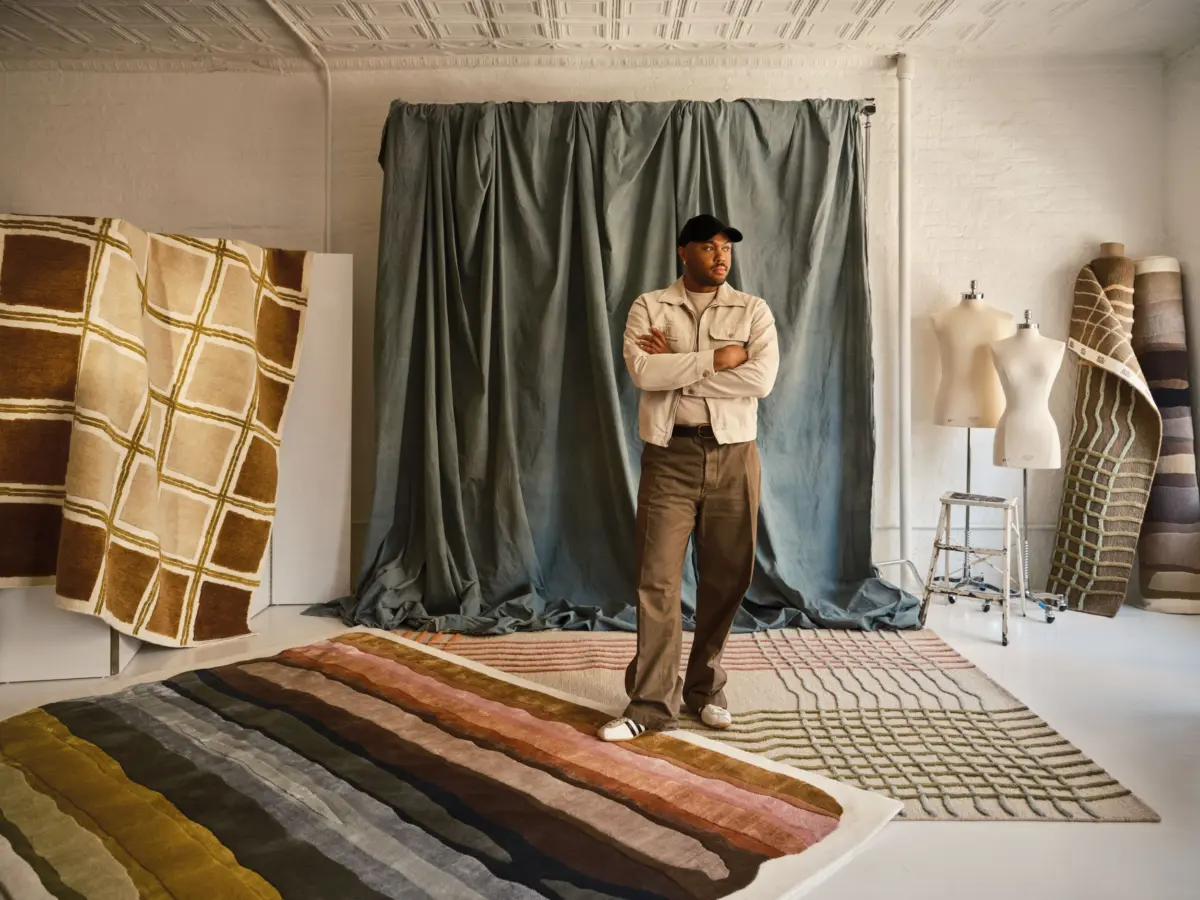
The convergence of high fashion and interior design has reached a new milestone with the official launch of The Studio by Christopher John Rogers, a sophisticated collection of floor coverings developed in partnership with The Rug Company. Christopher John Rogers, the Louisiana-born and New York-based fashion designer celebrated for his exuberant use of color and architectural silhouettes, has translated his distinct sartorial language into a series of six rugs that emphasize the beauty of the creative process. Conceived alongside Will Cooper, the creative director of The Rug Company, the collection represents an evolution of Rogers’s brand, moving from the runway into the permanent sanctuary of the home. This collaboration joins a prestigious lineage of partnerships for The Rug Company, which has previously worked with legendary fashion houses including Alexander McQueen, Diane von Furstenberg, and Vivienne Westwood, further cementing the brand’s role as a bridge between the garment industry and luxury interior design.

The genesis of The Studio collection lies in the preservation of the "hand" within the design process. Rogers, who has consistently prioritized the tactile and technical aspects of garment construction, sought to capture the ephemeral moments of the studio environment—the chalk lines on fabric, the stray threads, the ink bleeds on sketch paper, and the inherent imperfections that arise during the creation of a collection. By elevating these "accidents" into luxury textiles, Rogers challenges the notion of traditional perfection in home decor, offering instead a sense of lived-in history and artistic authenticity. The collection debuted as a centerpiece in the December issue of Architectural Digest, showcased within the Manhattan residence of Will Cooper, providing a real-world context for how these vibrant, process-driven pieces integrate into modern living spaces.
The Philosophy of the Process and Artistic Influences
For Christopher John Rogers, the appeal of this project was the opportunity to immortalize the "mistakes" that are usually discarded or hidden in the final version of a garment. He noted that the collection was built upon the idea of preserving draping, cutting, and the smears of pigment left behind during the drafting phase. This philosophy aligns with a broader trend in the luxury market toward "honest" design, where the evidence of human labor and the artist’s touch adds value and soul to an object.

The visual language of the rugs draws heavily from 20th-century abstract art, specifically the works of Morris Louis and Ellsworth Kelly. Louis’s influence is visible in the fluid, bleeding color fields that mimic the behavior of paint on raw canvas, while Kelly’s legacy is reflected in the bold, geometric simplicity and the interaction between saturated hues and negative space. These artistic references are filtered through Rogers’s own archival work, most notably his 2022 pre-fall collection. The "Marker Test" rug, for instance, is a direct translation of the ink scribbles Rogers made while testing colors for his garments. By reinterpreting these functional scribbles in high-end materials like silk and Tibetan wool, Rogers transforms a utilitarian moment into a central design element.
Technical Composition and Design Details
The Studio collection consists of six distinct designs, each utilizing different textures and weaving techniques to achieve its specific aesthetic goal. The Rug Company, known for its rigorous artisanal standards, employed hand-knotting and flatweaving processes to bring Rogers’s vision to life. The materials—primarily wool and silk—were chosen to provide both durability and a luxurious sheen that mimics the luster of the silks often used in Rogers’s evening wear.

- Marker Test: This design is perhaps the most autobiographical for the designer. It features vibrant, multi-colored streaks that resemble felt-tip marker strokes on a white page. The use of silk within the "ink" lines creates a shimmering effect that contrasts with the matte wool background, giving the rug a three-dimensional quality.
- Chalk Line: Drawing inspiration from the tailor’s chalk used to mark patterns on fabric, this rug features raised cross-hatching. The juxtaposition of these textured lines against a neutral, earth-toned ground provides a subtle, tactile experience that references the technical precision of haute couture.
- Paintstroke: This design evokes the movement of a wet brush across a surface. It utilizes a gradient of colors to simulate the way pigment thins and fades as it is pulled across a canvas.
- Lattoro: Featured in an "agave" colorway in the launch imagery, Lattoro offers a more structured, rhythmic pattern. It balances Rogers’s love for bold color with a more subdued, architectural layout, making it versatile for various interior styles.
- Ribbon: Inspired by the notion of trimmings and haberdashery, the Ribbon rug (often seen in the "magnolia" palette) uses winding, organic lines to create a sense of movement across the floor.
- The Palette: The color stories across the collection represent a shift for Rogers. While he is famous for high-octane neons and primary colors, The Studio collection filters these through a "subdued lens." By mixing faded primaries with warm earth tones—such as cardamom, agave, and magnolia—the pieces achieve a sense of patina, making them feel like vintage finds rather than brand-new products.
Strategic Context and the Farrow & Ball Connection
The partnership between Christopher John Rogers and The Rug Company was facilitated by another high-profile collaborator: the British paint and wallpaper manufacturer Farrow & Ball. Rogers had previously launched a highly successful collection with Farrow & Ball titled "Carte Blanche," which featured a range of paints and wallpapers inspired by his childhood memories and his love of art. Will Cooper was introduced to Rogers through this connection, highlighting the interconnected nature of the luxury design ecosystem.
This "lifestyle brand" approach is a strategic move for Rogers, whose fashion house has seen meteoric growth since its inception in 2016. By expanding into paints, wallpapers, and now luxury rugs, Rogers is creating a holistic aesthetic world. For The Rug Company, the collaboration allows them to tap into a younger, fashion-forward demographic that values the "cool factor" associated with Rogers, who has dressed icons such as former First Lady Michelle Obama, Vice President Kamala Harris, and Rihanna.

Chronology of the Collaboration
The timeline of The Studio collection reflects a multi-year development process that began shortly after the designer’s 2022 pre-fall runway show:
- Early 2022: Christopher John Rogers explores the "Marker Test" concept during the design phase of his pre-fall collection.
- Late 2022: Initial discussions between Rogers, Will Cooper, and The Rug Company begin, facilitated by the Farrow & Ball creative team.
- 2023: The design and prototyping phase takes place. Artisans in Nepal and other regions work to translate Rogers’s sketches into hand-knotted samples, perfecting the balance of wool and silk to mimic ink and chalk textures.
- Mid-2024: Final production of the six-piece collection is completed. The collection is photographed in situ at Will Cooper’s Manhattan apartment to emphasize its livability.
- December 2024: The collection is officially launched to the public, accompanied by a feature in Architectural Digest.
Market Implications and Analysis
The launch of The Studio by Christopher John Rogers comes at a time when the luxury home goods market is experiencing a significant shift toward "maximalist" and "expressive" interiors. Following years of "millennial minimalism" and "sad beige" aesthetics, consumers are increasingly seeking out pieces that tell a story and feature bold color palettes.

Data from luxury retail analysts suggests that the "fashion-to-home" pipeline is one of the fastest-growing segments in the interior design industry. Consumers who may not be able to afford a custom couture gown from Rogers can now invest in a piece of his brand for their home, which offers a different kind of longevity. Unlike a garment, which may be worn only a few times, a hand-knotted rug from The Rug Company is designed to last for decades, often becoming an heirloom.
Furthermore, the emphasis on "imperfection" and the "hand of the maker" aligns with the rising value of artisanal craftsmanship in the age of mass production. By highlighting the chalk lines and smears of the studio, Rogers and The Rug Company are marketing a form of "intellectual luxury" that appeals to collectors who appreciate the narrative behind the object as much as the object itself.

Broader Impact on Interior Design
The Studio collection is expected to influence interior design trends by encouraging the use of floor coverings as primary art pieces. Rather than serving as a neutral backdrop for furniture, rugs like "Marker Test" and "Paintstroke" act as the focal point of a room. This approach mirrors the way Rogers designs his garments—as bold, structural statements that command attention.
Will Cooper noted that the goal was to create pieces that "could be from any decade." This timelessness, combined with Rogers’s contemporary edge, ensures that the collection will remain relevant as design trends continue to evolve. As these rugs find their way into homes across the globe, they carry with them the history of the studio, the traces of the many hands involved in their making, and the vibrant, unapologetic spirit of Christopher John Rogers. The collection stands as a testament to the idea that the most beautiful results often come from the most unexpected places—the scribbles on a desk, the chalk on a floor, and the creative "mistakes" that define the human experience.
