

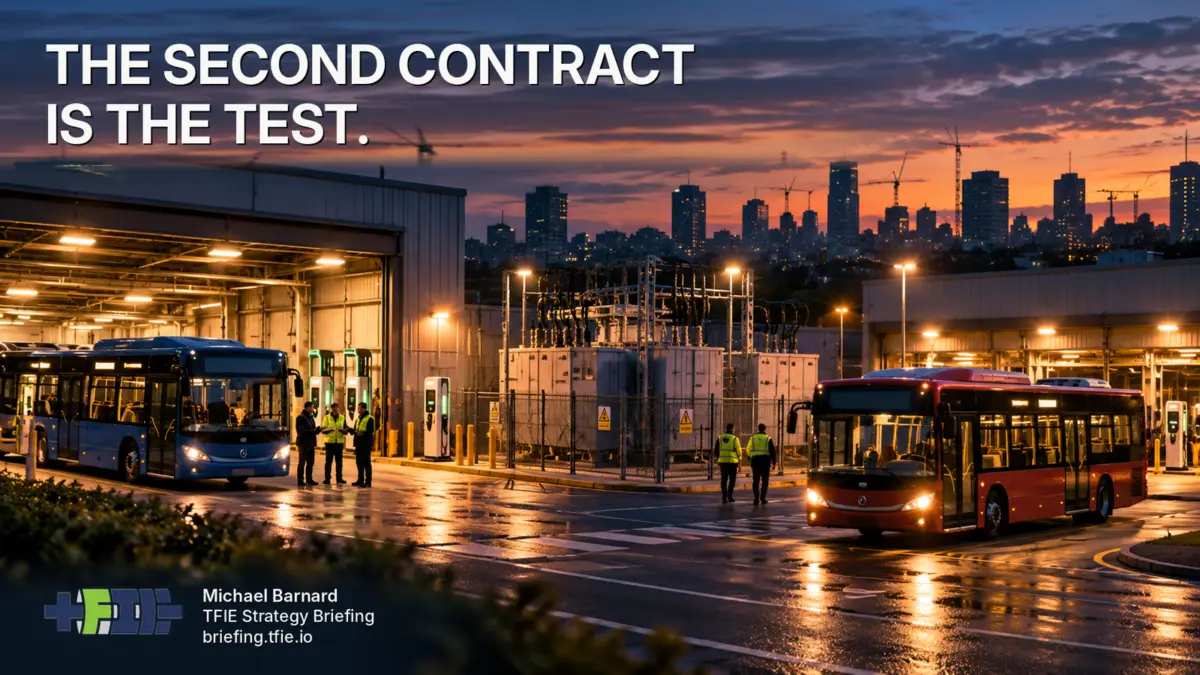
The landscape of British public transport is undergoing its most significant transformation since the deregulation of the 1980s. As major metropolitan areas transition toward franchised "Bee Network" styles of governance, a critical challenge has emerged at the intersection of contract law, electrical engineering, and urban planning. The recent announcement in Greater Manchester regarding new operating contracts highlights a burgeoning "second-contract test"—a dilemma where the short-term nature of service agreements clashes with the long-term reality of multi-million-pound electric vehicle (EV) infrastructure.
In September 2026, Greater Manchester officials confirmed that Go-Ahead, operating as Go North West, successfully secured two major Bee Network contracts. These agreements encompass 38 routes and approximately 60 buses, with services slated to commence in March 2027. A pivotal component of this award is the establishment of a new depot in Leigh, which will serve 18 of the routes. While the headlines focused on the operator and the fleet, the underlying narrative is one of "fixed assets" versus "mobile services." As the UK pushes toward a net-zero transport sector, the physical requirements of charging—substations, grid connections, and heavy-duty cabling—are becoming the permanent anchors of a system that used to be defined by the flexibility of diesel engines.
The Infrastructure Mismatch: Contracts vs. Concrete
Historically, bus franchising or tendering involved an operator bringing their fleet to a city, running routes for a few years, and potentially moving those assets elsewhere if a contract was lost. The electrification of the fleet has fundamentally broken this model. An operating agreement typically spans five to seven years, a timeframe designed to ensure competitive tension and performance accountability. However, the infrastructure required to support an electric fleet operates on a completely different chronological scale.
A modern electric bus depot is a sophisticated industrial power hub. A substation or a multi-megawatt grid connection is designed for a twenty-to-thirty-year lifespan. Similarly, the physical land, cable ducting, and reinforced concrete required for charging bays are permanent fixtures. Under traditional procurement models, an incumbent operator who invests in this infrastructure gains a significant, and perhaps unfair, competitive advantage during retendering.
If a competing operator wishes to bid for a route, they face a daunting barrier to entry. Without guaranteed access to the existing depot and its grid connection, the newcomer must factor in the astronomical costs of securing a new site, negotiating with Distribution Network Operators (DNOs) for power capacity—which can take years—and installing new hardware. This "incumbent lock-in" threatens to stifle the very competition that franchising is intended to foster, potentially leading to higher costs for taxpayers and passengers.
A Tale of Two Regions: Manchester and South Yorkshire
The approaches taken by Greater Manchester and South Yorkshire provide a roadmap for how local authorities are grappling with these asset-heavy requirements. In Manchester, the move toward the Bee Network has seen the transport authority take a more active role in specifying how and where buses are housed. By ensuring that the Leigh depot is integrated into the contract requirements, the authority is attempting to decouple the service provider from the essential physical site.

South Yorkshire has taken an even more direct interventionist path. In March 2026, the South Yorkshire Mayoral Combined Authority (SYMCA) announced the strategic purchase of five major bus depots. These sites were added to the already publicly owned Leger Way depot in Doncaster. To ensure a smooth transition to franchising, the authority leased these premises back to the current operators, First Bus and Stagecoach.
The SYMCA’s strategy is clear: by owning the "dirt and the copper" (the land and the electrical infrastructure), the public sector retains control over the network’s future. When the first franchised services begin in September 2027, any qualified operator can bid for the contract knowing that the depot and its charging capacity are provided as part of the package. This approach has already shown promise; six operators reached the advanced procurement stages for the initial service packages at the Olive Grove and Leger Way facilities, proving that removing the infrastructure hurdle increases market interest.
Chronology of the Transition
To understand the scale of this shift, one must look at the timeline of policy and implementation:
- January 2026: The UK Government publishes updated bus-franchising guidance, emphasizing the need for authorities to manage depots and charging infrastructure to ensure subsequent competition.
- March 2026: South Yorkshire Mayoral Combined Authority completes the acquisition of five depots to secure the region’s transit future.
- September 2026: Greater Manchester awards Go North West the contracts for 38 routes, marking a new phase in the Bee Network’s rollout.
- March 2027: Services under the new Go-Ahead contracts are scheduled to begin, utilizing the new Leigh depot.
- September 2027: South Yorkshire is expected to launch its first franchised operations, utilizing the publicly owned depot estate.
Technical and Financial Implications of Grid Access
The "second-contract test" is not merely a matter of real estate; it is a matter of "megawatts." Securing a high-voltage connection from a DNO is one of the most significant bottlenecks in the decarbonization of transport. In many urban areas, the grid is already constrained. An operator who secures a 5MW or 10MW connection for a depot essentially holds a valuable commodity.
If the contract for those routes changes hands, the legal right to that electricity capacity must be transferable. If the capacity is tied to the operator rather than the site or the authority, a departing company could, in theory, relinquish the capacity back to the grid, forcing the successor to go to the back of a multi-year queue for a new connection.
Furthermore, the financial concept of "residual value" becomes paramount. If an operator invests £2 million in charging hardware under a five-year contract, but that hardware has a fifteen-year useful life, the contract must specify who pays for the remaining ten years of value if the operator loses the next tender. Without clear frameworks for depreciation, compensation, and asset transfer, the cost of "risk" will simply be priced into the bids, leading to more expensive fares or higher public subsidies.
Lessons from the London Model and National Guidance
London has operated a franchised bus model for decades through Transport for London (TfL). Interestingly, London has not always required public ownership of every garage. Instead, the capital has utilized a mix of secure leases, access rights, and assignable contracts. The London market is mature enough that specialist infrastructure providers often bridge the gap between the property owner and the bus operator.

However, the rapid shift to electric power has forced even London to reconsider its "asset-light" approach. The 2026 national bus-franchising guidance for England specifically highlights that authorities must consider "step-in rights" and the "transfer of assets." The guidance suggests that for a network to be truly contestable, the successor operator must be able to obtain the depots, the buses, and the operational data required to take over on day one without a dip in service quality.
Broader Impact and Future Outlook
The implications of these procurement structures extend far beyond the bus lanes. They represent a fundamental shift in how cities view "infrastructure." In the 20th century, infrastructure meant roads and bridges. In the 21st century, infrastructure includes the "digital and electrical umbilical cords" that keep a city moving.
Successful franchising now requires a multidisciplinary approach involving:
- Legal Teams: To draft contracts that allow for the seamless transfer of software access, warranties, and grid-connection permissions.
- Electrical Engineers: To design depots that are "future-proofed" for even larger battery requirements or potential hydrogen integration.
- Financial Analysts: To create "residual value" tables that provide certainty to private investors while protecting public funds.
The engineering of the buses themselves has largely been solved; modern electric buses are reliable, efficient, and increasingly affordable. The challenge has moved from the vehicle to the system. As Greater Manchester and South Yorkshire move forward, they are providing a live laboratory for the rest of the world. The goal is to create a "plug-and-play" environment where the public authority manages the platform, and private operators compete to provide the best service on that platform.
If the UK succeeds in solving the "second-contract test," it will provide a blueprint for urban decarbonization that can be exported globally. If it fails, cities risk being trapped in expensive, non-competitive monopolies governed by whoever happened to own the local substation first. The coming years in Manchester and Yorkshire will determine which of these two futures becomes the reality for the British commuter.
