

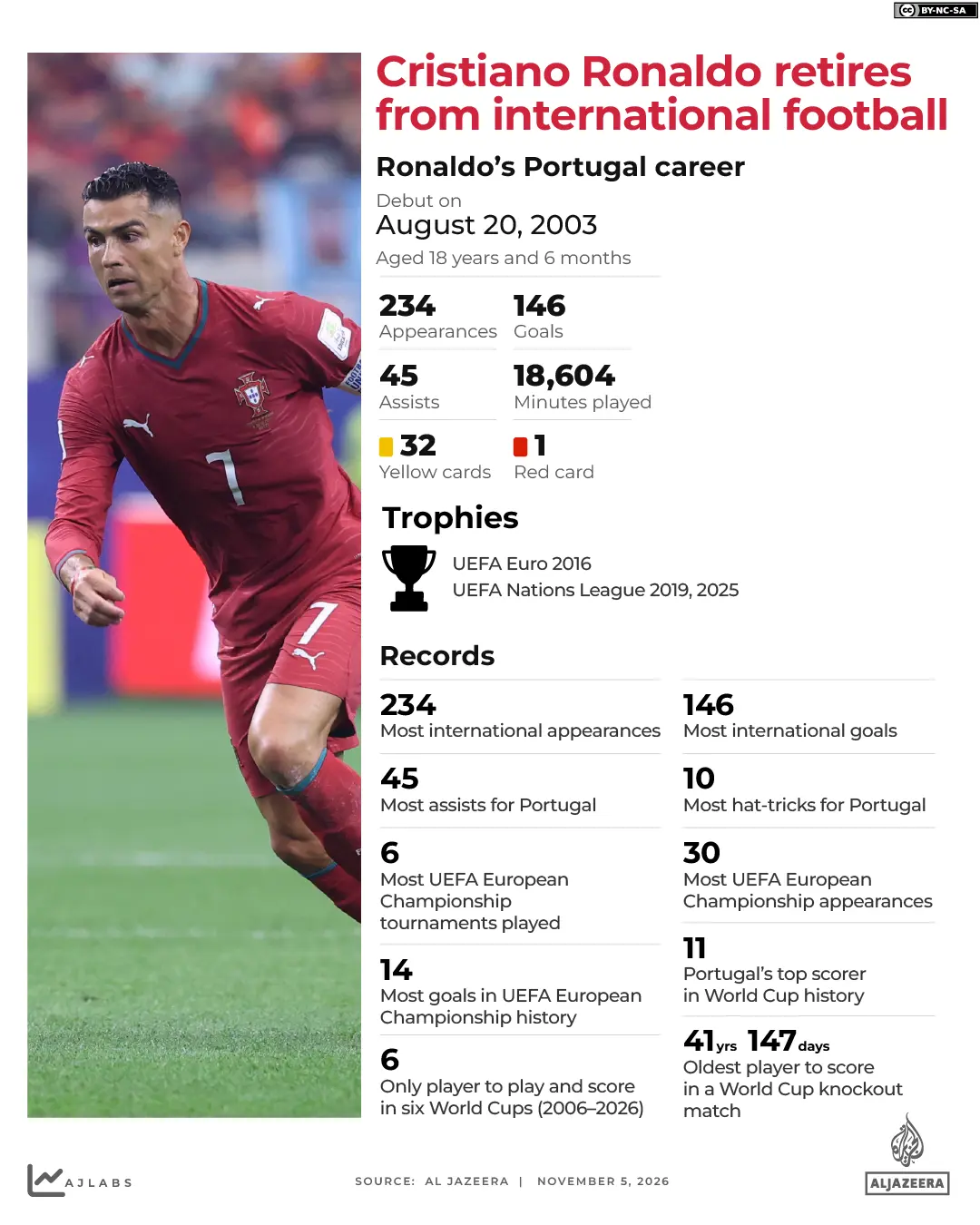
Cristiano Ronaldo, the 41-year-old icon of global sport, officially announced his retirement from international football on Thursday, November 5, 2026, marking the end of an unprecedented 23-year tenure with the Portugal national team. The decision, which follows weeks of intense media speculation and a high-profile disagreement with head coach Jorge Jesus, concludes a career that saw the forward become the all-time leading goalscorer in men’s international football. Ronaldo’s departure from the Seleção das Quinas signifies the end of an era for a player who has not only defined Portuguese football for two decades but has also maintained the largest social media presence of any athlete in history.
The announcement came via a meticulously worded statement on social media, where Ronaldo reflected on the emotional weight of his decision. While the forward did not explicitly cite the recent friction with the coaching staff as the primary reason for his exit, the timing of the announcement—coming just weeks after a public walk-out from a training camp—has led analysts to view the move as a definitive break from a situation that had become increasingly untenable. Ronaldo’s international career, which began in 2003, ends with a legacy that includes the 2016 UEFA European Championship and the 2019 UEFA Nations League title.
The Catalyst: The Copenhagen Incident and the Rift with Jorge Jesus
The final chapters of Ronaldo’s international journey were marred by a public falling-out with Jorge Jesus, the veteran manager who took charge of the national team following a successful stint at the club level, including time spent coaching Ronaldo at the Saudi Arabian side Al-Nassr. The tension reached a breaking point on September 30, 2026, during a training camp in Copenhagen ahead of a UEFA Nations League fixture against Denmark.
Ronaldo abruptly departed the team’s headquarters at the Parken Stadium shortly after a press conference in which Jesus confirmed that the five-time Ballon d’Or winner would be omitted from the starting lineup for the second consecutive match. This followed a 2-1 victory over Norway on September 27, where Ronaldo remained an unused substitute for the entire 90 minutes—the first time he had failed to feature in a competitive match while fit since November 2024.
In a subsequent statement, Ronaldo accused Jesus of "breaking his word" on two separate occasions. According to the player, a private agreement had been reached to manage his fitness by resting him for the Norway and Denmark fixtures. However, Ronaldo alleged that Jesus changed the terms on the day of the Norway match, informing him he would play 30 minutes, only to leave him on the bench as the minutes ticked away. The lack of public explanation from the coaching staff regarding his absence was cited by Ronaldo as a primary factor in his decision to leave the camp.
A Chronology of the Final Months
The decline in the relationship between the national team’s greatest-ever player and its leadership followed a specific timeline of events that began in the late summer of 2026:
- September 24, 2026: Ronaldo captains Portugal to a 1-0 victory over Wales in a Nations League home fixture. At this stage, there are no outward signs of internal discord.
- September 27, 2026: Portugal faces Norway in Oslo. Despite being healthy, Ronaldo is kept on the bench for the duration of the 2-1 win. Gonçalo Ramos leads the line, signaling a tactical shift toward a younger offensive core.
- September 30, 2026: During a press conference in Copenhagen, Jorge Jesus confirms Ronaldo will not start against Denmark. Ronaldo leaves the training camp hours later, citing a conversation with the President of the Portuguese Football Federation (FPF).
- October 6, 2026: Ronaldo issues a lengthy rebuttal to Jesus’s public comments, claiming the manager’s public narrative did not match their private discussions regarding his role and physical management.
- November 5, 2026: Ronaldo officially announces his retirement from international football, ending 23 years of service.
Statistical Legacy and World Cup 2026 Performance
Ronaldo’s retirement follows a historic appearance at the 2026 FIFA World Cup, hosted across North America. At the age of 41, he became the first player in history to play and score in six consecutive World Cup tournaments (2006, 2010, 2014, 2018, 2022, and 2026). During the 2026 edition, he netted three goals, helping Portugal reach the Round of 16 before a narrow exit.
Throughout his international career, Ronaldo shattered nearly every individual record available. He departs as the world record holder for most international appearances and most international goals. His career is characterized by a relentless drive that saw him evolve from a flamboyant winger in 2003 to a clinical central striker in his later years.
Key International Milestones:

- Total Caps: Over 215 (Record)
- Total Goals: Over 135 (Record)
- Major Trophies: UEFA Euro 2016, UEFA Nations League 2019.
- World Cup Goals: 11 across six tournaments.
- European Championship Goals: 14 (All-time record).
His performance in the 2026 World Cup was viewed by many as a "last dance." Following Portugal’s elimination, Ronaldo expressed a sense of closure, stating he had "given his all" and was leaving with a "clear conscience." However, the subsequent friction in the Nations League suggests that the transition away from his role as the focal point of the team was more turbulent than the player or the federation had hoped.
Official Responses and Tactical Implications
The Portuguese Football Federation (FPF) issued a brief statement following Ronaldo’s announcement, praising him as the "greatest player to ever wear the scarlet and gold." The FPF acknowledged his "unwavering commitment" and noted that a formal tribute match would be organized in the future to allow fans to say a proper farewell.
Jorge Jesus, whose tenure has been defined by this transition, maintained his stance that the decision was ultimately in the player’s hands. "Cris is the one who decides how he ends his time," Jesus had remarked prior to the announcement. "I told him I needed him close to me, whether playing or not, but the player must feel comfortable in his role."
The retirement presents a significant tactical crossroads for Portugal. For over two decades, the team’s offensive strategy was built around Ronaldo’s movement and finishing. Under Jesus, the team has already begun experimenting with a high-pressing system that utilizes younger, more mobile forwards like Gonçalo Ramos, Rafael Leão, and João Félix. Statistical data from the 2026 World Cup showed that Portugal’s "expected goals" (xG) remained high even when Ronaldo was not on the pitch, suggesting that the talent pool is deep enough to sustain competitiveness without their veteran captain.
Broader Impact on Global Sport and Social Media
Ronaldo’s exit from the international stage is not merely a sporting event but a significant cultural moment. With a social media following exceeding 900 million across various platforms, his retirement announcement generated unprecedented engagement. For the FPF, the "Ronaldo effect" has been a massive commercial boon, driving kit sales, sponsorship deals, and global viewership for Portuguese matches.
Market analysts suggest that while the national team may lose some of its "celebrity" pull in the short term, the brand of the Seleção is now firmly established on the world stage, thanks largely to the profile Ronaldo built. His retirement also signals a shift in the global football landscape, as the era of the Ronaldo-Messi rivalry, which dominated the sport for nearly 20 years, finally concludes its international chapter.
Conclusion: A Decision of the Heart
In his final address to the fans, Ronaldo emphasized that his choice was guided by emotion as much as logic. "It was not an easy decision, because there are decisions that are not made only with the head. They are also made with the heart," he stated. He urged his supporters to remember the joy his goals brought to the country, asking them to "forget a worry or feel proud of our country" when reflecting on his career.
As the Portuguese national team prepares for its upcoming fixtures without its all-time leader, the focus will inevitably shift to the future. However, the shadow of Cristiano Ronaldo will likely loom large over the Estádio da Luz and the Parken Stadium for years to come. He leaves behind a transformed national program, a trophy cabinet that was empty before his arrival, and a standard of professionalism that has redefined what is possible for an aging athlete in the modern era.
Ronaldo will continue his club career, focusing on his commitments in the Saudi Pro League, but his journey in the iconic red and green jersey of Portugal has reached its final whistle. The rift with Jorge Jesus may have provided the immediate impetus for the exit, but the 23-year body of work remains the definitive story of Cristiano Ronaldo’s international life.
