

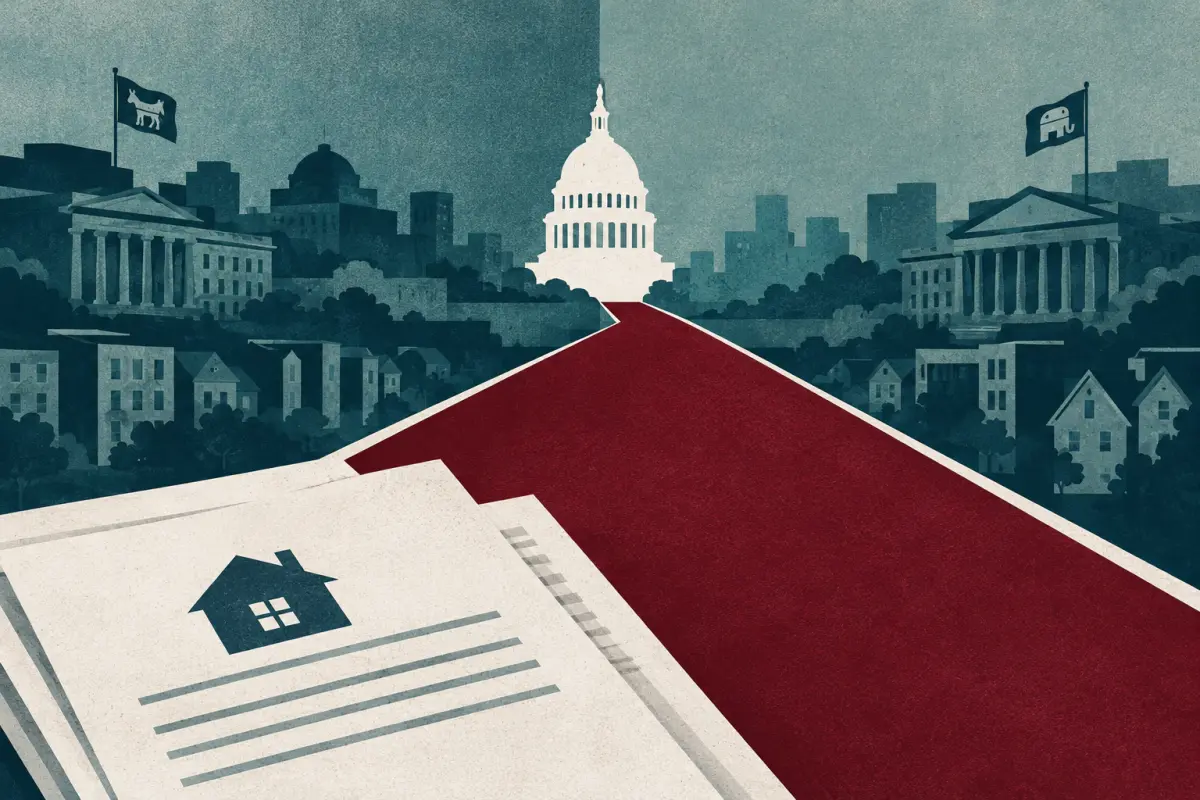
The landscape of American housing policy is entering a period of strategic realignment following a pivotal election cycle that has established a divided government in Washington, D.C. With Democrats securing control of both the House of Representatives and the Senate, while Republican President-elect Donald Trump prepares to return to the White House, the housing and mortgage industries are bracing for a complex legislative and regulatory environment. Despite the partisan split, industry veterans and policy analysts suggest that the urgent need for housing affordability creates a unique, albeit narrow, path for bipartisan cooperation. The reality of 2025 and beyond will be defined by a "split-screen" governance model where legislative agendas must pass through a Democratic Congress but ultimately face the signature of a Republican president.
The New Political Reality and the Mandate for Affordability
The election results of Tuesday night have fundamentally altered the power dynamics of the nation’s capital. By capturing both chambers of Congress, Democrats have earned the right to set the legislative calendar, chair powerful committees such as the House Financial Services and Senate Banking Committees, and control the purse strings of federal housing programs. However, this power is checked by a Republican-led executive branch that holds the authority to implement or stall regulations through various federal agencies.
Voters across the country signaled that economic "pocketbook" issues—specifically the cost of living—were their primary concern. Housing costs currently represent the single largest expenditure for the average American household, with many families spending upwards of 30% to 50% of their pre-tax income on rent or mortgage payments. Isaac Boltansky, the head of public policy at Pennymac, noted that this economic pressure has created a mandate that transcends party lines. According to Boltansky, the foundation for future progress has already been laid by existing frameworks, specifically the "ROAD to Housing Act."
The industry is now calling for a "ROAD to Housing 2.0" package. This proposed legislation would ideally build upon the initial goals of the original act—which focused on transparency, accountability, and supply-side solutions—to help more families transition from renting to sustainable homeownership. The challenge for lawmakers will be to find the "sweet spot" where Democratic priorities for consumer protection and rental assistance meet Republican preferences for deregulation and market-driven supply increases.
Chronology of the Policy Shift: From Campaign Rhetoric to Legislative Action
The transition of power follows a period of intense volatility in the housing market. Over the past four years, the United States has seen a dramatic rise in home prices, fueled by a chronic lack of inventory and a period of historically low interest rates followed by a rapid tightening of monetary policy by the Federal Reserve.
- 2021-2023: Federal policy focused largely on pandemic recovery and rental assistance. However, as inflation surged, the Federal Reserve raised the federal funds rate, causing mortgage rates to climb from 3% to over 7% in a relatively short window.
- October 2024: The Mortgage Bankers Association (MBA) released a proactive policy "road map" aimed at addressing the affordability crisis before the election results were even known. This signaled the industry’s readiness to work with whichever party took power.
- November 2024: Election Day resulted in a Democratic sweep of Congress and a Republican victory for the Presidency. This outcome immediately shifted the focus toward how a divided government would handle the 2025 legislative session.
- January 2025 (Projected): The new Congress will convene, and committee chairs will be appointed. This will be the first test of whether Democrats will pursue a confrontational oversight strategy or a collaborative legislative one.
- 2027 (Projected): A major fiscal cliff looms as the national debt ceiling will once again require a confrontation in Congress, likely impacting the bond market and mortgage rates.
Supporting Data: The Economic Context of the Housing Crisis
To understand why housing has become such a central political issue, one must look at the underlying data that has frustrated both buyers and sellers. According to the National Association of Realtors (NAR), the median price for an existing home in the U.S. has remained near record highs, hovering around $412,000 as of mid-2024. This price appreciation, coupled with mortgage rates that have stayed stubbornly high, has pushed the "Home Affordability Index" to its lowest levels in decades.
Furthermore, the "lock-in effect" has paralyzed the resale market. Estimates suggest that nearly 80% of current mortgage holders have an interest rate below 5%. With current market rates significantly higher, these homeowners are unwilling to sell, as doing so would require them to trade a low-interest debt for a much more expensive one. This has resulted in a 20% to 30% drop in existing home sales volume compared to pre-pandemic averages, further straining the supply of available homes for first-time buyers.
The Mortgage Bankers Association has proposed several technical fixes to lower costs for consumers. These include easing the requirements for "tri-merge" credit reports—which require lenders to pull data from all three major bureaus, often at a high cost—and aligning loan-level price adjustments (LLPAs) to ensure that borrowers are not unfairly penalized by redundant fees. Additionally, the industry is advocating for a reduction in the annual mortgage insurance premium (MIP) for Federal Housing Administration (FHA) loans, which would provide immediate monthly savings for lower-to-middle-income borrowers.
Official Responses and Industry Perspectives
The reaction from industry trade groups has been one of cautious optimism, emphasizing the non-partisan nature of shelter. The Mortgage Bankers Association (MBA) stated that housing remains a "bipartisan issue" and expressed a commitment to working with the Trump administration to advance "common-sense proposals." This sentiment was echoed by Scott Norman, CEO of the Texas Mortgage Bankers Association, who framed the change in power as a natural and healthy part of the American democratic process.
"In much of the world, a change in power signals a crisis," Norman said. "Here, it simply means new leadership and a fresh look at policy." Norman’s perspective suggests that the industry is less concerned with the "who" of Washington power and more concerned with the "what"—specifically, how quickly the government can move to address inventory shortages.
On the other hand, the American Land Title Association (ALTA) highlighted a different side of the affordability crisis: consumer protection. They warned that as the market becomes more stressed, fraud becomes a more significant threat. "Fraud is unaffordable," the group stated, pointing out that increasingly sophisticated schemes are putting property rights at risk. This indicates that any legislative package must include provisions for cybersecurity and title protection to ensure that the "ROAD to Housing" does not lead to financial ruin for unsuspecting buyers.
The Conflict Between Legislative and Executive Authority
While Congress holds the power of the purse and the ability to pass laws, the executive branch retains significant control over the day-to-day operations of the housing market. Tim Rood, founder and CEO of Impact Capitol, pointed out that the Democratic majorities in the House and Senate can control the agenda, but they cannot unilaterally rewrite the rules of the executive agencies.
The Trump administration will oversee the Department of Housing and Urban Development (HUD), the Federal Housing Finance Agency (FHFA), and the Consumer Financial Protection Bureau (CFPB). This creates a potential for gridlock. For example, the nomination of Brian Johnson to lead the CFPB is now a point of contention. With Democrats controlling the Senate, the confirmation of Republican nominees will require intense negotiation and potentially the appointment of Democratic-leaning officials to other boards or commissions as a "trade."
The real battleground, according to Rood, will be over the execution and funding of existing policies. Mortgage executives should expect more hearings and a more contested implementation calendar rather than a wholesale replacement of current regulations. One specific area of concern is the "loan originator compensation rule." Lenders have long sought changes to this rule to allow for more flexibility in competing for loans and providing discounts to borrowers. While there is some bipartisan support for these changes, the divided nature of the government makes the timing and likelihood of a resolution "open in the air."
Global Variables and the Impact on Mortgage Rates
The domestic housing market does not exist in a vacuum. Jake Krimmel, a senior economist at Realtor.com, noted that the broader economy and mortgage rates are heavily influenced by geopolitical events. Specifically, the ongoing conflict in the Middle East remains a volatile factor. If the new administration and Congress can work toward a resolution that stabilizes global oil supplies, it could significantly ease inflationary pressures.
Inflation is the primary driver of the 10-year Treasury yield, which in turn dictates mortgage rates. If inflation cools, the Federal Reserve may feel more comfortable continuing a cycle of rate cuts, which would provide much-needed relief to the mortgage market. However, as Krimmel warned, "Wanting the conflict to end and finding terms that work for all involved are two different things."
Furthermore, the fiscal trajectory of the United States remains a concern for the bond market. Isaac Boltansky warned of another debt ceiling confrontation in 2027. If the divided government cannot reach a consensus on federal spending, the resulting uncertainty could cause bond yields to spike, leading to higher mortgage rates regardless of what housing-specific policies are enacted.
Broader Impact and Long-Term Implications
The next two years will serve as a litmus test for the viability of bipartisan housing reform. If the Democratic Congress and the Republican White House can agree on supply-side incentives—such as the Neighborhood Homes Investment Act, which provides tax credits to build or renovate homes in distressed communities—it could signal a new era of "common-sense" economic policy.
However, if the two branches of government retreat into partisan corners, the housing crisis is likely to worsen. Without federal intervention to stimulate supply and lower transactional costs, the dream of homeownership may remain out of reach for a significant portion of the "Gen Z" and Millennial cohorts.
In conclusion, the path forward for housing policy in a divided Washington is fraught with political hurdles but buoyed by a clear economic necessity. The industry is not looking for an "overnight rewrite" of the rules but rather a steady, predictable environment where affordability is prioritized over political point-scoring. As the new Congress prepares to take the gavel and the Trump administration prepares to take the helm of the executive agencies, the eyes of millions of American renters and homeowners will be on the capital, waiting to see if a divided government can deliver a unified solution to the nation’s most pressing "pocketbook" issue.
