

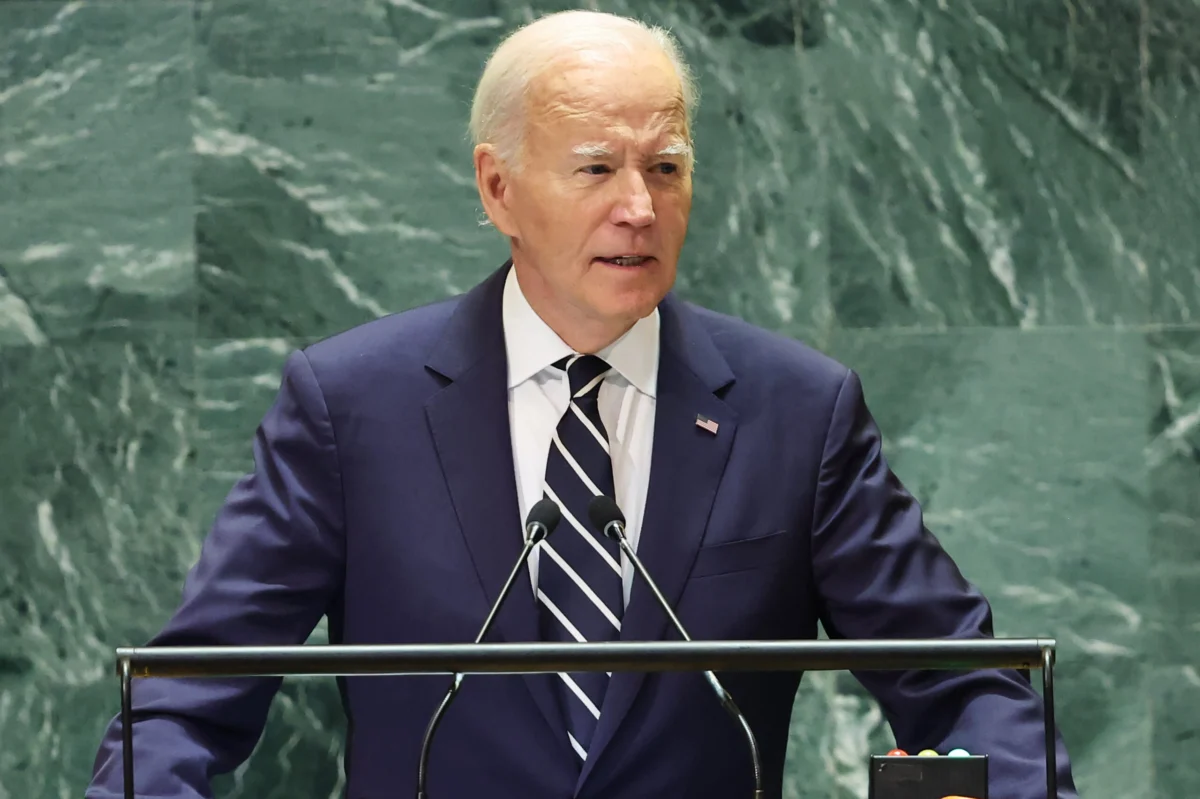
President Joe Biden stood before the 79th session of the United Nations General Assembly on Tuesday, delivering a poignant valedictory address that sought to reconcile his administration’s diplomatic aspirations with a global landscape increasingly defined by fractured alliances and escalating violence. Speaking from the green-marbled rostrum in New York, Biden offered a defense of his "middle-class foreign policy" and multilateralism, even as the shadow of widening wars in the Middle East, Eastern Europe, and East Africa loomed over the proceedings. This final address served as both a summation of a half-century in public service and an urgent plea to world leaders to reject the "despair" that has characterized the current geopolitical era.
"I know many look at the world today and see difficulties and react with despair," Biden told the assembled heads of state and diplomats. "But maybe because of all I’ve seen and all we have done together over the decades, I have hope." The President’s remarks were framed by the realization that his time on the world stage is drawing to a close, with just four months remaining in an administration that has been defined by its efforts to restore American leadership following the isolationist tendencies of the previous era.
A Legacy Defined by Global Realignment
Biden’s speech was meticulously structured to highlight what the White House considers the pillars of his foreign policy legacy. Central to this narrative was the revitalization of Western alliances, most notably the North Atlantic Treaty Organization (NATO). Since the Russian invasion of Ukraine in February 2022, Biden has overseen the addition of Finland and Sweden to the alliance, a feat that many geopolitical analysts considered impossible at the start of his term.
The President emphasized that the defense of Ukraine was not merely a regional concern but a fundamental test of the U.N. Charter’s principles regarding sovereignty and territorial integrity. "We could have stood by and merely protested," Biden said, referring to the initial days of the Russian assault. "But Vice President Harris and I understood that that was an assault on everything this institution was supposed to stand for."
Under Biden’s direction, the United States has authorized over $175 billion in total aid to Ukraine, including sophisticated missile systems, tanks, and intelligence support. However, this support faces mounting pressure at home. As the war enters its third year, a growing faction of congressional Republicans has questioned the sustainability of open-ended funding, a domestic political reality that Biden alluded to when he urged the international community not to "grow weary" or "look away."
The Middle East on the Precipice
While Biden sought to focus on the long-term success of NATO, the immediate crisis in the Middle East demanded a significant portion of his address. The timing of the speech coincided with a dangerous escalation between Israel and Hezbollah in Lebanon, threatening to transform the localized conflict in Gaza into a full-scale regional conflagration.
The President’s rhetoric on the Israel-Hamas war reflected the complex balancing act his administration has maintained since the October 7, 2023, attacks. He reaffirmed Israel’s right to defend itself against the atrocities committed by Hamas—which resulted in the deaths of approximately 1,200 people and the taking of over 250 hostages—but he also used the global platform to call for an immediate end to the suffering in Gaza.
According to data from the Gaza Health Ministry, the death toll in the enclave has surpassed 41,000, with much of the territory’s infrastructure reduced to rubble. Biden’s call for a ceasefire and a hostage release deal was direct: "Now is the time for the parties to finalize its terms, bring the hostages home, to secure security for Israel and Gaza free from Hamas’ grip, ease the suffering in Gaza, and end this war."
Furthermore, Biden addressed the deteriorating situation in the West Bank, condemning the rise in violence against innocent Palestinians. He doubled down on the necessity of a two-state solution, a goal that has remained elusive despite decades of U.S. mediation. He envisioned a future where Israel enjoys normalized relations with all its neighbors and Palestinians live in "security, dignity, and self-determination in a state of their own."

The Forgotten War in Sudan and Emerging Tech Frontiers
In an effort to broaden the scope of the Assembly’s attention, Biden drew focus to the catastrophic civil war in Sudan. Since April 2023, the conflict between the Sudanese Armed Forces (SAF) and the Rapid Support Forces (RSF) has displaced over 10 million people and pushed parts of the country into famine. The President’s inclusion of Sudan in his address was seen by humanitarian organizations as a vital attempt to elevate a crisis that has often been overshadowed by the wars in Ukraine and Gaza.
Beyond kinetic warfare, Biden touched upon the "new frontiers" of global governance, specifically artificial intelligence. The administration has been a vocal proponent of establishing international guardrails for AI to prevent its misuse by authoritarian regimes and to ensure it serves the "common good." This follows the U.N. General Assembly’s adoption of a U.S.-led resolution earlier this year—the first of its kind—to promote "safe, secure, and trustworthy" AI systems.
Chronology of a Diplomatic Marathon
The General Assembly address was the centerpiece of a frantic week of "lame-duck diplomacy" for the President. The timeline of his recent and upcoming engagements illustrates the breadth of the administration’s current priorities:
- September 21: Biden hosted the "Quad" summit in Wilmington, Delaware, meeting with the leaders of Australia, India, and Japan to discuss maritime security in the Indo-Pacific and counter-balance China’s regional influence.
- September 23: A bilateral meeting with UAE President Mohamed bin Zayed Al Nahyan in Washington, focusing on trade and the Middle East security architecture.
- September 24: The UNGA address, followed by a summit on synthetic drug trafficking, highlighting the domestic fentanyl crisis as a global security issue.
- September 25: A scheduled meeting with President Tô Lâm of Vietnam to solidify the "Comprehensive Strategic Partnership" signed last year.
- September 26: A critical meeting at the White House with Ukrainian President Volodymyr Zelenskyy, who is expected to present a "Victory Plan" to Biden and Vice President Kamala Harris.
The Domestic Shadow and Global Transitions
A unique element of this year’s General Assembly is the presence of the 2024 U.S. presidential election as a backdrop. Foreign leaders are acutely aware that the foreign policy trajectory of the United States could shift dramatically depending on whether Vice President Kamala Harris or former President Donald Trump wins in November.
Biden directly addressed his decision to withdraw from the race, a move he framed as a final act of service to democratic principles. "As much as I love the job, I love my country more," he said. "My fellow leaders, let us never forget: Some things are more important than staying in power." This statement was widely interpreted as a subtle critique of authoritarian leaders who cling to office, as well as a reflection on the peaceful transfer of power in the United States.
While Biden held the podium, the shadows of his potential successors were visible. Vice President Harris has maintained her own diplomatic track, meeting with the UAE president and preparing for her session with Zelenskyy. Simultaneously, Donald Trump’s campaign confirmed that the former president plans to meet with Zelenskyy, Indian Prime Minister Narendra Modi, and Polish President Andrzej Duda, signaling a "shadow cabinet" approach to foreign relations that underscores the current volatility of American politics.
Fact-Based Analysis: The Path Forward
The implications of Biden’s final U.N. address are twofold. First, it serves as a reaffirmation of the "liberal international order"—the idea that through institutions like the U.N. and NATO, the world can manage conflict and promote prosperity. However, the reality on the ground challenges this optimism. The U.N. Security Council remains largely paralyzed by the veto powers of Russia and China, and the "rules-based order" is being tested by non-state actors and regional powers who feel the current system does not serve their interests.
Second, Biden’s speech highlights the shift in American focus toward the Indo-Pacific. While the Middle East and Ukraine demand immediate resources, the long-term strategic competition with China remains the defining challenge for the next generation of American leadership. Biden’s mention of "managing competition" with Beijing suggests a desire to prevent the relationship from veering into conflict, a policy stance that Harris is expected to continue, while Trump has signaled a more confrontational, tariff-heavy approach.
As Biden concludes his final major international summit, the "hope" he spoke of remains tempered by the grim realities of 2024. The success of his legacy will likely be judged not by the words spoken in the General Assembly hall, but by whether the alliances he bolstered can survive the domestic and international pressures of the coming years. For now, the President has made his closing argument: that collective action is the only viable path in an era of "crisis and uncertainty."
