

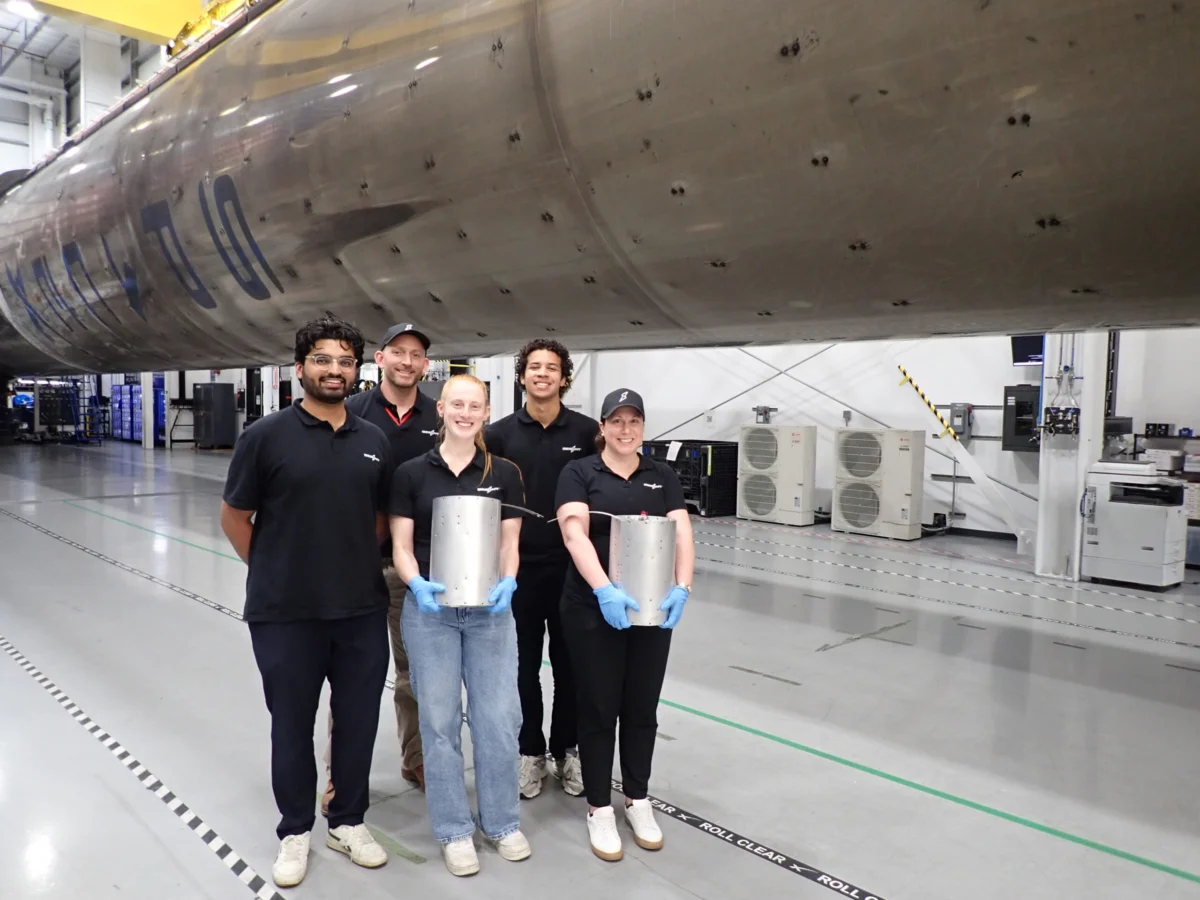
The burgeoning field of in-space manufacturing has long been constrained by a fundamental logistical bottleneck: the difficulty of returning finished goods to Earth. Historically, researchers and commercial entities have had to rely on a narrow set of options, such as securing limited space on the International Space Station (ISS) or partnering with a small cohort of specialized startups developing orbital return capsules. However, a new venture led by a former OpenAI staffer is seeking to bypass these traditional constraints by utilizing the most frequently flown return vehicle in history—the SpaceX Falcon 9 rocket booster.
Besxar, a California-based startup, has reached a landmark agreement with SpaceX to utilize the company’s reusable boosters as a testbed for semiconductor production. By integrating "fabships"—compact, automated manufacturing units—into the structure of the Falcon 9, Besxar aims to leverage the unique physical properties of the space environment to produce high-performance semiconductor precursors. This unconventional approach has already yielded its first flight data, marking a significant milestone in the effort to move high-tech industrial processes off-planet.
The Physics of Orbital Manufacturing
The primary driver behind Besxar’s mission is the pursuit of environmental conditions that are nearly impossible to replicate on Earth. Terrestrial semiconductor fabrication plants, or "fabs," are among the most complex and expensive infrastructure projects in existence. Companies like Intel, TSMC, and Samsung spend tens of billions of dollars to construct facilities that can maintain "clean room" environments. These facilities must be entirely free of microscopic dust, vibration-isolated, and capable of maintaining extreme vacuum conditions for certain processes.
Ashley Pilipiszyn, the founder and CEO of Besxar, argues that the current model of fighting Earth’s atmosphere and gravity is reaching a point of diminishing returns. "We’re at a time where it’s actually more cost-effective to go where the physics already works," Pilipiszyn noted. "Don’t do it on Earth where you’re fighting physics."
In the vacuum of space, the absence of atmospheric contaminants and the presence of microgravity allow for the growth of crystals and the deposition of thin films with a level of purity and structural integrity that exceeds terrestrial capabilities. For advanced semiconductors, particularly those used in high-power applications, these qualities are essential. Microscopic particulates that might settle on a wafer in a terrestrial clean room can cause catastrophic failures in high-density chips. In space, the natural vacuum provides a "clean room" of infinite scale.
The Falcon 9 as a Manufacturing Platform
While many space startups focus on the "outbound" journey, Besxar is capitalizing on the "inbound" efficiency of SpaceX. The Falcon 9 booster is currently the only vehicle that performs routine, high-frequency orbital launches followed by a controlled return to Earth. In 2023 alone, Falcon 9 boosters completed 163 successful round-trips. By the mid-point of 2024, that number had already surpassed 100.
Besxar’s strategy involves attaching its manufacturing canisters—dubbed "fabships"—to the booster. This allows the startup to conduct experiments and production cycles during the short window of time the booster spends in the upper atmosphere and space before its descent. This approach serves as a rapid prototyping method, allowing Besxar to iterate on its technology without the high costs and long lead times associated with dedicated satellite deployments or ISS missions.
The company’s first two fabships were launched in July 2024 as secondary payloads on a Starlink mission. These units were designed to test the structural integrity of the canisters and the ability to expose semiconductor wafers to the space vacuum while protecting them from the rigors of launch and reentry. Despite a localized malfunction in one canister’s flight data system, the mission was deemed a success. Analysis of the returned samples revealed that the wafers flown in space were significantly cleaner and contained fewer particulates than control samples maintained in high-end terrestrial labs.
Funding and Strategic Development
The technical validation of Besxar’s first flights has been bolstered by strong interest from the venture capital community. The company recently announced it has raised nearly $14 million in total funding. This includes a $9 million seed round led by Dauntless Ventures and Overture VC, with participation from several other firms specializing in deep tech and aerospace.
The capital infusion is slated to fund an aggressive two-year roadmap of iterative testing. Pilipiszyn, who previously served as the Technical Director to the CTO at OpenAI, brings a perspective focused on the hardware requirements of the artificial intelligence revolution. As AI models grow in complexity, the demand for more efficient, heat-resistant, and high-performance power semiconductors has surged.
Besxar, named after the fictional "beskar" metal from the Star Wars universe known for its extreme durability, plans to move through a series of technical milestones. Following the initial vacuum exposure tests, the company will transition to heating the wafers in orbit, followed by the deposition of single and then multiple layers of semiconductor materials. This "step-and-repeat" methodology is designed to de-risk the manufacturing process before scaling to full production.
Target Markets: Power Electronics and the AI Boom
Besxar is not aiming to manufacture the logic chips found in consumer smartphones. Instead, the company is targeting the market for power semiconductors. These are specialized components—often made from materials like Silicon Carbide (SiC) or Gallium Nitride (GaN)—that manage and convert electrical power in demanding environments.
The demand for these materials is driven by three primary sectors:
- Electric Vehicles (EVs): High-quality power semiconductors are essential for extending the range and improving the charging speeds of EVs.
- AI Data Centers: Modern GPUs and AI accelerators require massive amounts of power. High-efficiency semiconductors reduce energy loss and heat generation in data center power supplies.
- Robotics and Industrial Automation: Precision motor control in robotics relies on the fast-switching capabilities of advanced power electronics.
By producing superior wafer precursors in space, Besxar hopes to become a critical supplier to the world’s leading chipmakers, providing them with the "raw" materials needed to build the next generation of power-efficient hardware.
The Competitive Landscape and the "Return" Problem
Besxar is entering a competitive field. Other startups, such as Space Forge (UK-based) and United Semiconductors, are also exploring the benefits of microgravity for material science. Varda Space Industries, another high-profile player, recently successfully returned a capsule to Earth containing space-grown pharmaceutical crystals.
However, the primary challenge remains volume. To be commercially viable, these companies must be able to return not just grams, but hundreds or thousands of kilograms of product. Pilipiszyn acknowledges that Besxar’s long-term success is tethered to the "transport layer" of the space industry.
"We believe that there is a solid transport layer now, so we can focus on the application layer," she stated. While the Falcon 9 booster provides a frequent testing ground, the ultimate goal is to utilize SpaceX’s Starship. Currently in the testing phase, Starship is designed to carry over 100 tons of cargo to orbit and, crucially, return to Earth with significant payload capacity. The realization of Starship, or competing heavy-lift reusable rockets from companies like Rocket Lab (Neutron) or Stoke Space, is essential for scaling Besxar’s orbital factories from dozen-wafer prototypes to industrial-scale production.
Chronology of Besxar’s Development
- 2021: Ashley Pilipiszyn begins initial discussions with SpaceX regarding payload opportunities on Starship and Falcon 9.
- 2022-2023: Besxar formalizes its engineering team and begins development of the "fabship" canister prototype.
- Early 2024: Besxar secures $14 million in funding to accelerate its prototyping phase.
- July 2024: The first two fabships are launched on a SpaceX Starlink mission. The mission proves the canisters can survive launch and provide a cleaner environment than terrestrial fabs.
- Late 2024 – 2025: Scheduled tests for orbital heating and material deposition (thin-film growth).
- 2026 and beyond: Planned transition to larger-scale manufacturing payloads on Starship and other next-generation launch vehicles.
Broader Implications for the Global Supply Chain
The move toward orbital manufacturing comes at a time of significant geopolitical tension surrounding the semiconductor supply chain. Governments in the United States, Europe, and Asia are investing hundreds of billions of dollars to "onshore" chip production to ensure national security and economic stability.
Besxar’s model introduces a third option: "off-shoring" to orbit. While this does not solve the immediate geographical concentration of chip fabrication, it offers a potential leapfrog technology. If orbital manufacturing can produce materials that are fundamentally superior to those made on Earth, it could shift the competitive balance of the semiconductor industry.
Furthermore, the environmental impact of terrestrial fabs—which consume millions of gallons of water daily and utilize toxic chemicals—could be mitigated by moving the most resource-intensive parts of the process into the vacuum of space.
As SpaceX continues to lower the cost of access to orbit, the barrier between "space" and "industry" is thinning. Besxar’s partnership with SpaceX represents a shift from space as a destination for exploration to space as a functional extension of the global industrial floor. For the semiconductor industry, the vacuum of the high heavens may soon become the most sought-after piece of real estate in the manufacturing world.
