

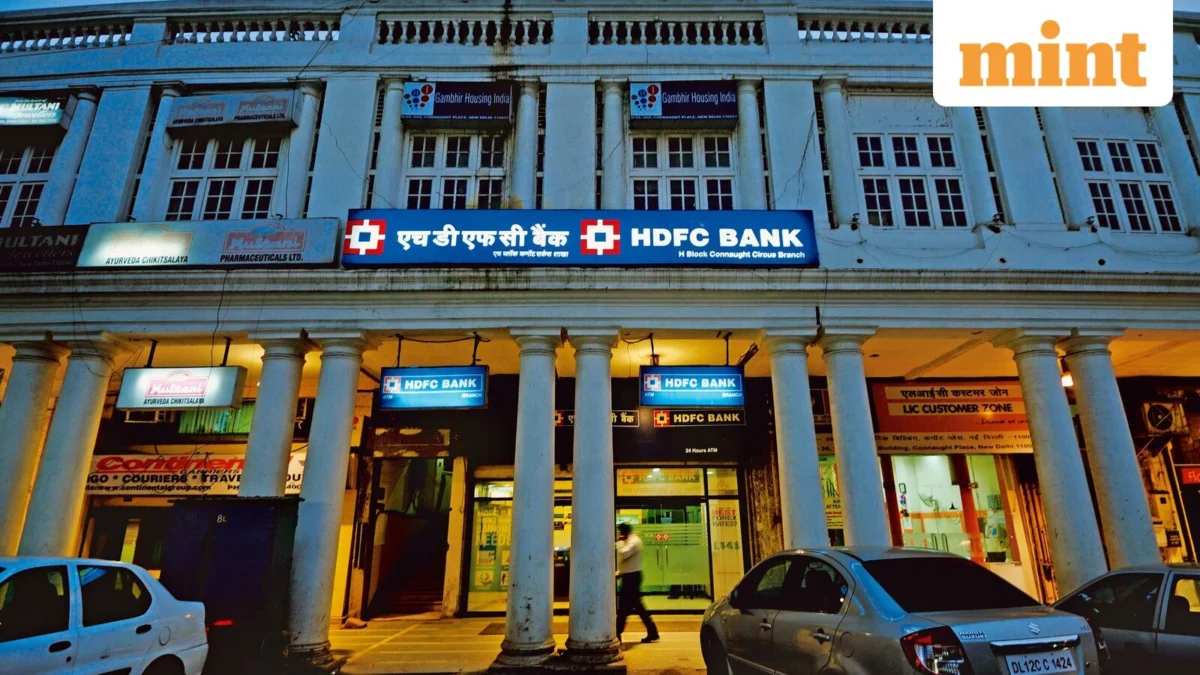
India’s financial markets witnessed a significant tremor on Wednesday as shares of HDFC Bank, the nation’s largest private sector lender, experienced a sharp selloff. The decline followed a detailed report in The Indian Express alleging that the bank had conducted an internal vigilance probe into payments totaling ₹45 crore made to the Maharashtra State Road Development Corporation (MSRDC). These payments, according to the report, were allegedly structured as marketing expenses but were effectively used to provide higher returns on deposits, a practice that bypasses standard regulatory disclosures regarding interest rates. The news has reignited concerns over governance standards at the banking giant, which is already navigating a complex post-merger integration phase and facing persistent pressure from foreign institutional investors.
By the close of trading on the National Stock Exchange (NSE), HDFC Bank shares had dropped 2.6% to finish at ₹758.65, marking it as one of the day’s most significant laggards in the banking sector. This downward movement contributed to a broader dampening of market sentiment; while the Nifty 50 remained relatively flat, the Nifty Bank index slipped by 0.4%. The timing of these allegations is particularly sensitive for the lender, as it seeks to stabilize its valuation following its massive merger with its parent entity, HDFC Ltd, and manages a transition in its top leadership hierarchy.
The Core of the Allegations: Marketing Expenses vs. Differential Interest
The controversy centers on a series of financial transactions involving the MSRDC during the 2024-2025 fiscal period. According to internal records cited in the investigative report, HDFC Bank allegedly funneled approximately ₹45 crore to the state-owned corporation. On the surface, these funds were documented as contributions toward a road safety awareness campaign, involving various local vendors and service providers. However, the report suggests that an internal audit and vigilance investigation found these payments were actually "differential interest" linked to large deposits maintained by the MSRDC with the bank.
In the Indian banking regulatory framework, banks are required to offer uniform interest rates on deposits of similar maturity and volume, with any deviations requiring strict adherence to transparency and disclosure norms. If a bank uses its marketing budget to effectively "top up" the interest yield for a specific high-value client, it can be viewed as a circumvention of Reserve Bank of India (RBI) guidelines. Such practices, often referred to as "shadow interest" or "side-pocketing returns," are designed to win or retain lucrative government mandates but can lead to severe regulatory repercussions and a breakdown in internal governance.
The report further claimed that the bank’s audit committee, led by M.D. Ranganath, initiated a formal internal vigilance investigation into these payments on March 12. This date is critical, as it fell just six days before the high-profile resignation of the bank’s then-chairman, Atanu Chakraborty.
A Timeline of Leadership Turbulence
The revelation of the internal probe provides a potential new context for the abrupt departure of Atanu Chakraborty, a former Economic Affairs Secretary to the Government of India, who stepped down as Chairman of HDFC Bank on March 17. At the time of his resignation, Chakraborty’s departure sent ripples through the financial community. While the official reason cited personal reasons, his resignation letter reportedly alluded to "certain happenings and practices within the bank" that were not in "congruence" with his personal values and ethical standards.
The chronology of events suggests a period of intense internal friction:
- Early March 2024: Internal questions arise regarding the nature of payments made to MSRDC and the classification of marketing expenditures.
- March 12, 2024: The Audit Committee of the Board, chaired by M.D. Ranganath, orders a formal internal vigilance investigation.
- March 17, 2024: Atanu Chakraborty submits his resignation, effective immediately, citing a lack of alignment with certain institutional practices.
- March 18, 2024: HDFC Bank announces Chakraborty’s resignation to the stock exchanges.
- March 19, 2024: In a late-night regulatory filing, the bank announces that the RBI has approved the appointment of Keki Mistry, a veteran of the HDFC Group, as the interim part-time chairman for a three-month tenure.
- May–June 2024: Media reports emerge detailing the specifics of the ₹45 crore MSRDC payment probe, leading to a significant drop in share price.
Since Chakraborty’s departure, HDFC Bank’s stock has declined by nearly 10%, reflecting investor anxiety over what many perceive as a "governance discount" being applied to a stock that was once considered the "gold standard" of Indian banking.
Official Response and Defense of Governance
In response to the intensifying scrutiny, HDFC Bank issued a formal statement on Wednesday, categorically denying any systemic failure or wrongdoing. The bank emphasized its commitment to transparency and its adherence to a "robust internal oversight" mechanism.
"The bank has robust internal oversight, audit and control processes and systems," the statement read. "All issues are dealt with in accordance with the bank’s established norms, and the full process is always followed before a final determination is made after any internal review."
The lender further cautioned against drawing conclusions based on what it termed "selective material" and "incomplete disclosures." HDFC Bank maintained that its internal systems are designed to flag and investigate any irregularities, and the existence of a probe should be seen as evidence of its governance framework working as intended, rather than as an admission of corporate culpability. However, the report’s claim that senior management, including MD and CEO Sashidhar Jagdishan, were part of discussions regarding these payments remains a point of concern for market analysts.
Financial Performance Amidst Governance Headwinds
Despite the cloud of controversy, HDFC Bank’s fundamental operating performance for the quarter ended March 2024 showed signs of resilience. The lender reported a net profit of ₹19,220 crore, a 9% year-on-year increase, which slightly exceeded the ₹19,053 crore consensus estimate by Bloomberg analysts.
Key financial metrics from the March quarter include:
- Loan Growth: The bank’s loan book expanded by 12% year-on-year, reaching ₹3.17 trillion.
- Deposit Growth: Deposits rose by 14% to ₹3.91 trillion, a crucial metric as the bank seeks to improve its credit-to-deposit ratio following the merger.
- Asset Quality: The bank reported stable asset quality with lower provisions, which bolstered the bottom line.
However, analysts note that in the banking sector, financial numbers often take a backseat to governance concerns. The market’s reaction suggests that investors are less worried about the bank’s ability to generate profit and more concerned about the potential for regulatory penalties or a deeper cultural issue within the organization that could affect long-term stability.
Broader Implications and Market Sentiment
The HDFC Bank controversy arrives at a delicate time for the Indian banking sector. The RBI has recently intensified its supervision of both private and public sector banks, focusing on "evergreening" of loans, improper accounting of expenses, and transparency in digital lending. If the allegations regarding the MSRDC payments are proven, it could invite a stern regulatory response from the central bank, potentially including monetary penalties or restrictions on certain business activities.
Furthermore, the bank is still in the process of integrating the massive mortgage book of the erstwhile HDFC Ltd. This merger has already put pressure on the bank’s Net Interest Margins (NIMs) and has led to a re-evaluation of its growth trajectory. Foreign Institutional Investors (FIIs), who hold a significant stake in the bank, have been net sellers of Indian equities in recent months, and governance concerns at a flagship institution like HDFC Bank only serve to accelerate this capital outflow.
Market experts suggest that for investor confidence to return, HDFC Bank will need to provide a more transparent account of the vigilance probe’s findings and demonstrate that its leadership transition is stable. The appointment of Keki Mistry was seen as a stabilizing move given his decades of experience within the HDFC ecosystem, but the temporary nature of his three-month appointment leaves questions about the long-term chairmanship of the board.
Conclusion: The Road Ahead
As HDFC Bank navigates this period of heightened scrutiny, the focus will remain on the final outcome of the internal investigation and any subsequent communication from the Reserve Bank of India. The bank’s ability to maintain its growth momentum while addressing these governance "red flags" will determine whether it can regain its status as the preferred pick for institutional investors.
For now, the ₹45 crore payment to MSRDC serves as a cautionary tale of the complexities involved in managing large-scale corporate and government relationships in a highly regulated environment. While the financial impact of the specific transaction is relatively small compared to the bank’s total balance sheet, the symbolic impact on the bank’s reputation for integrity is substantial. As the dust settles on this latest report, the banking industry will be watching closely to see how India’s largest private lender reinforces its internal controls to prevent such "selective" disclosures from impacting its market valuation in the future.
