

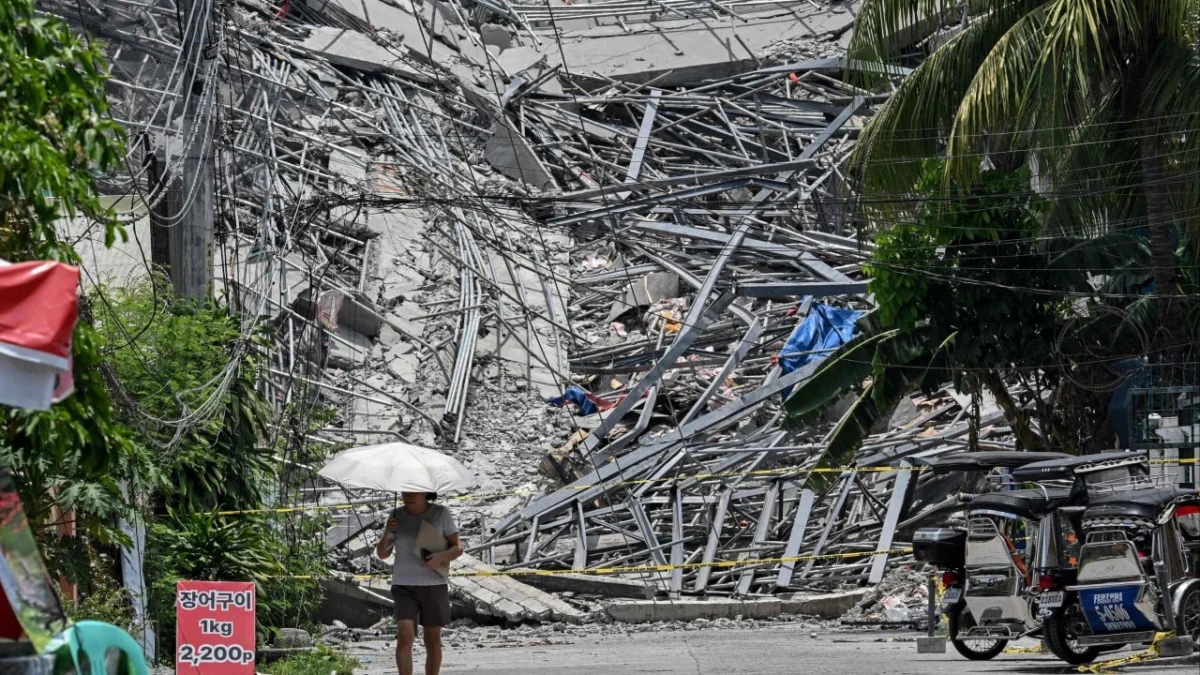
The pre-dawn silence of Angeles City was violently shattered early Sunday morning when a nine-story commercial building under construction suddenly gave way, collapsing into a mountain of twisted steel and pulverized concrete. The incident, which occurred on Teodoro Street, has prompted a massive emergency response and raised urgent questions regarding construction safety standards in one of the Philippines’ most rapidly developing urban centers. As the initial 48-hour search and rescue window closed, local authorities made the difficult decision to transition from a mission of hope to one of retrieval, signaling a grim outlook for those still unaccounted for beneath the debris.
The collapse occurred at approximately 3:00 AM, a factor that officials believe significantly limited the potential death toll, as the surrounding streets and the construction site itself were not at peak occupancy. However, the scale of the destruction remains immense. For those present in the vicinity, the event was nothing short of cataclysmic. James Bernardo, a 30-year-old food delivery rider who was traversing Teodoro Street at the exact moment of the failure, described a scene of industrial horror that unfolded in his rearview mirror.
Bernardo, who was performing a routine delivery, noted that the initial sounds of the structural failure were deceptive. He told investigators and regional media that what he heard behind him sounded like a large aircraft coming in for a landing—a roar so mechanical and rhythmic that it defied immediate categorization as a building collapse. Upon glancing at his side mirror and subsequently turning around, he witnessed the nine-story skeleton of the building folding in on itself. He described a chaotic sequence of falling pylons and exploding power lines that sent sparks showering across the roadway. Fearing electrocution from the severed high-voltage wires, Bernardo accelerated his motorcycle to escape the immediate radius of the falling structure, which was quickly engulfed in a massive plume of concrete dust.
The Immediate Response and Transition to Retrieval
Emergency services from across Pampanga province were dispatched to the site within minutes of the collapse. The Bureau of Fire Protection (BFP), the Philippine National Police (PNP), and various Disaster Risk Reduction and Management Offices (DRRMO) converged on Teodoro Street to begin the arduous task of searching for survivors. The initial manifest suggested that at least 16 people were missing, the majority of whom were construction workers believed to be staying in temporary quarters within or adjacent to the site.
For two days, specialized search and rescue teams utilized K-9 units, thermal imaging, and sound-detection equipment to probe the voids within the rubble. The operation was hampered by the instability of the remaining sections of the structure and the tangled web of reinforcement bars that made manual excavation nearly impossible. Despite these efforts, by the end of the second day, officials in Angeles City—located approximately 80 kilometers northwest of Manila—announced that they were shifting the focus of the operation.
The decision to move to "retrieval operations" was made after technical teams detected no further signs of life within the wreckage. This transition is a standard but somber protocol in disaster management, indicating that the probability of finding survivors has reached near-zero. As heavy machinery was brought in to begin the systematic removal of large concrete slabs, the atmosphere at the site shifted from urgent adrenaline to somber mourning.
Casualties and the Human Toll
As of the latest official briefings, four individuals have been confirmed dead. Among the victims was a Malaysian national, whose presence at the site is currently being investigated to determine if he was a consultant, an investor, or a visitor. The bodies of two construction workers were also recovered during the early stages of the rescue operation. The identities of the deceased are being withheld pending full notification of their families, many of whom have traveled from neighboring provinces to wait for news at a designated holding area near the site.
The fate of the remaining missing persons hangs in the balance as retrieval teams work through the night. The city government has promised to provide financial assistance to the families of the victims and has ensured that the surviving workers, many of whom lost their meager belongings in the collapse, are being provided with food, shelter, and psychological counseling.
Regional Context: The Construction Boom in Angeles City
To understand the gravity of this incident, one must look at the broader economic landscape of Angeles City and the surrounding Clark Freeport Zone. Over the last decade, this region has undergone a dramatic transformation, evolving from a post-military base economy into a premier hub for business process outsourcing (BPO), tourism, and high-end real estate.
The "Build, Build, Build" initiative of the previous administration, coupled with continued infrastructure spending, has seen a proliferation of mid-to-high-rise developments across Pampanga. While this growth has brought economic prosperity and employment, it has also placed immense pressure on local government units (LGUs) to keep pace with building inspections and permit processing. Angeles City, in particular, has seen its skyline grow rapidly, with Teodoro Street being part of a corridor targeted for densification. This incident has now cast a shadow over this rapid urbanization, leading to calls for a comprehensive audit of all ongoing and recently completed high-rise projects in the city.
Technical Analysis and Potential Causes
While the official investigation by the Department of Public Works and Highways (DPWH) is in its preliminary stages, structural engineers have begun to speculate on the potential causes of such a catastrophic failure. In construction projects of this scale, several factors are typically scrutinized:
- Subsoil Integrity: The soil quality in Central Luzon can vary significantly, especially in areas affected by historical volcanic activity from Mount Pinatubo. If the foundation was not properly engineered to account for soil liquefaction or insufficient bearing capacity, the entire structure could become unstable.
- Material Quality: There are ongoing concerns in the Philippine construction industry regarding the use of substandard steel and low-grade concrete. Investigators will be taking samples of the debris to ensure that the materials used met the specifications outlined in the approved building plans.
- Structural Design Errors: A nine-story building requires precise load-bearing calculations. Any error in the design of the columns, beams, or "dead loads" can lead to a progressive collapse, where the failure of one component triggers the failure of the entire system.
- Permit and Oversight Compliance: Authorities will be reviewing the building’s permits to ensure that the construction followed the National Building Code of the Philippines (Presidential Decree No. 1096). This includes checking if the developer made unauthorized changes to the blueprints during the construction phase to save on costs or increase floor area.
Official Statements and Legal Implications
The Mayor’s office of Angeles City has issued a stern statement, promising a transparent and thorough investigation. "We will not leave any stone unturned. If there was negligence on the part of the developer, the contractor, or even within our own regulatory offices, those responsible will be held accountable to the fullest extent of the law," the Mayor stated during a press conference held near the site.
The Department of Labor and Employment (DOLE) has also intervened, issuing a temporary stop-work order for all projects managed by the developer involved in the Teodoro Street collapse. DOLE is specifically looking into occupational safety and health (OSH) violations, questioning why workers were purportedly residing within a high-risk construction zone during off-hours.
Legal experts suggest that the developer could face a range of charges, from reckless imprudence resulting in multiple homicide to violations of the Civil Code, which holds contractors and engineers liable if a building collapses within fifteen years of completion due to defects in the construction or the ground.
Broader Implications for the Philippine Construction Industry
The Angeles City collapse is being viewed as a wake-up call for the national construction industry. The Philippines is a country prone to seismic activity and typhoons, making structural integrity a matter of national security. This event has reignited debates regarding the "Certificate of Occupancy" and the rigor of periodic inspections.
Advocacy groups for urban safety are now calling for a "National Building Inspection Month," where LGUs would be required to hire third-party structural auditors to verify the safety of buildings, particularly those that were constructed during the height of the recent building boom. There is also a push for stricter licensing requirements for contractors and more significant penalties for those found using substandard materials.
Conclusion and Current Status
As the dust literally and figuratively settles on Teodoro Street, the community remains in a state of shock. The image of a nine-story building crumbling like a house of cards has left a lasting impact on the residents of Angeles City. For James Bernardo, the delivery driver who narrowly escaped, the sound of the collapse remains a haunting reminder of how quickly life can change.
Retrieval operations are expected to continue for several more days as crews navigate the dense pile of rubble. The priority remains the dignified recovery of those still missing, followed by a meticulous forensic analysis of the site. In the coming weeks, the results of the official probe will likely dictate new safety protocols for the region, as authorities strive to ensure that such a tragedy never repeats itself in the pursuit of urban progress.
The incident serves as a somber reminder that in the rush to build upward and modernize, the foundational principles of safety, engineering integrity, and human life must remain the highest priority. For now, Angeles City mourns its losses while demanding answers that can only be found deep beneath the ruins of Teodoro Street.
