

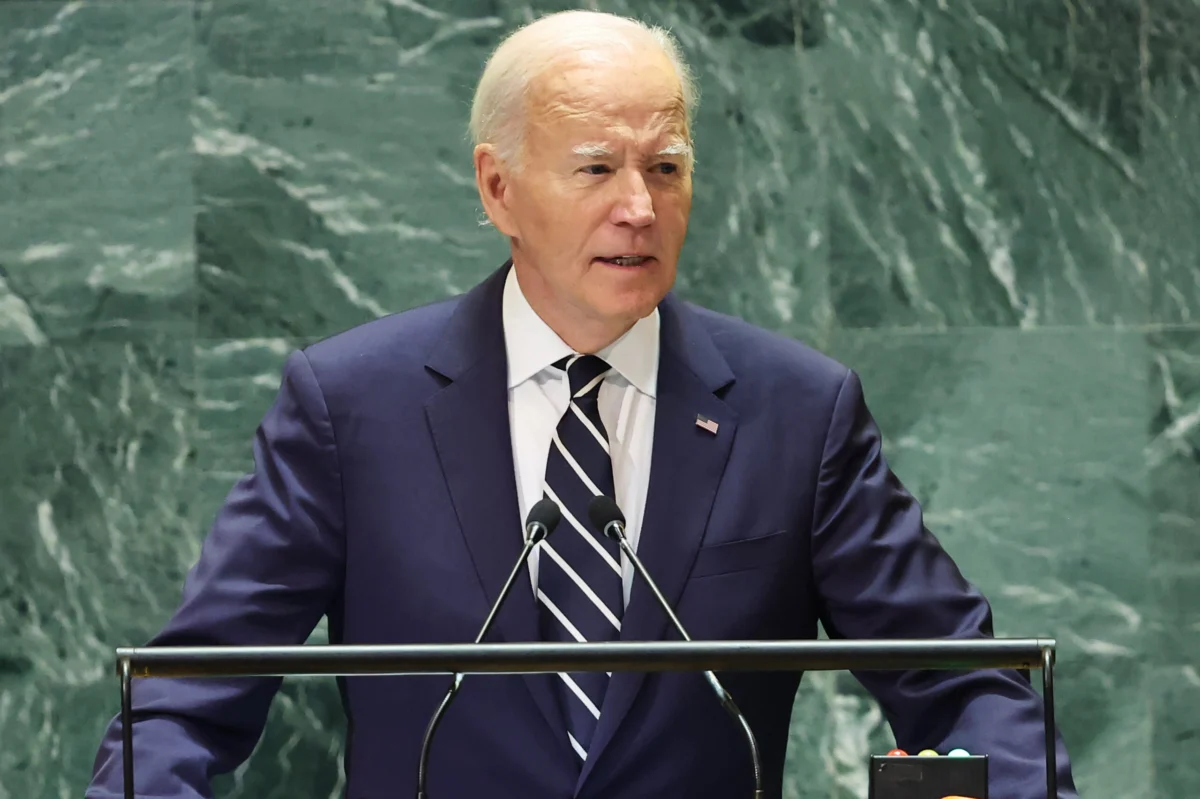
President Joe Biden stood before the 79th session of the United Nations General Assembly on Tuesday, delivering a final address that sought to reconcile his lifelong commitment to internationalism with a world increasingly fractured by brutal warfare and shifting alliances. Speaking from the iconic green marble dais in New York City, Biden attempted to frame his foreign policy legacy not merely as a series of reactions to crises, but as a sustained effort to uphold a rules-based international order that currently faces its most significant challenges since the end of the Cold War. With only four months remaining in his term, the President addressed an audience of world leaders, diplomats, and observers, acknowledging the "despair" felt by many while insisting that his five decades in public service have provided him with a historical perspective that justifies hope.
The address arrived at a pivotal moment in global history. Biden, who entered office promising to restore American leadership and mend traditional alliances, now finds his final months overshadowed by a tripartite of humanitarian and geopolitical catastrophes: the ongoing Russian invasion of Ukraine, a spiraling conflict in the Middle East that threatens to engulf Lebanon and Iran, and a devastating civil war in Sudan that has triggered one of the world’s worst displacement crises. Biden’s speech was less of a victory lap and more of a plea for persistence, urging the international community to remain steadfast in the face of aggression and human suffering.
The Middle East on the Brink of Regional Escalation
A significant portion of the President’s address focused on the volatile situation in the Middle East, which has deteriorated rapidly since his last appearance at the General Assembly in September 2023. At that time, the administration was championing the "normalization" of relations between Israel and its Arab neighbors. However, the October 7, 2023, attack by Hamas, which resulted in the deaths of approximately 1,200 people and the taking of over 250 hostages, fundamentally altered the regional landscape. Since then, Israel’s military campaign in Gaza has resulted in more than 41,000 deaths, according to local health officials, and a humanitarian disaster of staggering proportions.
"Now is the time for the parties to finalize its terms," Biden declared, referring to the cease-fire and hostage release deal that has remained elusive despite months of American-led mediation. He emphasized that the deal is essential to "bring the hostages home, to secure security for Israel and Gaza free from Hamas’ grip, ease the suffering in Gaza, and end this war."
The President also addressed the rising tensions on Israel’s northern border with Lebanon, where recent exchanges between the Israeli military and Hezbollah have raised the specter of a full-scale regional war. Biden’s rhetoric was carefully calibrated, balancing Israel’s right to defend itself with a stern warning against further escalation. He further highlighted the need to address the "rise in violence against innocent Palestinians on the West Bank" and reiterated his administration’s commitment to a two-state solution. He argued that long-term stability can only be achieved if Palestinians "live in security, dignity and self-determination in a state of their own," while Israel enjoys "full recognition and normalized relations with all its neighbors."
Sustaining the Defense of Ukraine
Turning to Europe, Biden revisited the conflict that has defined much of his presidency: the Russian invasion of Ukraine. Since February 2022, the United States has led a global coalition to provide Ukraine with more than $175 billion in total aid, including advanced weaponry and economic support. Biden framed the defense of Ukraine as a fundamental test for the United Nations Charter and the principle of national sovereignty.
"We could have stood by and merely protested," Biden said, reflecting on the early days of the invasion. "But Vice President Harris and I understood that that was an assault on everything this institution was supposed to stand for." He took the opportunity to celebrate the expansion of NATO, which saw Finland and Sweden join the alliance in direct response to Russian aggression—a move that has significantly altered the security architecture of Northern Europe.
However, the President’s call for continued support comes at a time of domestic political friction. A growing faction of congressional Republicans has expressed skepticism toward further funding for Kyiv, advocating for an "America First" approach that prioritizes domestic spending over foreign military aid. Biden’s message to the General Assembly was an implicit rebuttal to this isolationist trend. "You cannot grow weary," he warned the assembled leaders. "You cannot look away. We will not let up on our support for Ukraine, not until Ukraine wins a just and durable peace."
Sudan, AI, and the Global Humanitarian Mandate
While Gaza and Ukraine dominated the headlines, Biden used his platform to draw attention to the "forgotten" war in Sudan. The conflict between the Sudanese Armed Forces (SAF) and the Rapid Support Forces (RSF) has entered its second year, resulting in over 15,000 deaths and the displacement of more than 10 million people. Biden called for an immediate end to the violence and urged the international community to increase humanitarian assistance to the region, which is currently facing the threat of widespread famine.

Beyond active conflict zones, the President touched upon the emerging challenges of the 21st century. He outlined the administration’s efforts to establish global principles for artificial intelligence, advocating for a framework that ensures the technology is used to "advance human rights and promote the common good" rather than as a tool for surveillance or disinformation. This focus on AI reflects a broader administration strategy to manage technological competition with China while maintaining open lines of communication to prevent "competition from veering into conflict."
A Personal Reflection on Power and Transition
In a moment of uncharacteristic personal reflection, Biden addressed his decision to withdraw from the 2024 presidential race. In July, following a period of intense internal party pressure and concerns regarding his age, Biden announced he would not seek re-election, effectively passing the torch to Vice President Kamala Harris.
"As much as I love the job, I love my country more," Biden told the assembly. "I decided, after 50 years of public service, it’s time for a new generation of leadership to take my nation forward." His message served as a subtle lecture on the nature of democracy, pointedly stating, "My fellow leaders, let us never forget: Some things are more important than staying in power." This comment was widely interpreted as a contrast to both domestic political rivals and autocratic leaders abroad who have sought to consolidate power indefinitely.
A Marathon of Final Diplomacy
The speech at the UNGA was the centerpiece of a high-intensity week of "lame duck" diplomacy. On September 21, Biden hosted the "Quad" summit in Wilmington, Delaware, meeting with the leaders of Australia, India, and Japan to discuss maritime security in the Indo-Pacific. On Monday, he met with United Arab Emirates President Mohamed bin Zayed Al Nahyan to discuss regional stability and economic cooperation.
The President’s schedule for the remainder of the week includes a meeting with President Tô Lâm of Vietnam, highlighting the administration’s success in upgrading ties with Hanoi to a "Comprehensive Strategic Partnership." On Thursday, Biden is set to host Ukrainian President Volodymyr Zelenskyy at the White House. Zelenskyy is expected to present a "victory plan" and request permission to use Western-supplied long-range missiles for strikes deeper into Russian territory—a request that the Biden administration has thus far approached with caution due to concerns over escalation.
The Shadow of the 2024 Election
Despite Biden’s presence at the UN, the attention of many foreign leaders was split between the current administration and the potential future of American foreign policy. Both Vice President Kamala Harris and former President Donald Trump are actively engaging with world leaders visiting the U.S. for the General Assembly.
Harris, who is campaigning to succeed Biden, held her own meeting with the UAE president and is scheduled to meet with Zelenskyy on Thursday. Meanwhile, Donald Trump’s campaign confirmed that the former president is expected to meet with Zelenskyy, Indian Prime Minister Narendra Modi, and Polish President Andrzej Duda. This parallel diplomacy underscores the uncertainty felt by America’s allies and adversaries alike as they prepare for a possible shift in U.S. engagement—from Biden’s multilateralism to Harris’s projected continuity or Trump’s more transactional and isolationist approach.
Analysis of Implications and Legacy
As Joe Biden concludes his final major address to the United Nations, his legacy remains a work in progress, heavily dependent on the outcomes of conflicts currently beyond his control. His proponents will point to the revitalization of NATO and the strengthening of Pacific alliances as evidence of a successful "return to the world stage." Critics, however, will highlight the chaotic withdrawal from Afghanistan in 2021 and the current inability to secure a cease-fire in the Middle East as signs of diminished American influence.
The President’s final message was one of "persistent optimism." By emphasizing the progress made over his 50-year career—from the end of the Cold War to the expansion of democracy in Eastern Europe—he sought to remind the world that even the most intractable conflicts can eventually find resolution through diplomacy and collective action. Whether that optimism survives the coming months of transition and global upheaval remains the defining question of his presidency’s twilight.
