

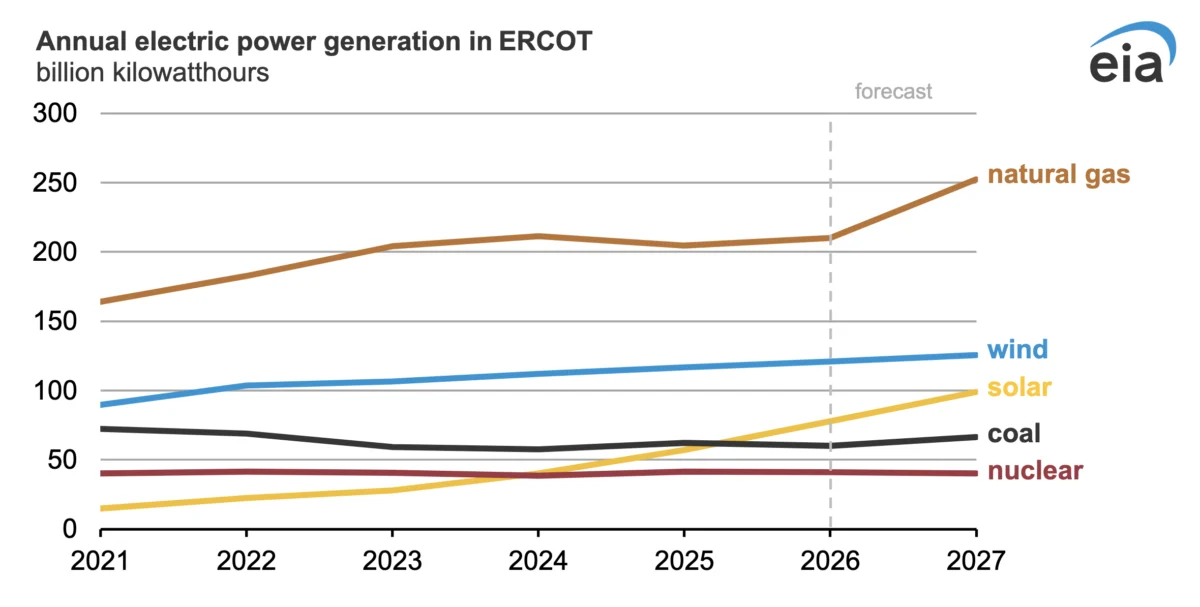
The energy landscape in Texas is approaching a historic inflection point as utility-scale solar power is forecasted to overtake coal-fired generation for the first time on an annual basis by 2026. According to the latest Short-Term Energy Outlook (STEO) released by the U.S. Energy Information Administration (EIA), the electricity grid managed by the Electric Reliability Council of Texas (ERCOT) will see solar generation climb to 78 billion kilowatthours (BkWh) in 2026, significantly outpacing the 60 BkWh projected for coal. This transition marks a fundamental shift in the power profile of the nation’s largest energy-producing state, driven by rapid capacity additions and a market-led move away from carbon-intensive fossil fuels.
While natural gas continues to serve as the primary pillar of the Texas grid, accounting for an average of 44% of total generation between 2021 and 2025, the secondary tiers of the energy mix are undergoing a radical transformation. In 2021, coal provided 19% of the state’s electricity, while solar accounted for a mere 4%. By 2025, those figures are expected to converge at 13% and 12%, respectively, setting the stage for solar to take the lead the following year. This trajectory highlights the accelerating pace of the energy transition in a state that has traditionally been synonymous with oil and gas but has increasingly become a global leader in renewable energy deployment.
The Drivers of Solar Expansion in the Lone Star State
The surge in solar generation is not merely a result of environmental policy but is largely a response to the massive growth in electricity demand within the ERCOT territory. Texas has seen a surge in population and industrial activity, requiring a robust and rapidly scalable source of new power. Utility-scale solar has filled this gap effectively due to decreasing installation costs and the state’s vast geographical advantages.
In 2026, the EIA expects Texas to account for approximately 40% of all new solar capacity additions in the United States. This represents a massive influx of roughly 14 BkWh of new generation potential. Among the flagship projects slated to begin operations is the Tehuacana Creek 1 Solar and Battery Energy Storage System (BESS). With a capacity of 837 megawatts (MW), Tehuacana Creek is expected to be the largest solar photovoltaic project to come online in the United States in 2026.
The integration of Battery Energy Storage Systems (BESS) with solar plants is a critical component of this growth. Because solar is an intermittent resource, the addition of large-scale battery storage allows the grid to capture excess energy produced during peak sunlight hours and deploy it during the evening when demand remains high but solar output drops. This technological synergy is making solar a more reliable and competitive alternative to traditional baseload sources like coal.
A Timeline of the Solar-Coal Reversal
The transition from coal to solar has been a gradual process that is now reaching a crescendo. While 2026 will mark the first year solar beats coal on an annual basis, the "flip" has already occurred on a monthly basis.
In March 2025, ERCOT recorded a milestone when solar generation reached 4.33 BkWh, surpassing coal’s 4.16 BkWh for the first time in history. This trend continued throughout the spring and summer months of 2025, as long daylight hours and high temperatures—which drive both solar production and air conditioning demand—favored renewable output. Coal only regained its lead during the shorter days of the winter months when solar productivity naturally dips.
For 2026, the EIA forecasts that solar will again overtake coal in March and maintain that lead through November. It is only in December 2026 that coal is expected to briefly return to the second-place spot behind natural gas. However, by 2027, the gap is expected to widen even further. The EIA projects annual solar generation will reach 99 BkWh in 2027, while coal generation is expected to hover around 66 BkWh. By that point, solar is forecasted to outperform coal in every month of the year except January and December.
The Decline of Coal and the Absence of New Investment
As solar ascends, coal continues a long-term decline in the ERCOT market. The shift is driven by both economic and regulatory pressures. According to the EIA’s Preliminary Monthly Electric Generator Inventory, there are currently no plans to build new coal-fired power plants in Texas. The existing fleet of coal plants is aging, and many units face higher operational costs compared to modern natural gas and renewable installations.
Furthermore, coal plants lack the flexibility of natural gas "peaker" plants, which can ramp up and down quickly to balance the grid. In a market like ERCOT, which utilizes a real-time pricing model, coal’s inability to respond rapidly to price signals—combined with the zero-marginal-cost nature of solar and wind—has made it increasingly difficult for coal operators to remain profitable. As more solar enters the grid, it pushes the "clearing price" of electricity down during the day, often making it uneconomical for coal plants to run.
Rising Demand: Crypto, Data Centers, and Industrial Growth
The urgency for new solar capacity is underscored by an unprecedented rise in electricity demand across Texas. Unlike other regions of the U.S. where demand has remained relatively flat, ERCOT is facing a "large load" challenge. Several sectors are contributing to this surge:
- Cryptocurrency Mining: Texas has become a global hub for Bitcoin mining due to its deregulated energy market and historically low power prices. These operations require massive amounts of continuous electricity.
- Data Centers and AI: The global explosion in artificial intelligence and cloud computing has led to a building boom of data centers in the Dallas-Fort Worth, Austin, and San Antonio corridors. These facilities operate 24/7 and require high-density power solutions.
- Industrial Electrification: Major industrial players, particularly in the Gulf Coast refining and petrochemical sectors, are increasingly electrifying their processes to meet corporate sustainability goals and improve efficiency.
- Oil and Gas Operations: Paradoxically, the fossil fuel industry is a major driver of renewable demand. In the Permian Basin, oil and gas producers are shifting away from diesel generators to grid-tied electric motors for drilling, pumping, and processing, a trend known as the "electrification of the oil patch."
Market and Policy Implications
The projected transition in 2026 carries significant implications for grid reliability, market dynamics, and environmental targets. For grid operators, the primary challenge will be managing the "duck curve"—a phenomenon where net load (total demand minus renewable generation) drops significantly during the day and spikes rapidly in the evening.
The success of this transition depends heavily on the continued rollout of transmission infrastructure. Texas has historically invested in projects like the Competitive Renewable Energy Zones (CREZ) to move wind power from the west to the population centers in the east. Similar investments may be required to ensure that the massive solar output from rural West Texas can reliably reach urban centers like Houston and Dallas without hitting transmission bottlenecks.
From an environmental perspective, the displacement of coal by solar will lead to a substantial reduction in the carbon intensity of the Texas grid. Coal is the most carbon-intensive fuel used for electricity, and its diminishing share of the generation mix will assist in lowering the state’s overall emissions, even as total energy consumption rises.
Conclusion: A New Era for Texas Energy
The EIA’s forecast for 2026 serves as a definitive signal that the era of coal dominance in the American South is drawing to a close. By 2027, with 11.8 BkWh of additional solar capacity expected to come online, the lead held by renewables over coal will likely become a permanent fixture of the ERCOT grid.
While natural gas will remain the backbone of the Texas power system for the foreseeable future, providing the necessary baseload and balancing services, the rise of solar represents a triumph of technology and market economics. Texas, a state long defined by its underground resources, is successfully pivoting toward the sky to meet the energy demands of the 21st century. As solar generation moves toward the 100 BkWh milestone, the 2026 "flip" will be remembered as the moment the Lone Star State’s energy transition became undeniable.
