

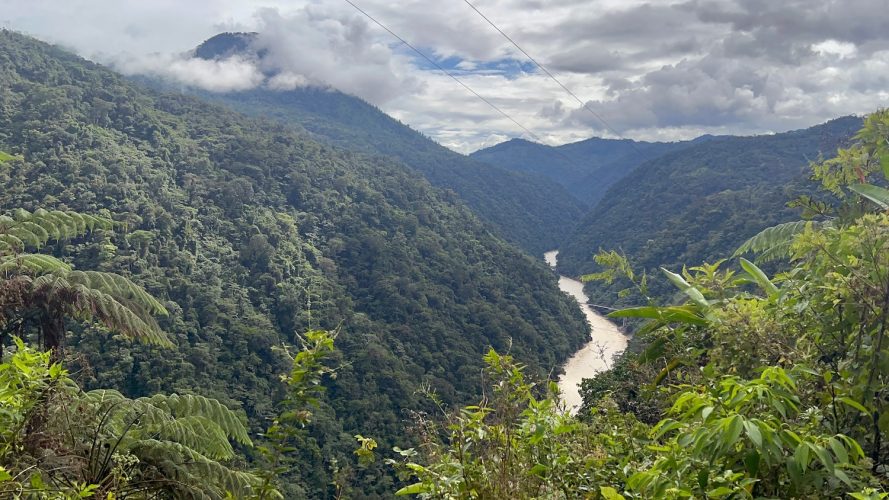
In the dense, humid highlands of Ecuador’s southeastern Amazon, Olger Kitiar and Jhostin Antún move through the rainforest with a precision born of lifelong immersion. High on a ridge in the Shuar territory of Maikiuants, Kitiar suddenly freezes, signaling his partner to stop. In the churned mud of the trail lies a deep, four-toed indentation. It is the fresh print of a large jaguar. For these men, the discovery is not merely a moment of wildlife observation; it is a critical piece of legal evidence.

Kitiar and Antún are "paraecologists"—Indigenous residents trained to document the biodiversity of their ancestral lands using a combination of traditional ecological knowledge and modern scientific methodology. Their work, supported by the nonprofit organization Ecoforensic, serves as a defensive wall against the encroachment of large-scale extractive industries. Maikiuants sits atop vast copper deposits currently claimed by Solaris Resources, a Canadian mining firm planning an open-pit operation known as the Warintza Project. If the project proceeds, the primary forest, home to endangered species and sacred waterfalls, faces permanent transformation.
The Legal Status of Nature in Ecuador
The struggle in Maikiuants is framed by a unique legal landscape. In 2008, Ecuador became the first nation in the world to enshrine the "Rights of Nature" within its constitution. Under these laws, ecosystems are not viewed as mere property or objects of resource extraction, but as living subjects with the inherent right to exist, regenerate, and maintain their vital cycles. This constitutional framework requires the government to meet a significantly higher burden of proof before approving industrial projects that might cause irreversible damage.

The data collected by paraecologists—ranging from water samples to species inventories—is increasingly being used to win landmark court cases. In 2021, the Ecuadorian Constitutional Court ruled in favor of the Los Cedros protected cloud forest, revoking mining concessions because the government failed to account for the impact on biodiversity. Similarly, in 2023, community-led documentation helped halt a mega copper mine in the Intag Valley. These precedents have established that when scientific data proves a project threatens endangered or endemic species, the Rights of Nature can take precedence over corporate interests.
A Chronology of Conflict and Concessions
The tension in Shuar territory has been building for decades, reflecting a broader shift in Ecuador’s economic strategy from oil to mining.

- The 1990s: The Ecuadorian government began carving Shuar ancestral lands into mining concessions, often without the knowledge or consent of local communities.
- 2008: The new Constitution recognizes the Rights of Nature and the right of Indigenous peoples to "free, prior, and informed consent."
- 2016: Mining concessions were granted in protected areas like Los Cedros, sparking a wave of legal challenges.
- 2019: Solaris Resources acquired the Warintza Project, intensifying exploration efforts in the Morona Santiago province.
- 2021: The Constitutional Court’s Los Cedros ruling provided a legal blueprint for environmental defense based on ecological evidence.
- 2022–2024: Tensions escalated as the government deployed military forces to protect mining concessions, leading to clashes with community guards and criminal charges against Indigenous leaders.
As of 2021, the Ecuadorian government had granted nearly 8,000 mining concessions. Notably, 30% of these overlap with protected areas, and 20% overlap with Indigenous territories. The Shuar people are among the most impacted groups in the country.
Scientific Gaps and "Eco-Forensics"
One of the primary challenges for Indigenous communities is the disparity in scientific resources. Mining companies often conduct their own Environmental Impact Assessments (EIAs), which critics and independent scientists frequently describe as insufficient.
Ecoforensic, co-founded by British ecologist Mika Peck and Inde Kaur Hundal, seeks to bridge this gap. Peck’s analysis of Solaris Resources’ EIA for the Warintza Project identified what he termed "critical deficiencies." According to Ecoforensic, the company’s study omitted 91 at-risk or endangered species known to inhabit the area. Furthermore, it provided scant data on local fish populations—a significant oversight given the high risk of heavy-metal contamination and acidic runoff associated with copper mining.
The paraecologists in Maikiuants have already documented species that the company’s reports failed to mention, including the giant anteater, the bush dog, and a new-to-science species of frog with iridescent blue spots, currently being named the Maikiuants frog. Under the Ecuadorian Constitution, species with unique evolutionary paths or those facing extinction receive special protection. By documenting these "keystone" and endemic species, paraecologists provide the empirical evidence necessary to trigger constitutional protections.

Corporate and Government Perspectives
Solaris Resources has consistently framed the Warintza Project as a model of sustainable and socially responsible mining. In official statements, CEO Matthew Rowlinson has emphasized that the project includes the insights and values of stakeholders, particularly Indigenous populations. The company has signed cooperation agreements with several nearby Shuar communities, promising infrastructure, healthcare, and education—services that the cash-strapped Ecuadorian state has historically failed to provide.
Pro-mining Shuar groups have defended their right to seek a better quality of life through these partnerships. In court filings, they argue that mining represents a path to modernization and economic stability for their children and elderly.

However, the administration of President Daniel Noboa has taken an increasingly hardline stance against environmental opposition. Recent government actions include freezing the bank accounts of prominent Indigenous leaders and imposing restrictions on non-governmental organizations. The administration views the expansion of mining and oil extraction as essential for addressing the country’s debt and economic stagnation.
The Human Cost: Violence and Division
The arrival of mining interests has fractured the social fabric of the Amazon. Leaders in Maikiuants describe a "divide and conquer" tactic where financial incentives are used to turn neighboring villages against one another. This internal friction has occasionally escalated into violence and legal warfare.

In 2022, pro-mining community members filed criminal complaints against Maikiuants residents, alleging planned attacks on mining camps—claims the residents fiercely deny. Conversely, anti-mining leaders have reported death threats and harassment. Globally, the mining sector is the industry most frequently linked to the killing of environmental defenders. In Ecuador, the deaths of leaders like Eduardo Mendúa and José Isidro Tendetza Antún serve as somber reminders of the risks involved in territory defense.
Global Implications: AI and the Green Transition
The conflict in the Ecuadorian Amazon is inextricably linked to global technological trends. The world is currently in the midst of a massive "green energy transition" and an artificial intelligence boom, both of which are incredibly mineral-intensive.

Copper is a primary component in electric vehicle batteries, wind turbines, and power grids. Furthermore, the infrastructure required for AI—specifically massive data centers—demands staggering amounts of the metal. A conventional data center requires approximately 15,000 tons of copper; facilities designed for AI systems can require up to 45,000 tons. This global demand has driven copper prices to record highs, making the deposits beneath the Shuar mountains increasingly lucrative for international investors and the Ecuadorian government alike.
This creates a paradox: the "clean" technology intended to save the planet from climate change is driving the destruction of the very ecosystems that serve as the world’s most vital carbon sinks and biodiversity hotspots.

Implications and the Search for "Buen Vivir"
For the people of Maikiuants, the struggle is not just about stopping a mine; it is about defining a different path for development. They advocate for the concept of Buen Vivir (Living Well)—a philosophy rooted in balance between humans and the natural world.
Economic alternatives to extraction are already being explored. In other parts of Ecuador, paraecology projects have successfully linked forest protection to sustainable livelihoods, such as high-quality cocoa production and ecotourism. In Maikiuants, residents are discussing the potential for sustainable fish farming, vanilla cultivation, and the ethical commercialization of traditional medicinal knowledge.

The outcome of the legal and ecological battle in Maikiuants will have profound implications for the future of environmental law. If the data collected by Jhostin Antún, Olger Kitiar, and their peers can successfully halt the Warintza Project, it will reinforce the Rights of Nature as a formidable check on global extractive industries. If the mine proceeds, it may signal that even the most progressive environmental laws can be bypassed by the pressures of global commodity markets and national economic necessity.
As the final operational approvals for Solaris Resources loom, the paraecologists continue their work. For them, the forest is not a "resource" to be managed or a "concession" to be sold; it is a repository of ancestral wisdom, a pharmacy of undiscovered medicines, and a living entity that possesses the legal right to remain intact. In the words of Jhostin Antún, "Without territory, you cannot teach children who they are. You cannot teach them the forest."
