

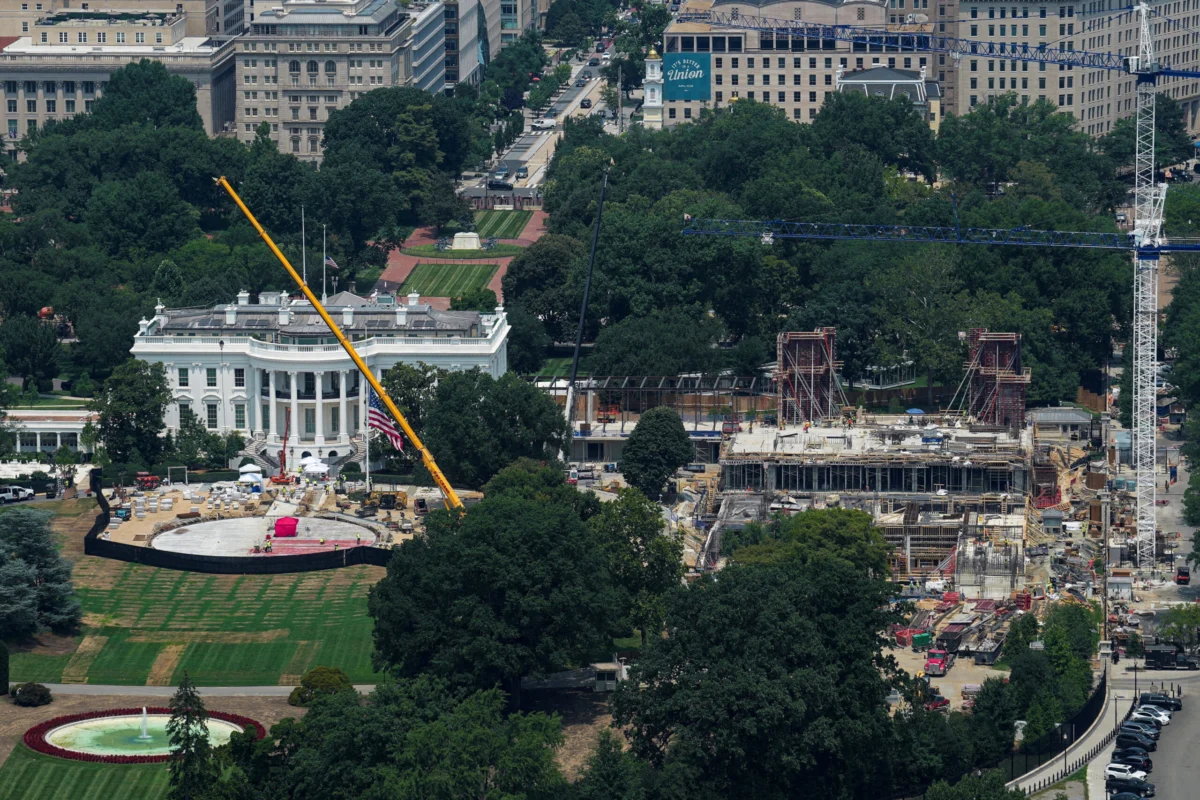
The Trump administration has mounted a robust defense of its ambitious and controversial White House construction and expansion projects, asserting that the nearly $1 billion endeavor is "long-overdue and necessary" and "inextricably tied to the security of the President, the White House grounds, and certain security infrastructure assets." This statement comes amidst mounting scrutiny from lawmakers, legal challenges, and an investigative report detailing the extensive costs and complex, often opaque, funding mechanisms for the work, which includes a substantial new ballroom intended to replace a significant portion of the White House’s historic East Wing.
Unveiling the Billion-Dollar Plan
For an extended period, the Trump administration maintained that the construction and renovation efforts at the nation’s most iconic residence were primarily financed through private donations, undertaken for critical security enhancements. However, an investigative report published by The Washington Post on Wednesday, citing obtained documents, painted a starkly different picture, revealing that the administration was budgeting close to $1 billion for the comprehensive construction work. This figure drastically overshadowed previous public estimates and brought into sharp focus the scale and financial implications of the project.
The proposed alterations are far from minor cosmetic updates. Central to the plan is the construction of a large new ballroom, which would necessitate the dismantling and replacement of a substantial part of the East Wing. This particular aspect has drawn considerable attention, not only for its architectural impact on a historic landmark but also for its perceived deviation from purely security-driven renovations. While the White House frequently undergoes maintenance and minor upgrades, a project of this magnitude, fundamentally altering the structure and purpose of a wing, is unprecedented in recent history.
Official Justifications and Funding Claims
White House spokesman Davis Ingle, in a statement provided to Al Jazeera, vigorously defended the projects, directly linking them to recent security concerns. Ingle specifically referenced "recent security incidents," including "attempted attacks" on the president and security preparations surrounding events for the 250th anniversary of US independence. These events, he argued, underscored the urgent need for enhanced protective measures and modernized facilities capable of accommodating contemporary security protocols and large-scale public engagements.
Ingle further clarified that the construction efforts were being executed in close coordination with the United States Secret Service and the White House Military Office, both critical agencies tasked with ensuring the safety and operational continuity of the presidency. Regarding the contentious funding, Ingle asserted that approximately $400 million specifically for the new ballroom was being provided by "President Trump and generous American patriots." This statement aimed to reinforce the administration’s narrative of private philanthropy supporting public infrastructure.
However, The Washington Post‘s investigation revealed a more intricate and less straightforward financial landscape. The report highlighted that an extraordinary sum of approximately $875 million had been deposited into the White House Repair and Restoration account. This account, historically managed by the National Park Service and primarily designated for routine maintenance and upkeep, typically holds only several million dollars. The sudden influx of hundreds of millions of dollars into this specific account raised immediate red flags regarding transparency and standard budgetary practices.
Delving deeper into the funding sources for this $875 million, the report indicated that $500 million originated from the budgets of the Secret Service and the White House Military Office – agencies whose primary mandates are security and operational support, not large-scale architectural overhauls. Another $305 million was attributed to private donations, corroborating a portion of the administration’s claims. Crucially, the provenance of an additional $70 million remained unspecified, adding another layer of ambiguity to the overall financial picture. This complex web of funding, drawing from both federal security budgets and private contributions with a significant undisclosed portion, fueled criticisms regarding fiscal accountability and the potential for circumvention of traditional congressional oversight.
A Chronology of Controversy and Legal Battles
The White House reconstruction project has been mired in controversy almost since its inception, evolving into a protracted battleground between the executive branch, legislative oversight, and judicial review.
- Early 2026: Initial reports emerge of significant renovation plans at the White House, with the administration emphasizing private funding and security upgrades as the primary drivers. Specific details about the scale and cost remain largely undisclosed.
- June 2026: The advocacy group Public Citizen publishes a damning report, alleging a potential quid pro quo arrangement. Their investigation claimed to have identified corporate donors to the White House project who subsequently received over $50 billion in government contracts during the preceding six months. This report ignited widespread concerns about influence peddling and the integrity of federal procurement processes, suggesting that private donations might be exchanged for preferential treatment in securing lucrative government contracts.
- July 2026: Lawmakers, particularly from the opposition party, begin to voice strong objections. Concerns are raised about the lack of transparency, the bypassing of standard congressional appropriation processes for such a substantial federal project, and the potential for conflicts of interest arising from private donor involvement. Calls for investigations and greater oversight intensify.
- August 2026 (Early): A federal judge in Washington, D.C., issues a significant ruling, ordering a temporary halt to work specifically on the new ballroom. The judge’s decision underscored that, under existing law, major federal construction projects of this nature require explicit Congressional approval. This ruling represented a significant legal setback for the administration, reaffirming the principle of separation of powers and legislative authority over federal spending.
- August 2026 (Late): An appeals court upholds the injunction pausing construction of the White House ballroom. This appellate decision further solidified the legal requirement for congressional approval, putting additional pressure on the administration to either secure legislative consent or revise its plans. The ruling reinforced the judiciary’s role in ensuring adherence to established legal frameworks governing public funds and infrastructure projects.
- September 2026 (Current Period): The Washington Post publishes its detailed investigation, revealing the near $1 billion price tag and the complex, multi-source funding structure, including significant contributions from federal security budgets and a substantial undisclosed portion. This exposé further intensifies the public debate and legal challenges surrounding the project.
Broader Impact and Implications
The controversy surrounding the White House construction project extends beyond immediate budgetary concerns, touching upon fundamental principles of governance, transparency, and public trust.
Transparency and Accountability: The most immediate implication is the challenge to transparency. The gradual revelation of the project’s true cost and the convoluted funding streams – initially presented as privately funded but later shown to heavily rely on federal security budgets and undisclosed sources – raises serious questions about the administration’s commitment to open governance. The commingling of private donations with public funds, particularly within an account typically reserved for routine maintenance, complicates oversight and makes it difficult to trace expenditures, inviting suspicions of impropriety.
Separation of Powers and Congressional Oversight: The federal judge’s injunction, subsequently upheld by an appeals court, serves as a critical reaffirmation of the principle of separation of powers. It underscores that even projects deemed vital for national security or presidential comfort are not exempt from congressional review and approval, especially when involving significant public funds and alterations to federal property. Bypassing Congress for a project of this scale could set a dangerous precedent, potentially eroding legislative authority over appropriations and executive branch spending.
Donor Influence and Ethics: Public Citizen’s allegations of corporate donors receiving substantial government contracts after contributing to the project introduce profound ethical concerns. This scenario raises the specter of "pay-to-play" politics, where private contributions might be perceived as a means to gain privileged access or influence over government contracts. Such perceptions can significantly undermine public confidence in the fairness and integrity of federal procurement processes and raise questions about potential conflicts of interest at the highest levels of government.
National Security vs. Public Interest: While the White House consistently frames the projects as essential for national security, critics argue that the inclusion of a lavish ballroom, funded partly by federal security budgets, blurs the lines between genuine security needs and amenities. This debate forces a critical examination of how security imperatives are defined and whether they are being used to justify projects that might otherwise struggle to gain public or congressional approval. Balancing legitimate security enhancements with fiscal responsibility and public trust is a delicate act.
Historical Precedent and Preservation: The White House is not merely an office or residence; it is a national symbol and a historic landmark. Major structural alterations, such as replacing a significant portion of the East Wing, have implications for its architectural integrity and historical preservation. While previous administrations have undertaken renovations (e.g., Truman balcony, Kennedy restoration), these were often met with public discussion and generally aimed at preserving or restoring historical elements rather than introducing entirely new, large-scale structures like a ballroom. The current project raises questions about the long-term stewardship of this iconic building and the precedent it sets for future administrations seeking to modify national heritage sites.
Economic Implications: The expenditure of nearly $1 billion, even if partially privately funded, represents a significant allocation of resources. The use of Secret Service and White House Military Office funds for construction, rather than their core operational mandates, could draw scrutiny regarding resource allocation and the potential impact on their primary functions. Furthermore, the economic benefits of such a project, while generating construction jobs, must be weighed against the broader context of federal spending priorities and the potential for more impactful investments in other areas.
Reactions from Stakeholders
While direct, explicit statements from all inferred parties are not available in the original text, logical inferences can be made:
- Congressional Democrats: Would likely express outrage over the alleged lack of transparency, the circumventing of congressional oversight, and the potential for donor influence. They would demand full investigations, detailed accounting, and adherence to legal processes.
- Congressional Republicans (critical wing): Some might join calls for greater transparency and fiscal accountability, particularly those concerned with conservative spending principles or the appearance of impropriety.
- Congressional Republicans (supportive wing): Would likely echo the administration’s stance on national security, emphasizing the importance of protecting the President and the White House, and might defend the private funding aspect as a patriotic gesture.
- Legal Experts: Would likely commend the judiciary for upholding the rule of law and the principle of separation of powers, reinforcing the necessity of congressional approval for major federal projects. They might also highlight the legal complexities of commingled public and private funds in such contexts.
- Architectural Historians and Preservationists: Would likely express concern over the extensive alterations to a historic landmark, advocating for solutions that prioritize preservation while meeting modern needs. They might argue for a more consultative and transparent design process.
The White House construction project stands as a complex and multi-faceted controversy, intertwining issues of national security, fiscal responsibility, ethical governance, and the preservation of national heritage. As legal battles continue and calls for greater transparency intensify, the ultimate fate of the ambitious $1 billion plan, and its long-term implications for presidential power and accountability, remain uncertain. The ongoing scrutiny underscores the fundamental tension between executive authority and the imperative for checks and balances in a democratic system.
