

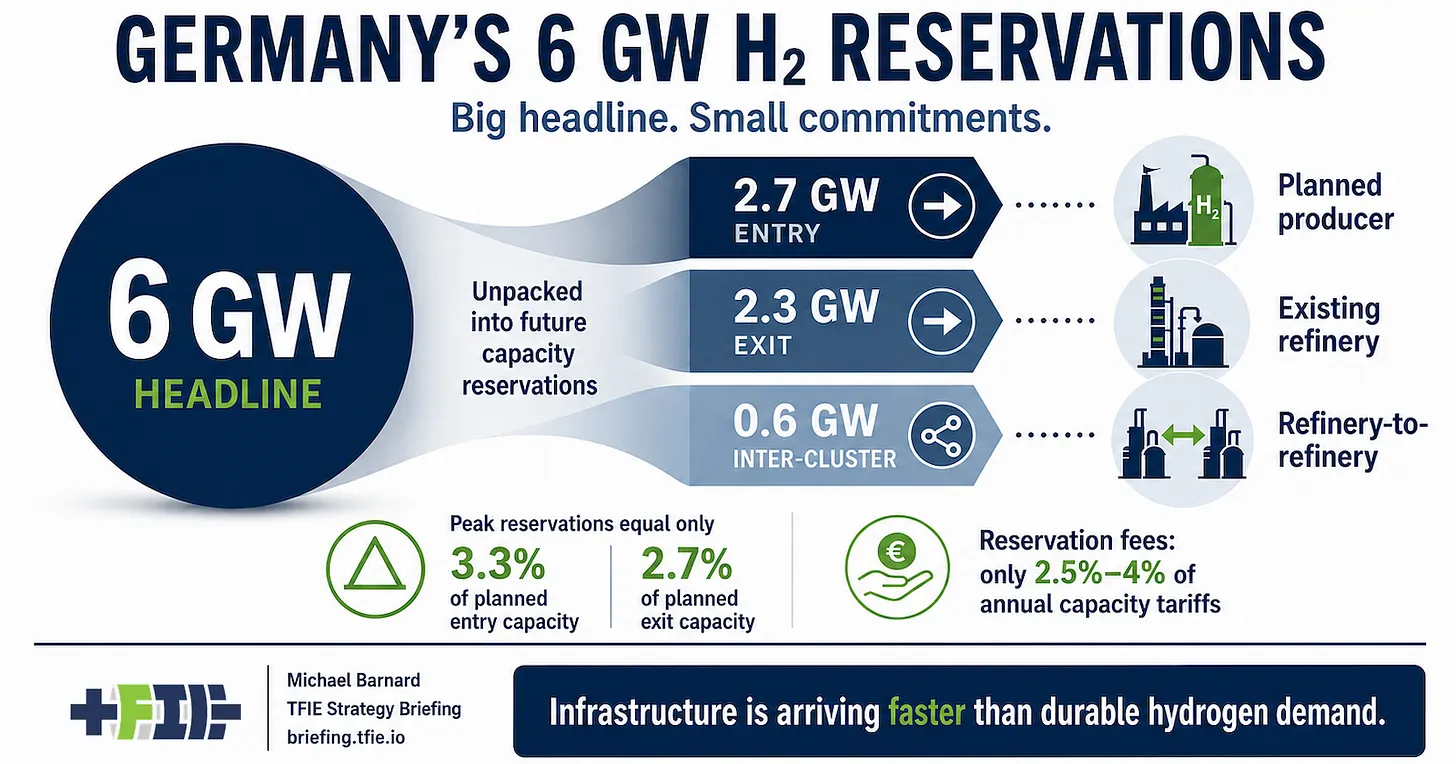
The German hydrogen industry has recently touted a significant milestone in its transition toward a low-carbon economy, announcing nearly 6 gigawatts (GW) of paid capacity reservations on the nation’s emerging "Hydrogen Core Network" (Wasserstoff-Kernnetz). Presented by FNB Gas, the association of supra-regional gas transmission planners, the figure was framed as a robust signal of market momentum and commercial readiness. However, a deeper analysis of the underlying data, the structure of the reservations, and the sheer scale of the planned infrastructure reveals a more complex and perhaps less optimistic reality. While the 6 GW headline suggests a burgeoning market, the actual commercial commitments represent only a small fraction of the network’s total planned capacity and are largely concentrated within existing industrial sectors rather than the broad-based "hydrogen economy" envisioned by policymakers.
The Accounting Behind the 6 GW Headline
To understand the scale of Germany’s hydrogen challenge, one must first unpack the "6 GW" figure. In the world of pipeline operations, capacity is measured in terms of "entry" (where hydrogen is injected into the system) and "exit" (where customers withdraw it). The headline figure is a cumulative total of approximately 2.7 GW of entry reservations, 2.3 GW of exit reservations, and an additional 0.5 to 0.6 GW of inter-cluster transport capacity.
From a network management perspective, these categories are standard. However, from a market demand perspective, adding entry and exit capacities together can be misleading. Hydrogen that is produced and injected at one point (entry) and then consumed at another (exit) is effectively counted twice in the 6 GW total. Consequently, the figure does not represent 6 GW of unique hydrogen demand or production; rather, it is a functional accounting of how much capacity has been earmarked across different nodes of the system. When viewed as actual consumption, the commitment shrinks to the 2.3 GW exit figure, which is the amount companies have signaled they might actually use.
A Drop in the Infrastructure Ocean
The significance of these reservations further diminishes when compared to the total design capacity of the Hydrogen Core Network. Germany’s Federal Network Agency (Bundesnetzagentur or BNetzA) recently approved a massive infrastructure plan that includes approximately 9,040 kilometers of pipelines, with an estimated investment cost of €18.9 billion. This network is designed to facilitate a massive energy transition, providing approximately 101 GW of entry capacity and 87 GW of exit capacity by the early 2030s.
When the current peak reservations are measured against these design targets, the gap is stark. The 3.3 GW of peak entry reservations represent only about 3.3% of the planned entry capacity, while the 2.3 GW of exit reservations account for a mere 2.6% of the planned exit capacity. While it is standard practice to build infrastructure ahead of demand—the classic "chicken and egg" problem of energy transitions—the current level of commitment suggests that the vast majority of the €18.9 billion network remains unutilized in terms of firm commercial interest.
The Economics of Low-Risk Reservations
A critical factor in the current reservation numbers is the low financial barrier to entry for corporations. The reservations currently being reported are not binding, long-term "take-or-pay" contracts. Instead, they are options that allow companies to secure a place in the future network without a heavy upfront capital commitment.

Network operators such as ONTRAS and GASCADE have established fee structures that make these reservations relatively inexpensive for large industrial players. For instance, ONTRAS charges only 2.5% of the applicable annual capacity tariff to maintain a reservation, while GASCADE charges 4%. These payments can often be credited toward actual bookings if the company decides to proceed with hydrogen consumption in the future.
A practical example of this is found in the operations of TotalEnergies at its Leuna refinery. The company has reserved up to 500 MW of hydrogen withdrawal capacity starting around 2030. Under current regulated tariffs, a full 500 MW booking would cost roughly €12.5 million annually in capacity charges. However, to simply hold the reservation as a strategic option, TotalEnergies pays approximately €312,500 per year. For a multinational energy giant, this represents a negligible cost for "future-proofing" its operations and maintaining a seat at the table of Germany’s energy transition. However, it does not constitute a firm guarantee that 500 MW of green hydrogen will be consumed.
Chronology of the German Hydrogen Strategy
The current state of the Hydrogen Core Network is the result of a multi-year policy evolution aimed at making Germany a global leader in hydrogen technology.
- June 2020: The German government adopts the National Hydrogen Strategy (NWS), earmarking €9 billion to support the buildup of a hydrogen market and identifying hydrogen as a "key element" for decarbonizing sectors like steel and chemicals.
- July 2023: An update to the National Hydrogen Strategy doubles the 2030 domestic electrolysis capacity target from 5 GW to 10 GW.
- May 2024: The German Cabinet approves the "Hydrogen Acceleration Act" to simplify planning and approval procedures for hydrogen infrastructure.
- October 2024: The Federal Network Agency officially approves the Hydrogen Core Network (Kernnetz), confirming the 9,040 km route, of which 60% will consist of repurposed existing natural gas pipelines.
- November 2024: FNB Gas releases the reservation data, sparking the current debate over the actual "momentum" of the market.
Customer Profiles: The "Old" Hydrogen Market
The identity of the companies making these reservations is perhaps the most telling indicator of where the market stands. Rather than a broad shift toward hydrogen in trucking, residential heating, or decentralized power generation, the reservations are heavily concentrated in traditional industrial hubs.
The majority of identifiable exit reservations come from refineries and chemical plants—facilities that already use significant amounts of hydrogen produced from fossil fuels (grey hydrogen). For these entities, the Hydrogen Core Network offers a way to transition from "captive" onsite production to a networked supply of potentially "green" or "blue" hydrogen.
While this is a logical and necessary step for industrial decarbonization, it is a far narrower application than the "hydrogen for everything" narrative often used to justify the massive scale of the Core Network. Sectors like heavy-duty trucking and building heat, which were once touted as major hydrogen growth areas, are conspicuously absent from the current reservation list, as battery-electric solutions continue to gain a competitive edge in those markets.
The Risk of Stranded Assets and Public Liability
The discrepancy between the massive planned capacity (101 GW entry) and the modest reservations (3.3 GW) raises significant questions about the financial viability of the network. The German government has implemented a "state-guaranteed" financing model to encourage investment in the Kernnetz. Under this model, the government will cap grid fees to keep hydrogen affordable for early adopters, with the state covering the initial revenue shortfalls of the operators. These costs are intended to be paid back by users in the 2040s and 2050s when the market is expected to be mature.

However, if the projected demand fails to materialize, the German taxpayer could be left holding the bill for a "stranded asset"—a massive network of pipelines with no gas to carry. Critics argue that the current design of the Kernnetz is based on overly optimistic demand projections from the industrial sector, which may have incentivized companies to overstate their future needs during the planning phase to ensure a pipeline was built to their doorstep.
Analysis of Implications
The 6 GW headline serves as a microcosm of the broader challenges facing the global energy transition. It highlights the tension between visionary infrastructure planning and the cold reality of corporate balance sheets.
1. Market Signal vs. Market Reality: The reservations are a "soft" signal. They show that industry is interested in hydrogen as a hedge against future carbon taxes and regulatory shifts, but they do not yet show a willingness to pay the high premiums associated with green hydrogen production.
2. The Feedstock Focus: Germany’s hydrogen future appears increasingly tied to "hard-to-abate" heavy industry rather than a general-purpose energy carrier. This suggests that the network may eventually need to be scaled back or phased in more conservatively than the current 9,040 km plan suggests.
3. The Role of Imports: With only 2.7 GW of domestic entry reservations, Germany remains heavily dependent on the "import" aspect of its strategy. The Core Network is designed to connect to ports in the North Sea and pipelines from Norway, North Africa, and Southern Europe. The success of the German network is therefore inextricably linked to the development of a global hydrogen supply chain that does not yet exist.
Conclusion
Germany’s 6 GW hydrogen headline is a masterpiece of industrial optimism, but it requires careful scrutiny. By unpacking the numbers, it becomes clear that the "momentum" described by network operators is currently limited to a few strategic reservations by established industrial players at a very low cost. While these steps are necessary for the eventual decarbonization of German industry, they represent only the very beginning of a long and financially risky journey. As the government moves forward with the €18.9 billion Core Network, the focus must shift from building "big" to ensuring that the demand is real, sustainable, and capable of supporting the most expensive plumbing project in the nation’s history.
