

August 10, 2026 – The geopolitical landscape of the Middle East witnessed a significant hardening of positions today, with former U.S. President Donald Trump indicating a sustained strategy of economic pressure on Iran and Israel formally rejecting a comprehensive 15-point peace proposal for Gaza. These parallel developments, coming amidst already strained regional dynamics, underscore a period of entrenched conflict and cautious diplomacy, as global attention remains fixed on the potential for escalation.
Speaking on the U.S. approach to Tehran, former President Trump stated that Washington would "wait for economic pressure to mount on Iran," suggesting a patient, albeit unrelenting, application of sanctions. He further characterized the current U.S. posture as "low-keying it" with Iran, implying a preference for financial strangulation over direct military confrontation, even as Tehran maintained its firm stance regarding conditions for maritime passage through the strategically vital Strait of Hormuz. Simultaneously, the Israeli government officially dismissed a multifaceted 15-point peace plan aimed at resolving the protracted conflict in Gaza, a move that has drawn immediate international concern regarding the future of humanitarian efforts and regional stability.
The announcements, reported by Adam Hancock and Zsombor Peter, highlight the complex interplay of economic leverage, security imperatives, and deeply rooted political grievances that continue to define the Middle East.
The "Low-Key" Economic Squeeze on Iran
Former President Trump’s remarks about "low-keying it" with Iran signify a continuation of the "maximum pressure" campaign initiated during his previous term, albeit with potentially altered rhetoric. This strategy relies heavily on an extensive network of sanctions designed to cripple Iran’s economy, thereby compelling a change in its nuclear program, ballistic missile development, and support for regional proxy groups. The rationale behind a "low-key" approach is likely to avoid overt military provocations that could spark a wider conflict, while still pursuing the strategic objective of weakening the Iranian regime’s financial capabilities.
Background of US-Iran Tensions:
The roots of the current standoff trace back to the 2018 U.S. withdrawal from the Joint Comprehensive Plan of Action (JCPOA), commonly known as the Iran nuclear deal. Following this, the U.S. re-imposed and expanded sanctions targeting Iran’s oil exports, banking sector, shipping industry, and key individuals and entities. These measures have had a profound impact on the Iranian economy, leading to significant currency devaluation, high inflation, and a contraction of its GDP.
- 2018: U.S. withdraws from JCPOA, re-imposes sanctions on Iran’s oil, banking, and shipping sectors.
- 2019-2020: "Maximum pressure" campaign intensifies, targeting Iran’s supreme leader’s office and IRGC. Incidents in the Persian Gulf, including tanker attacks and drone shoot-downs, escalate tensions.
- 2021-2025: Sanctions continue to bite, leading to widespread economic hardship in Iran. Sporadic indirect talks between the U.S. and Iran fail to revive the nuclear deal or achieve a broader de-escalation. Iran reportedly accelerates its nuclear enrichment program beyond JCPOA limits.
- Early 2026: International Atomic Energy Agency (IAEA) reports indicate Iran’s uranium enrichment levels nearing weapons-grade purity, while the Iranian rial reaches historic lows against major currencies. U.S. intelligence assesses continued Iranian support for regional militias.
Economic Impact and Data:
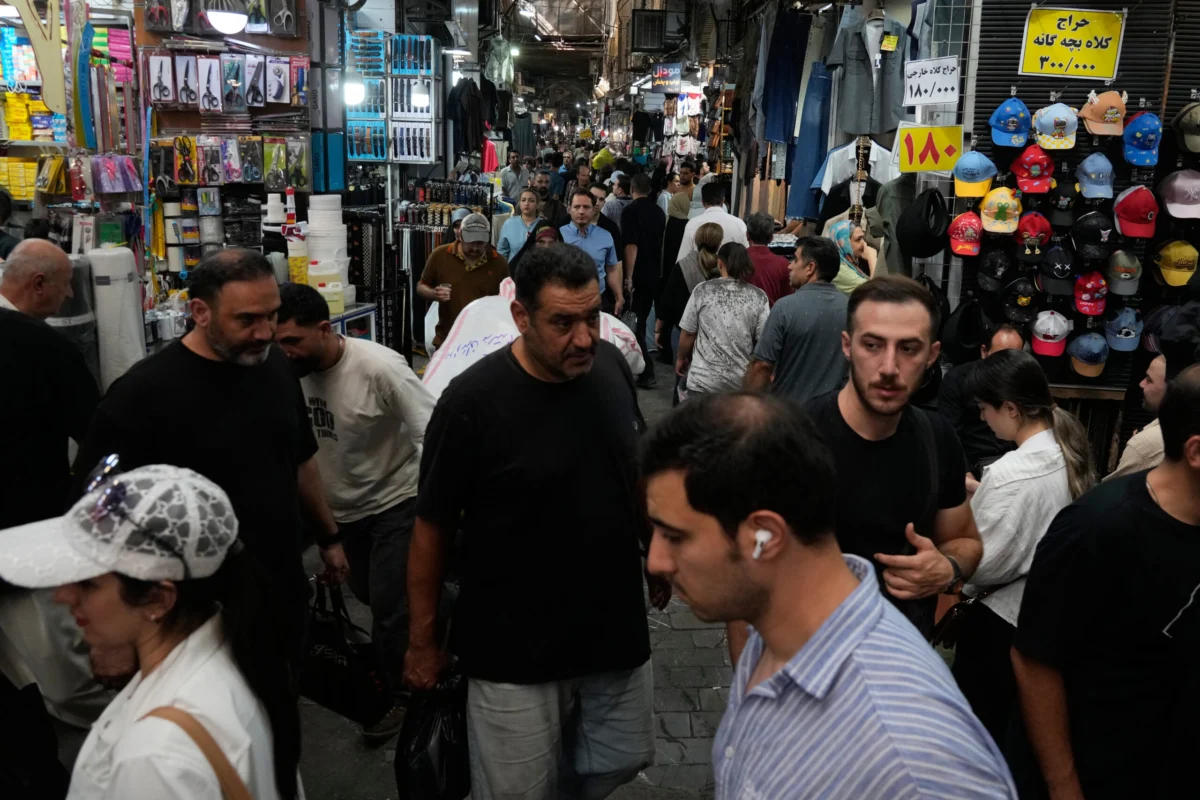
By August 2026, Iran’s economy has been under severe strain for over eight years. Data from international financial institutions indicates a cumulative GDP contraction of over 15% since 2018, with annual inflation rates consistently in the double digits, often exceeding 40-50%. Oil exports, once the lifeblood of the Iranian economy, have been drastically reduced, reportedly from over 2.5 million barrels per day before sanctions to less than 500,000 barrels per day. This has severely limited the government’s ability to fund public services, develop infrastructure, and manage social welfare programs, leading to growing domestic discontent. The image of people walking in Tehran’s traditional main bazaar on August 8, 2026, serves as a poignant reminder of the daily economic realities faced by ordinary Iranians.
Tehran’s Firmness on Hormuz:
Amidst this economic pressure, Tehran has consistently reiterated its sovereign rights and its conditions for the safe passage of vessels through the Strait of Hormuz. This critical chokepoint, through which approximately one-fifth of the world’s oil supply passes, remains a point of considerable leverage for Iran. Iranian officials have historically threatened to disrupt shipping if its own oil exports are severely curtailed or if its security is perceived to be under threat. This position highlights Iran’s determination to resist external pressure and use its strategic geographic location as a bargaining chip, complicating international efforts to ensure global energy security. Any miscalculation in the Strait could have immediate and severe repercussions for global oil prices and trade.
Israel’s Rejection of the Gaza Peace Plan: A Setback
Concurrently, the Israeli government’s formal rejection of a 15-point Gaza peace plan marks a significant setback for international and regional diplomatic efforts aimed at stabilizing the volatile Palestinian enclave. While the precise details of the comprehensive plan were not fully disclosed, such proposals typically encompass a broad spectrum of issues critical to achieving lasting peace and security in the region.
Inferred Components of the 15-Point Plan:
Based on historical peace initiatives and the persistent challenges in Gaza, the 15-point plan was likely to include:
- Immediate and Permanent Ceasefire: Ending all hostilities between Israel and Palestinian factions.
- Release of Hostages and Prisoners: A comprehensive exchange of Israeli hostages held in Gaza for Palestinian prisoners in Israeli jails.
- Unrestricted Humanitarian Aid Access: Ensuring a continuous flow of food, medicine, and essential supplies into Gaza.
- Reconstruction Mechanism: Establishment of an internationally supervised fund and mechanism for the large-scale rebuilding of Gaza’s devastated infrastructure.
- Demilitarization of Gaza: Phased disarmament of armed Palestinian factions, potentially under international supervision.
- Security Guarantees for Israel: Measures to prevent future attacks from Gaza, including border security and intelligence sharing.
- Border Crossings Management: International or joint management of Gaza’s border crossings with Israel and Egypt to facilitate movement of goods and people.
- Return of Displaced Persons: Safe return of Gazans displaced by conflict to their homes.
- Long-term Economic Development: Initiatives to revive Gaza’s economy, create jobs, and improve living standards.
- Interim Governance Structure: Establishment of a technocratic or unified Palestinian administration in Gaza, potentially leading to elections.
- Monitoring and Verification Mechanism: An international presence to oversee the implementation of the agreement.
- Protection of Holy Sites: Guarantees for the status quo and access to religious sites in Jerusalem and elsewhere.
- Commitment to Two-State Solution: A clear pathway or framework for future negotiations on a two-state solution based on pre-1967 borders.
- Regional Security Dialogue: Establishment of a forum for regional states to address broader security concerns.
- Timeline for Implementation: A detailed schedule for the phased execution of the plan’s provisions.
Israel’s Stated Reasons for Rejection:
The Israeli government’s rejection was reportedly predicated on fundamental security concerns and a perceived lack of adequate provisions to ensure Israel’s long-term safety. Key reasons likely include:
- Security Imperatives: Concerns that the plan did not sufficiently address the threat posed by armed groups in Gaza, particularly Hamas, and their capacity to re-arm or launch attacks.
- Hamas’s Role: Reluctance to accept any plan that could be seen as legitimizing Hamas’s governance or military capabilities in Gaza without its complete disarmament.
- Viability of Enforcement: Doubts about the effectiveness of international monitoring or a unified Palestinian authority in preventing future aggressions.
- Sovereignty and Control: Apprehensions regarding any provisions that might compromise Israel’s control over its borders or its ability to respond to security threats.
Background of Israel-Gaza Conflict and Peace Efforts:
The Gaza Strip, home to over two million Palestinians, has been under an Israeli and Egyptian blockade since 2007, following Hamas’s takeover. This has led to a severe humanitarian crisis, with high unemployment, widespread poverty, and dilapidated infrastructure. Numerous rounds of conflict have erupted over the past two decades, including major escalations in 2008-09, 2012, 2014, and 2021, each leaving behind a trail of death, destruction, and further entrenchment of animosity.
- 2007: Hamas takes control of Gaza; Israel and Egypt impose a blockade.
- 2008-2014: Multiple major Israeli military operations in Gaza ("Cast Lead," "Pillar of Defense," "Protective Edge") in response to rocket fire from Gaza.
- 2018-2019: "Great March of Return" protests along the Gaza border lead to deadly clashes.
- 2021: 11-day conflict erupts, causing significant casualties and damage in Gaza.
- 2022-2025: Sporadic flare-ups continue, alongside persistent international calls for humanitarian relief and a lasting political solution. Several informal diplomatic initiatives, often led by Egypt or the UN, attempt to broker long-term ceasefires or reconstruction agreements, but none achieve comprehensive success.
- Mid-2026: A renewed push by international actors, possibly including the UN, EU, and a consortium of Arab states, culminates in the proposed 15-point plan, reflecting growing urgency due to deteriorating humanitarian conditions.
Reactions and International Responses
The dual developments have elicited a range of reactions from key regional and international actors.
From Iran:
Iranian officials, while not directly addressing Trump’s "low-keying it" comment, reiterated their consistent stance that any U.S. strategy based on economic coercion is doomed to fail. Foreign Ministry spokesperson, Saeed Khatibzadeh (hypothetical for 2026), stated that "Iran will not succumb to bullying or illegal sanctions. The path to de-escalation lies in the lifting of all oppressive sanctions and respect for international law, not in mounting pressure." He also reaffirmed Iran’s right to defend its sovereignty and its interests in the Strait of Hormuz, emphasizing that "Iran’s conditions for maritime security are non-negotiable."
From Palestinian Authorities and Hamas:
Palestinian officials in Ramallah expressed deep disappointment and condemnation of Israel’s rejection of the peace plan. A spokesperson for the Palestinian Authority described the decision as "another blow to the prospects of peace and a perpetuation of the occupation and suffering in Gaza." Hamas, while often critical of proposals not originating from its own framework, also criticized the Israeli rejection, stating it demonstrated Israel’s "lack of genuine desire for a just solution." They reiterated calls for international intervention and an end to the blockade.
From the International Community:
- United Nations: Secretary-General António Guterres (hypothetical for 2026) voiced "profound concern" over both developments. Regarding Iran, he urged all parties to "exercise maximum restraint and seek diplomatic solutions to avert further regional instability." On Gaza, he expressed "deep regret" at Israel’s rejection, emphasizing the "dire humanitarian situation" and reiterating the UN’s commitment to facilitating a comprehensive and just peace based on international resolutions.
- European Union: The EU High Representative for Foreign Affairs and Security Policy called for continued dialogue with Iran to revive the JCPOA and expressed disappointment at the Israeli decision, urging both sides to "return to the negotiating table" and "prioritize the lives of civilians in Gaza."
- Regional Powers: Egypt and Jordan, traditional mediators in the Israeli-Palestinian conflict, expressed frustration at the impasse, calling for renewed efforts to find common ground. Saudi Arabia, while silent on the specifics of the Israeli rejection, reiterated its call for a lasting resolution to the Palestinian issue in line with the Arab Peace Initiative, and urged de-escalation in the Gulf.
Broader Implications and Outlook
The double-edged developments of sustained U.S. economic pressure on Iran and Israel’s rejection of a Gaza peace plan carry significant implications for the Middle East and beyond.
Economic and Humanitarian Impact:
For Iran, the continuation of "low-key" economic pressure means prolonged hardship for its population. The sanctions are designed to deplete Iran’s financial reserves, limit its trade, and isolate it from the global financial system. This will likely exacerbate existing social tensions and could lead to further instability within the country. The humanitarian impact, including shortages of essential medicines and goods, remains a critical concern for international aid organizations.
In Gaza, Israel’s rejection of the 15-point plan condemns the enclave to continued stagnation and potential for further conflict. Without a comprehensive framework for aid, reconstruction, and political stability, the humanitarian crisis is likely to deepen. The lack of a clear political horizon for Palestinians further fuels desperation and radicalization, perpetuating a cycle of violence.
Geopolitical Stability:
The U.S. strategy towards Iran risks entrenching a dangerous standoff. While "low-keying it" might reduce immediate military flare-ups, the underlying economic warfare could lead to unpredictable responses from Tehran, particularly concerning its nuclear program or actions by its regional proxies. Any misstep in the Strait of Hormuz, a critical global oil chokepoint, could trigger a wider regional conflict with devastating economic consequences for the world.
The Israeli-Palestinian conflict, meanwhile, remains a central destabilizing factor. The rejection of a comprehensive peace plan signals a continuation of the status quo, increasing the risk of renewed armed confrontations. This, in turn, diverts international attention and resources from other regional challenges and complicates broader peace and normalization efforts in the Middle East.
Diplomatic Stalemate:
Both situations highlight a deep diplomatic impasse. With the U.S. focused on economic leverage rather than immediate diplomatic breakthroughs with Iran, and Israel rejecting a significant peace proposal for Gaza, the pathways to resolution appear increasingly narrow. The role of international mediators becomes even more crucial, yet their influence is often limited without genuine political will from the primary actors. The current climate suggests that the region is braced for a period of protracted tension, punctuated by sporadic crises, with little immediate prospect for comprehensive peace or de-escalation. The international community faces a daunting challenge in navigating these complex, intertwined conflicts, demanding renewed diplomatic ingenuity and sustained efforts to prevent further human suffering and regional destabilization.
